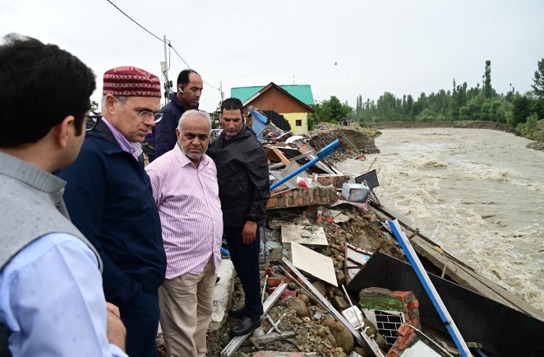
Srinagar: Chief Minister Omar Abdullah on Wednesday visited Beerwah town in Budgam district where a shopping complex was washed away in flash floods a day ago.
Abdullah interacted with affected shopkeepers and promised adequate compensation to those who had permitted commercial establishments in the complex, an official press release informed.
Massive flash floods triggered by torrential rainfall struck Beerwah on Tuesday afternoon, causing widespread devastation, washing away a shopping complex and around two dozen shops, and damaging public infrastructure.
During his visit, Abdullah said he has asked owners and tenants of the shops to bring relevant documents to the deputy commissioner’s office so that their compensation application can be processed. “Those who were operating shops here with valid permissions will be provided compensation and every assistance from the government.”
Abdullah said the shopkeepers have demanded temporary relocation of their shops and permission to rebuild their establishments.
“I have told them that in this regard, we will first need to conduct an inspection through the R&B (roads and buildings) department to determine whether there is any danger, as these shops are situated on the riverbank. If the R&B department declares these shops safe, we can assure something for the shopkeepers. They would also need permission to rebuild their shops here, and we will take action on that too,” he said.
Regarding the terror attack in Anantnag, the chief minister said a brave police officer sacrificed his life for the country in the attack. “We deeply regret this. We are not seeing such cowardly attacks for the first time, but we will not be weakened by these attacks, nor will those who carry out the attacks succeed in their intentions.”
Abdullah said he has faith that the security forces will conduct necessary operations to bring those responsible for the attack to justice.
The chief minister refused to be drawn into any political comment on the incident. “Today, on this occasion, when we have not even buried our brave hero yet, making any political statement would be irresponsible and wrong on my part. So today, I will only offer my tributes to him,” he added.
Meanwhile. Chief Minister reviewed the response of the government in the aftermath of the rains that have caused intense damage in some parts of the union territory.
At least 23 people have lost their lives and seven others are missing in separate incidents of flash floods and landslides in Poonch, Rajouri and Doda districts since Sunday, while the prolonged spell of heavy rain has caused extensive damage to public infrastructure and private property, washed away roads and bridges, disrupted power and water supply in several areas.
Omar Abdullah today chaired another review meeting at Civil Secretariat here to review the restoration works, relief measures and overall flood preparedness across Jammu & Kashmir that has arisen due to incessant rains and flash floods, an official press release informed.
It said the meeting was attended by Minister for Health, Education and Social Welfare, Sakeena Itoo, Chief Secretary Atal Dulloo, Administrative Secretaries, Divisional Commissioner Kashmir and other senior officers.
Minister for Jal Shakti, Forest, Ecology & Environment and Tribal Affairs, Javed Ahmed Rana, Minister for Youth Services & Sports, Transport, Information Technology, Food, Civil Supplies & Consumer Affairs, Science & Technology, ARI & Trainings, Satish Sharma, Divisional Commissioner, Jammu, all Deputy Commissioners attended the meeting through Video Conferencing.
While chairing the meeting, the Chief Minister stressed the need for maintaining a high state of preparedness to effectively deal with flood-like situations arising from erratic weather patterns.
The Chief Minister emphasized the importance of adopting long-term flood mitigation measures, noting that recurring flood-like events necessitate sustained planning and resilient infrastructure. He instructed the concerned departments to take all necessary steps to minimise loss of life and property, ensure restoration of essential services, particularly drinking water and electricity, within 24 hours, prioritise vulnerable locations, and intensify efforts to trace and retrieve missing persons.
The Chief Minister directed the Divisional Commissioners of Kashmir and Jammu to undertake an immediate assessment of the flood situation and identify the worst-affected districts. He further directed that adequate funds, on the pattern followed during 2025–26, be placed at the disposal of the Deputy Commissioners of these districts to facilitate immediate relief, rehabilitation and restoration of damaged infrastructure.
The Chief Minister also reviewed the rescue and relief operations in the flood-affected districts of Poonch and Rajouri. He directed the district administrations to ensure that all relief camps are adequately equipped with essential food, drinking water and medical facilities for the affected population. The meeting was informed that joint rescue and relief operations involving the Civil Administration, Police, SDRF, NDRF, Army, BRO and other line departments were launched immediately after the flash floods and are continuing in the affected areas.
The Chief Minister directed the concerned officers to intensify efforts for the restoration of electricity supply in the worst-affected districts of Poonch and Rajouri, observing that the restoration of drinking water supply schemes is largely dependent on the timely restoration of power. He instructed the Power Development Department to complete the restoration works within the stipulated timeline and ensure that any remaining issues are resolved without delay so that essential public services, particularly water supply, are fully restored at the earliest.
The Chief Minister also reviewed the district-wise status of relief disbursement and damage assessment, directing the Deputy Commissioners to ensure timely assistance to all affected families in accordance with the prescribed norms. He also reviewed the damage to houses, livestock, public infrastructure and agricultural land, and instructed the concerned departments to expedite assessment, restoration and compensation without delay.
During the meeting a detailed presentation was made by Divisional Commissioners Jammu/Kashmir of their respective regions highlighting the flood preparation and relief measures undertaken.
The Chief Minister was informed that the Kashmir Division has put in place a comprehensive flood preparedness mechanism, with all Deputy Commissioners, district administrations and line departments on high alert. Rescue teams, evacuation centres, emergency equipment and essential services have been positioned to ensure a prompt and coordinated response to any eventuality.
The meeting was informed that 654 vulnerable villages with an estimated 7.22 lakh population at risk have been identified across the Valley. As a precautionary measure, 1,505 people from vulnerable areas have already been shifted to designated rescue centres, while evacuation plans remain in place for other vulnerable locations.
Officials informed that 744 rescue centres, 108 SDRF boats, 25 Army boats, 98 satellite phones, 102 identified helipads and adequate emergency response funds have been kept ready to strengthen rescue and relief operations. District Emergency Operations Centres and the State Emergency Operations Centre are functioning round the clock to monitor the situation and coordinate response measures.
The meeting was also informed that water levels in the River Jhelum continue to remain well below the warning level at all monitoring stations, while Irrigation and Flood Control teams deployed across the Valley are maintaining continuous surveillance of rivers and flood channels. Essential services, including healthcare, drinking water supply and telecommunications, are functioning normally, with contingency arrangements kept in place.
Regarding flood preparedness in Jammu, Divisional Commissioner Jammu informed that comprehensive preparedness measures have been put in place across the Jammu Division to deal with adverse weather conditions and flash floods. District administrations have activated 24×7 Emergency Operation Centres, contingency and flood response plans are in place, and weather advisories are being disseminated regularly. He also informed that a total of 363 vulnerable locations have been identified, 142 mock drills conducted, and 138 functional helipads earmarked for emergency operations. Adequate SDRF funds, trained volunteers and emergency response equipment have also been kept in readiness.
The meeting was apprised that restoration machinery has been pre-positioned at vulnerable locations, while district administrations and line departments remain on high alert to ensure prompt response to any emergency.