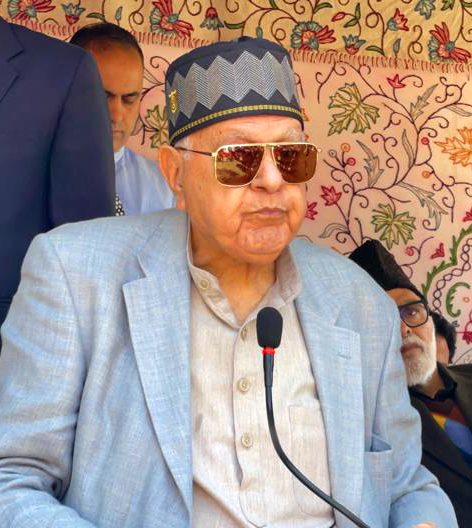
Srinagar: Jammu and Kashmir National Conference president Dr. Farooq Abdullah on Tuesday expressed grief over the loss of lives and widespread damage caused by torrential rains, flash floods and landslides across Jammu and Kashmir, and urged the Centre to announce a special relief package for the affected areas.
In a statement, Dr. Farooq said the heavy rainfall had caused extensive destruction in Rajouri, Poonch, Doda and other districts, damaging homes, roads, bridges, public infrastructure, agricultural land and livelihoods. He said flash floods inundated residential areas and markets, swept away vehicles and disrupted connectivity due to landslides, affecting rescue and relief operations.
Describing the devastation as enormous, he said the financial burden of relief, rehabilitation and reconstruction could not be borne by the Union Territory government alone and appealed to the Government of India to announce a comprehensive relief package for rehabilitation of affected families and restoration of damaged infrastructure.
Recalling what he termed inadequate assistance following previous flood disasters in Jammu, Dr. Farooq expressed hope that the Centre would extend greater support in view of the scale of the current disaster.
He also appreciated Chief Minister Omar Abdullah’s response to the crisis, saying the Chief Minister cut short his visit to Delhi to oversee relief operations, remained in touch with the administration and public representatives, announced an ex gratia of ₹6 lakh for the next of kin of those killed and directed officials to expedite rescue, relief and restoration of essential services. He said damage assessment of houses, crops and other property was also underway.
Referring to waterlogging in Srinagar following the recent rains, Dr. Farooq raised concerns over the effectiveness of the Srinagar Smart City Project, which he said was implemented under the erstwhile unelected administration before the elected government assumed office.
He called for an independent technical and financial audit of the project to examine its planning, execution, quality of work and adherence to engineering standards.
“A thorough inquiry must ascertain whether public funds were utilised efficiently and whether deficiencies in planning or execution contributed to the city’s inability to withstand heavy rainfall. If lapses are found, responsibility must be fixed and corrective measures undertaken without delay,” he said.