
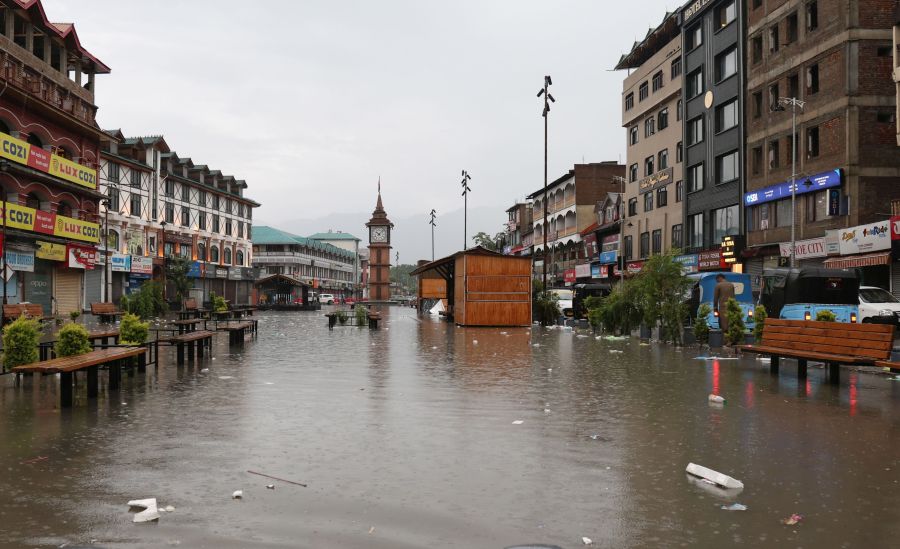
Srinagar: A few hours of rain on Monday morning inundated most areas in both downtown and uptown Srinagar, causing widespread waterlogging that disrupted normal life across the city.
While the terrible waterlogging is a sad commentary on Srinagar’s faulty and inefficient drainage and sewerage system, it also raises questions about the broader concept of the Smart City. Is this how smart cities are to be?
Most parts of Srinagar on Monday reminded one of Mir Taqi Mir’s famous couplet: Kin neendon ab tu soti hai, ai chashm-e-girya-naak, Mizhgan to khol, shahr ko sailaab le gaya. (What kind of sleep are you enjoying, O! my grieving eye; open your lids and see, the city has been flooded).
The downpour submerged roads and led to water entering residential houses, shops, hotels and restaurants in the Buschwara-Dalgate area.
Boulevard Road, one of the city’s busiest tourist routes along Dal Lake, remained waterlogged for several hours, affecting vehicular movement and inconveniencing commuters, tourists and local businesses. Videos shared on social media showed large stretches of the road submerged, with vehicles moving slowly through flooded sections.
Residents and business owners said rainwater entered several homes and commercial establishments in the Buschwara-Dalgate locality, causing property damage and disrupting business activity. They alleged that inadequate drainage infrastructure has made waterlogging a recurring problem during heavy rainfall.
The premises of the JVC Hospital also witnessed waterlogging, causing inconvenience to patients and attendants.
The latest spell of flooding has renewed concerns among residents about the city’s drainage infrastructure, with many calling for measures to address persistent waterlogging in vulnerable areas.
Monday’s fiasco has raised serious concerns about the Srinagar Smart City Project.
Walking knee-deep in the water at the much-publicised Lal Chowk and Polo View, people questioned what is smart about the Smart City.
Millions have been spent on making Srinagar a “smart city”, and every time there is a drizzle, streets flood, complain people.
They also complain of a lack of parking spaces, traffic mismanagement and the shrinking of roads, questioning what kind of smart city plan it is.
Meanwhile, officials said that Srinagar Municipal Corporation (SMC) Commissioner on Monday conducted an extensive tour of vulnerable areas to assess the situation and review dewatering and emergency response measures.
During the visit, the Commissioner inspected waterlogging-prone areas, including Government Medical College (GMC) Srinagar, Eidgah, Khanyar, Hari Singh High Street (HSHS) and other low-lying localities.
The Commissioner reviewed the functioning of dewatering stations, mobile pumping units, stormwater drainage systems and the deployment of field teams working round the clock. He directed officials to ensure uninterrupted operation of all dewatering facilities, closely monitor vulnerable locations and respond promptly to reports of water accumulation, particularly around hospitals, major roads, commercial areas and other critical public infrastructure.
He also instructed officers to strengthen coordination among engineering wings, intensify field monitoring during the ongoing rainy spell and ensure that pumping stations, drains and stormwater networks remain fully functional for the quick drainage of rainwater and to minimise inconvenience to the public.
Reviewing the preparedness of emergency response teams, the Commissioner directed officials to keep sufficient manpower, machinery and mobile pumping units ready for immediate deployment wherever required. He stressed that uninterrupted civic services and public safety should remain the Corporation’s top priority.
The SMC’s 24×7 Control Room remains operational to receive complaints related to waterlogging and other civic issues. Citizens have been advised to report blocked drains, water accumulation or related problems on the SMC helpline numbers 0194-2474499, 0194-2470465, or the toll-free number 1800-180-7038. Emergency response teams have been deployed across the city for timely action.
Furthermore, Deputy Commissioner (DC) Srinagar Akshay Labroo, who is also the Chairman of the District Disaster Management Authority (DDMA), on Monday chaired a comprehensive review meeting at the Meeting Hall of the DC Office Complex to assess the preparedness and mitigation measures put in place by all line departments across the district in view of the inclement weather forecast and prevailing weather conditions.
At the outset, the Chairman, DDMA, emphasized the need for close coordination among all line departments and formulating an efficient plan to ensure prompt response to any weather-related eventuality in the district. He directed the officers to remain in a state of readiness by mobilising all men and machinery on the ground, particularly at vulnerable spots, to prevent any damage.
The DC stressed the importance of round-the-clock and close monitoring of identified vulnerable areas and taking swift action in case of any embankment breaches or flood-related emergencies.
He underscored the need for seamless coordination and effective communication among officers, field functionaries and with the public during any emergencies to ensure a swift response and minimise inconvenience. The DC emphasized undertaking advance dewatering measures and ensuring prompt intervention to prevent waterlogging, particularly at critical infrastructure and essential public facilities, including major hospitals, power stations, government offices, major roads and other vulnerable low-lying areas across the city.
The DC further underscored the importance of seamless coordination among the National Disaster Response Force (NDRF), State Disaster Response Force (SDRF), District Police and the District Administration to ensure a swift, coordinated and effective response to any eventuality. He directed the concerned agencies to pre-position adequate manpower, rescue teams and essential equipment, besides mobilising field staff well in advance, particularly in the vulnerable areas of Fakir Gujri, Hawan and other higher reaches of the district, to effectively deal with any situation arising from weather-related emergencies.
Meanwhile, torrential rains lashed many parts of Kashmir on Monday, leading to waterlogging in several areas, even as the Meteorological Department has forecast spells of rainfall or thundershowers till July 23, officials said.
Heavy rains lashed most parts of Kashmir, with torrential rains in many areas since early Monday morning, the officials said.
The officials said heavy rains and a cloudburst triggered a flash flood in the Safapora area of central Kashmir’s Ganderbal district, causing a sudden surge in water levels in the water bodies there.
The sudden rise in water levels caused panic among the people, but there were no reports of any loss of life or property, they said.
Several areas in the Valley, including the summer capital Srinagar, witnessed waterlogging due to heavy rains, causing traffic jams, the officials said.
In the past 24 hours till 8:30 am on Monday, Srinagar recorded 45.6 mm of rainfall, Ganderbal 46 mm, Pahalgam 3.2 mm, Gulmarg 8.2 mm, Pampore 21.5 mm, Budgam 15 mm, Bandipora 10.5 mm, and Sopore in Baramulla 55.4 mm.
The Meteorological Department has forecast widespread rainfall across the Kashmir Valley till July 23.
There is a possibility of isolated heavy rain, thunderstorms and lightning in a few areas from July 21 to 23, the MeT Office said.
It added that gusty winds (40–60 kmph), landslides, mudslides, shooting stones, flash floods and waterlogging can occur at vulnerable places.