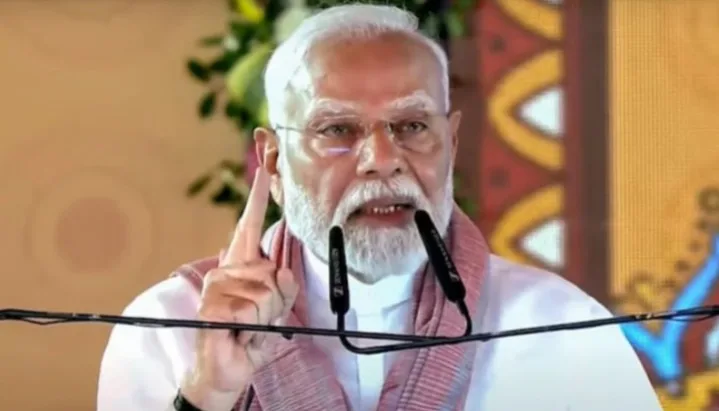
New Delhi: Prime Minister Narendra Modi on Saturday spoke to the team of Skyroot Aerospace, which spearheaded India’s first privately developed orbital rocket Vikram-1, and termed it a defining moment in India’s space journey.
Modi also said the growing participation of India’s private sector is opening new frontiers and accelerating innovation.
“Spoke to the team of Skyroot Aerospace and congratulated them on the successful launch of Vikram-1. This is a defining moment in India’s space journey,” Modi wrote on X.
“This achievement will encourage countless youngsters to dream bigger and innovate fearlessly,” he said.
India’s first privately developed orbital rocket, Vikram-1 on Saturday successfully placed multiple technology demonstration payloads and postcards, including from PM Modi into a low earth orbit.
Dubbed ‘Mission Aagaman’ (meaning arrival), it marks the entry of India’s private space sector into the orbital launch market, spearheaded by Skyroot Aerospace. The mission was a “grand success”, the company said.
Earlier, the prime minister has termed the initiative as “a historic new frontier” for India’s space journey. He said this four-stage rocket is designed to provide rapid and on-demand launch services.
The prime minister said that this mission highlights the talent, determination and entrepreneurial spirit of India’s youth and it shows how Indian space sector reforms are unlocking new opportunities for innovation and enterprise.
Modi also urged all Indians, especially “my young friends, to follow this historic mission and join in wishing Team Skyroot success using #IndiaWithVikram1”.
Union Minister Jitendra Singh said the successful launch of Skyroot Aerospace’s Vikram-1 reiterates the country’s entry into the global space economy.
Speaking to reporters after the launch, the minister said it would not have been possible if India had not opened up the space sector for private players.
“Thanks to Prime Minister Narendra Modi for unlocking India’s space sector and allowing private players like Skyroot within the four walls of Sriharikota (from where the launch took place),” Singh said.
Unlike other test flights of orbital-class rockets, Vikram-1 carried actual payloads to space, he said, adding that it carried technology demonstration payloads from Grahaa Space, Cosmoserve and DCubed, among others.
Vikram-1 is a seven-storey-tall, multi-stage orbital launch vehicle built with an all-carbon composite structure and powered by in-house developed propulsion systems, including 3D-printed engines and high-thrust solid-fuel rocket boosters.
During its mission “Agaman” on Saturday, Vikram-1 targeted an orbit at an altitude of 450 kilometres with a 60-degree orbital inclination.
The engineering data collected during this test flight will be analysed to validate guidance and navigation systems, and to guide future refinements for commercial satellite missions.
The launch marks Skyroot’s second mission following the successful suborbital flight of Vikram-S, the first private rocket to reach space from Indian soil, on November 18, 2022.