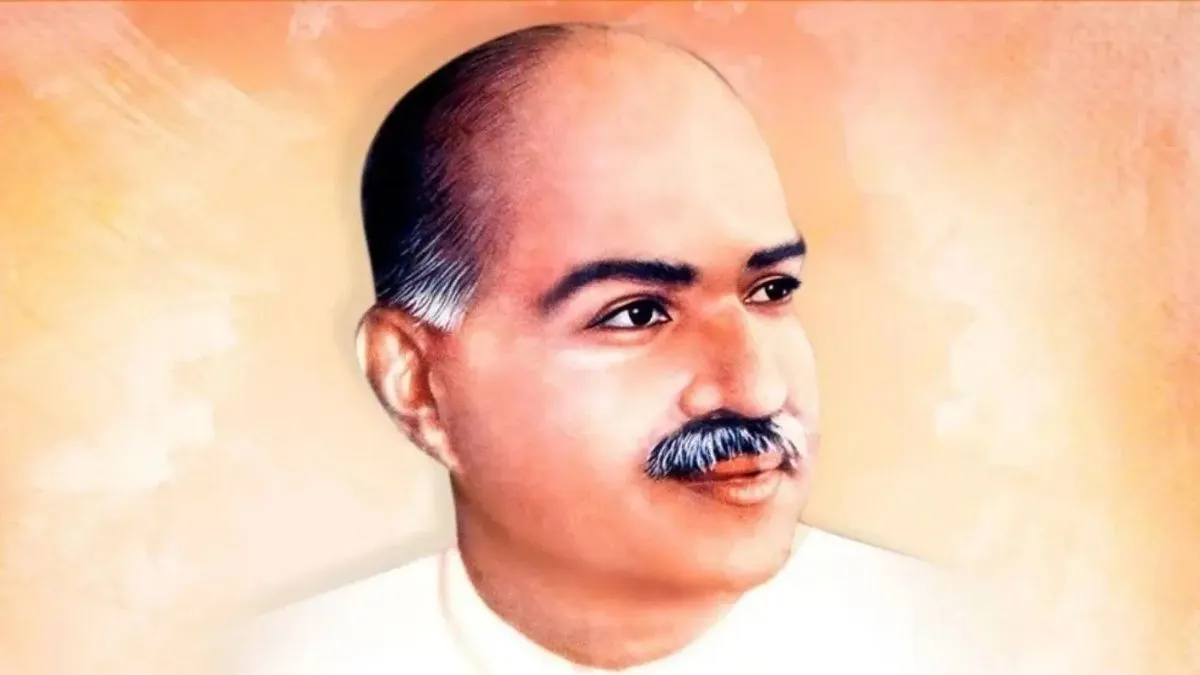
History often remembers great leaders through the political battles they fought. Yet the most enduring contribution of statesmen is rarely confined to politics alone. Their real legacy lies in the institutions they create, the ideas they nurture and the values they leave behind for future generations. As the nation commemorates the 125th birth anniversary of Bharat Kesari Dr. Syama Prasad Mookerjee, it is worth revisiting an aspect of his public life that deserves far wider attention: his lifelong commitment to institution building as the foundation of nation building.
Independent India did not emerge merely from a political struggle. It had to build universities capable of educating its citizens, research institutions that could advance scientific knowledge, industries that could generate economic self-reliance, cultural organisations that would preserve civilisational heritage, and public institutions that could uphold democratic values. Dr. Mookerjee understood early that a nation’s future depends not only on visionary leadership but also on strong institutions that outlast individual leaders and governments.
His remarkable academic career reflected this conviction. Appointed the youngest Vice-Chancellor of the University of Calcutta, he assumed office at a time when higher education was becoming central to India’s intellectual awakening. For him, universities were not merely places that produced graduates; they were institutions that shaped informed citizens capable of contributing responsibly to public life. Education, in his view, was inseparable from the larger task of nation building.
His commitment to scientific and technological advancement extended well beyond the university campus. As a member of the Court and Council of the Indian Institute of Science, Bengaluru, he contributed to strengthening one of India’s premier centres of scientific research. In 1947, he laid the foundation stone of the Department of Power Engineering, recognising that engineering education and technological capability would become indispensable to an independent India’s economic progress. Long before innovation became a central policy objective, he had recognised that scientific excellence and industrial development would determine the country’s long-term strength.
This vision found practical expression after Independence when Dr. Mookerjee became India’s first Minister for Industry and Supply. During those formative years, the newly independent nation faced the enormous challenge of creating an industrial base almost from scratch. Institutions such as the Chittaranjan Locomotive Works and the Sindri Fertilizer Factory were established not merely as manufacturing units but as symbols of India’s determination to achieve technological competence and economic self-reliance. For Dr. Mookerjee, industrialisation was never an end in itself; it was an investment in national capability and collective confidence.
Institution building, however, requires more than physical infrastructure or administrative efficiency. It demands compassion, public spirit and a deep sense of moral responsibility. These qualities were evident during the Bengal famine of 1943, when Dr. Mookerjee devoted himself to organising large-scale relief efforts for those affected by one of the greatest humanitarian tragedies of the twentieth century. Following Partition, he worked extensively for the rehabilitation of displaced persons, recognising that national reconstruction involved healing human suffering as much as rebuilding institutions.
His public life also reflected a profound appreciation of India’s civilisational heritage. As President of the Maha Bodhi Society of India, he played an important role in strengthening India’s cultural and spiritual ties with Buddhist nations. He participated in welcoming the sacred relics of the Buddha’s chief disciples, Arhant Sariputra and Arhant Maudgalyayana, to India, recognising the enduring significance of civilisational diplomacy. Even today, India’s efforts to share these holy relics with countries such as Mongolia demonstrate how cultural heritage continues to strengthen international goodwill and deepen historical bonds.
Equally revealing was his concern for literature and scholarship. His correspondence shows the assistance he extended to the eminent poet Kazi Nazrul Islam during a period of personal difficulty. Such episodes remind us that public leadership is often measured not only by major policy decisions but also by quiet acts of generosity that seldom attract public attention.
Dr. Mookerjee carried the same institutional outlook into the Constituent Assembly. Describing the framing of the Constitution as “a great responsibility” and “a solemn and sacred trust”, he underlined the moral obligations that accompany constitutional governance. Those words remain strikingly relevant today. The strength of the Constitution ultimately depends not only on its written provisions but also on the integrity of Parliament, the independence of public institutions, the rule of law and the civic responsibility of citizens. Constitutional democracy flourishes only when institutions command public trust and operate with integrity.
As India advances towards the goal of becoming a developed nation, Dr. Mookerjee’s vision offers an important reminder. Economic growth alone cannot define national progress. Lasting development requires sustained investment in education, scientific research, technological innovation, cultural preservation and institutions that inspire public confidence.
Roads, airports and factories are indispensable, but so are universities that encourage inquiry, laboratories that expand knowledge, museums that preserve heritage and public institutions that safeguard constitutional values.
Institutions possess a remarkable quality: they outlive governments, political movements and even generations. They preserve accumulated knowledge, provide continuity amid change and enable societies to pursue long-term national goals. Leaders may shape history, but institutions sustain civilisation.
That perhaps is the most enduring lesson of Dr. Syama Prasad Mookerjee’s public life. His legacy rests not merely in the offices he held or the debates in which he participated, but in his unwavering belief that strong institutions are the true custodians of a nation’s aspirations.
As India continues its journey of development, strengthening those institutions that promote knowledge, scientific temper, cultural confidence and constitutional values would be the most meaningful tribute to his memory.
Courtesy PIB, Srinagar
(The Author is Union Minister for Culture & Tourism, Government of India)