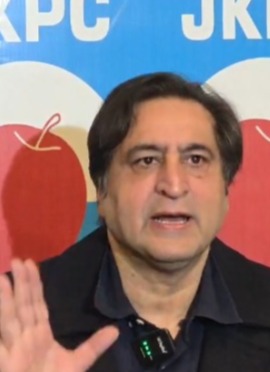
Srinagar: J&K Peoples Conference President and MLA Handwara, Sajad Lone, has launched a fierce political offensive against the National Conference government over what he describes as a deeply compromised outsourcing regime in Jammu and Kashmir, promising explosive disclosures within a week.
In a strongly worded statement directed squarely at the ruling party, Lone declared, “To my friends in NC please be ready to answer a range of questions on Outsourcing. As promised within a week we will put every fact about outsourcing in the public domain.”
While stopping short of holding NC responsible for originating the outsourcing policy, Lone made the party’s complicity unmistakably clear.
“Agreed NC didn’t start it. We knew that from Day 1. But you didn’t stop it either. You went along with it. And in fact encouraged it,” he stated, leaving no room for the ruling party to distance itself from the consequences of a policy it inherited but chose to sustain and expand.
Lone then made his most serious allegation, one that goes beyond policy failure into the territory of outright wrongdoing. “Outsourcing is prone to corrupt collusion. And that corrupt collusion I can see very clearly,” he said, signalling that his upcoming disclosures are backed by concrete information rather than political conjecture.
Adding a documented dimension to his offensive, Lone revealed that he had formally raised a Starred Question before the General Administration Department during the last Assembly session, demanding full disclosure on the government’s outsourcing activities.
The question, a photograph of which he shared publicly, sought information on the total number of outsourced jobs across the government sector, the names and addresses of every outsourcing company currently engaged by the government, the total payments made to these companies across all departments, whether standardised salary guidelines exist for outsourced workers, and a complete department-wise breakdown of outsourced positions.
The government responded only partially, and Lone pointed out that it chose to stay completely silent on the two most revealing and consequential parts of his question.
It failed to respond to part (f), which asked, “What is the government’s objective in outsourcing jobs? Does the government see outsourcing as means to reduce costs or as means to improve efficiency?” It equally avoided part (g), which asked, “Will government as a policy encourage or discourage outsourcing of government jobs?”
Lone underlined the gravity of this silence, saying, “That remains unanswered and the devil is in the details,” making clear that a government unwilling to state its own policy objectives on outsourcing has questions far bigger than administrative gaps to answer.