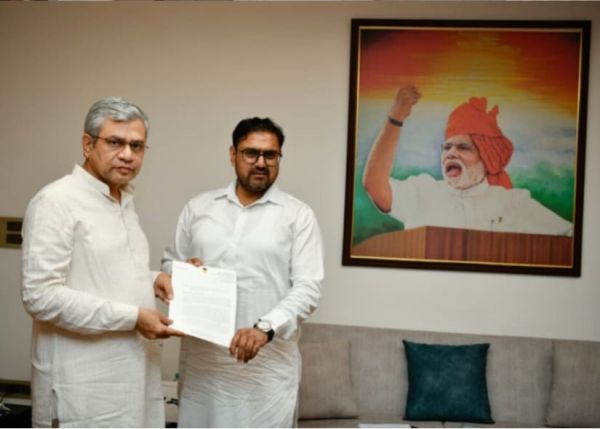
New Delhi: Satish Sharma today met Union Minister for Railways, Information & Broadcasting, and Electronics & Information Technology Ashwini Vaishnaw and strongly pitched for the revival of the long-pending Jammu–Rajouri–Poonch rail connectivity project while also seeking enhanced central support for Jammu and Kashmir’s digital transformation.
During the meeting, Sharma urged the Union Minister to accord priority to the proposed Jammu–Akhnoor–Dori Dager–Sunderbani–Nowshera–Rajouri–Poonch rail corridor, describing it as a project of immense strategic, economic and social significance for the people of Jammu and Kashmir, particularly those living in the border districts.
The minister informed Vaishnaw that a survey for the proposed rail alignment had already been conducted in the past and stressed the need for its revival and early execution. He pointed out that the border districts of Rajouri and Poonch remain among the few major regions in the country without rail connectivity despite their strategic location and substantial population.
Highlighting the difficulties faced by residents, Sharma said the twin districts frequently encounter connectivity challenges due to adverse weather conditions, road blockades and difficult terrain, affecting the movement of people, essential commodities and emergency services. He maintained that a rail link would provide a reliable all-weather transportation network, significantly improving accessibility, boosting economic activity and enhancing the quality of life of the people.
Emphasising the national security aspect of the project, Sharma said Rajouri and Poonch share a sensitive international border and have historically played an important role in safeguarding the country’s interests. He noted that rail connectivity would not only improve civilian transportation but also strengthen logistical capabilities and facilitate faster movement of personnel and resources whenever required.
The minister further stated that the proposed rail corridor would open new avenues for tourism, trade, industry and employment generation in the region. Improved rail infrastructure, he said, would help integrate the border districts more closely with the national economy and accelerate their socio-economic development.
Sharma urged the Railway Ministry to immediately commission a fresh feasibility study based on the earlier survey, declare the project a national priority because of its strategic importance and make suitable budgetary provisions for its implementation. He also assured full cooperation from the Jammu and Kashmir government at every stage, including survey work, land acquisition, clearances and other administrative requirements.
Reiterating the aspirations of the people of Rajouri and Poonch, Sharma said rail connectivity is not merely an infrastructure project but a long-awaited developmental necessity that would bring the border districts closer to the national mainstream and ensure equitable access to growth opportunities.
The Union Railway Minister assured the J&K minister that the issues and demands raised during the meeting would be examined sympathetically.
During the meeting, Sharma also raised several issues related to the Information Technology sector and sought enhanced support from the Government of India for accelerating Jammu and Kashmir’s digital transformation journey.
He urged the Union Minister to facilitate the establishment of advanced IT infrastructure and innovation ecosystems in Jammu and Kashmir, including IT parks, incubation centres and digital skill development hubs. Sharma said such initiatives would create new employment opportunities for youth and position the Union Territory as an emerging destination for technology-driven investments.
Highlighting the potential of J&K’s young and educated workforce, he called for greater collaboration between the Ministry of Electronics and Information Technology and the UT government in areas such as artificial intelligence, cybersecurity, e-governance, digital service delivery and startup development.
He stressed that focused investments in the IT sector would help generate sustainable livelihoods and reduce regional disparities.
The minister also sought support for expanding digital infrastructure in remote and border areas to ensure seamless internet connectivity and access to digital services. He said improved digital access would strengthen governance, education, healthcare, entrepreneurship and citizen service delivery, particularly in underserved regions.
Expressing hope after the meeting, Sharma said the long-pending rail project and proposals for digital development would receive due consideration in the larger interest of the people and the strategic development of Jammu and Kashmir.