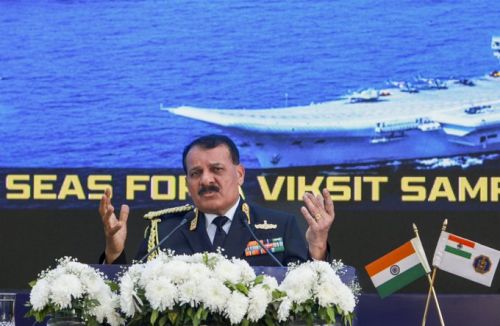
New Delhi: The Indian Navy has significantly enhanced its anti-submarine warfare capability, underwater surveillance and network-centric operations to confront any “two-front” threat from China and Pakistan in the Indian Ocean region, Navy Chief Admiral Dinesh K Tripathi said Saturday.
In an exclusive interview to PTI, Admiral Tripathi said the Navy’s efforts are not aimed at any specific nation, but rather at ensuring the absolute security of India’s maritime interests.
His comments came amid the growing presence of China’s PLA Navy in the Indian Ocean region, coupled with its deepening maritime alignment with Pakistan.
“We are fully aware that the Indian Ocean Region is witnessing increasing strategic contestation and greater extra-regional presence, moving us from an ‘era of cooperation’ into an ‘era of intense competition’,” he said.
“As a professional maritime force, the Indian Navy monitors all regional developments very closely, and our approach remains strictly capability-based and threat-informed.”
There has been an upswing in collaboration between Pakistan and China in the maritime domain. Last month, the two sides announced the commissioning of the first of four Chinese-built diesel-electric attack submarines for the Pakistan Navy. China has been playing a major role in modernising the Pakistani Navy.
Admiral Tripathi said his force continuously assesses the evolving strategic environment and accordingly adapts its force structure, operational concepts, deployment patterns and preparedness levels.
“Our efforts are not aimed at any specific nation, but rather at ensuring the absolute security of India’s maritime interests and contributing to a stable, free, open and inclusive Indo-Pacific. The Navy’s answer to any complex or two-front challenge is credible deterrence backed by capability,” he said.
“To achieve this, the Indian Navy has significantly enhanced its surveillance architecture, maritime domain awareness, anti-submarine warfare capability, underwater surveillance, long-range maritime reconnaissance, network-centric operations across sensors and shooters, and integrated operational response capability,” he added.
He was responding to a question about India’s maritime security challenge in view of the rapid modernisation of the PLA Navy, coupled with its deepening maritime collaboration with Pakistan including the transfer of submarine capabilities.
Admiral Tripathi said the Indian Navy’s “Mission-Based” deployments across “critical choke points” and shipping lanes ensure sustained operational presence, persistent surveillance and rapid response capability across the region.
“Importantly, deterrence is not built merely through numbers. It is built through credible capability, operational readiness, technological integration, sustained presence and the ability to impose costs, if required,” he said.
The Navy Chief said deterrence flows from credible capability and operational readiness.
“We are continuously evaluating niche technologies to provide an asymmetric advantage and ensure that every capability we acquire contributes to operational advantage and decision superiority,” he said.
“I am extremely confident in our current combat capabilities, and our ongoing capability accretion plans – including the P-75(I) submarine programme and expanding to a 200-plus ship Navy — ensuring we are fully committed to maintaining our combat edge and safeguarding India’s national maritime interests under all circumstances,” Admiral Tripathi said in the email interview.
Under Project 75 India (P75-I), the Indian Navy is acquiring six stealth submarines.
The Navy Chief also highlighted the importance of the government’s policy towards self-reliance in the defence sector.
“Atmanirbharta (self-reliance) is fundamental to strategic autonomy, technological resilience, and future combat capability,” he said.
“The most transformative milestone during this period is our definitive shift from a ‘Buyer’s Navy’ to a ‘Builder’s Navy’,” he said.
Admiral Tripathi said the Indian Navy is no longer just acquiring indigenous platforms or pursuing simple import substitution, but it is pursuing “true strategic autonomy and sovereign capability” at the deep component, software and sub-component levels.
“On the platform and industrial side, the sheer scale of our domestic shipbuilding stands out. The commissioning of our 100th indigenously designed warship marked a defining milestone in this journey,” he said.
“Today, all 45 ships currently under construction are being built exclusively in Indian shipyards, and our recent commissions feature near 80 per cent overall indigenisation content,” he said.