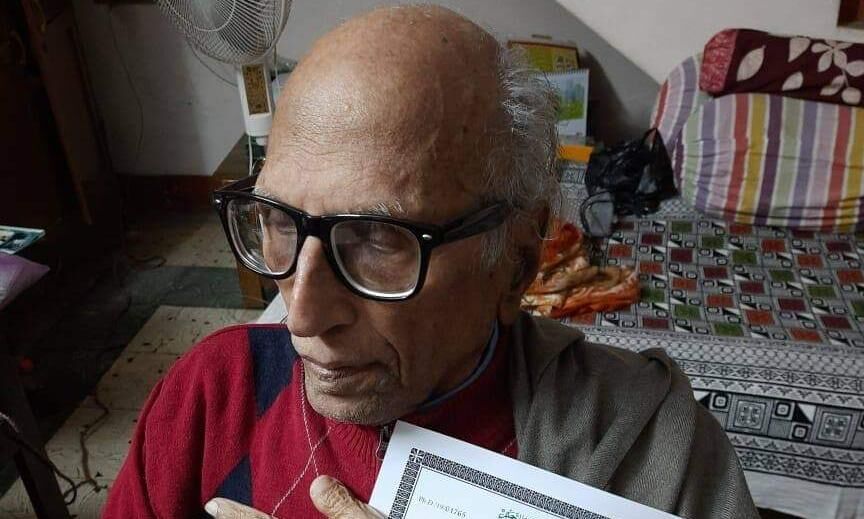
New Delhi: Bashir Badr, one of Urdu poetry’s most relevant voices whose words reflected the complexity of life and politics, leaves behind a legacy that travelled far beyond literary circles and found their way into everyday conversations, political speeches and popular culture.
Badr, who died at his Bhopal home at the age of 91, had stepped away from the limelight several years ago following the onset of dementia. But his poetry drew the Badr name out of the shadows. Those who didn’t know his name perhaps knew his lines, and those who weren’t familiar with the delicate nuance of Urdu poetry were aware that this was a literary giant who mattered.
Badr’s passing has left a void in Urdu poetry that will be hard to fill.
The talent began to sparkle early in life. Born on February 15, 1935, in Faizabad (now Ayodhya), he was just seven when he started writing poetry.
One of his most cited couplets — “Ujale apni yaadon ke hamare saath rehne do, Na jaane kis gali mein zindagi ki shaam ho jaye… (Let the light of your memories remain with me /Who knows in which alley the evening of life may descend)”– was penned when he was a teen.
As his son Syed Badr put it, “This couplet is a representation of his life; it is his trademark. I would like all of you to celebrate this. His poetry is the poetry of love and life.”
Known for the use of highly contemporary Urdu in his ghazals, Badr brought conversational simplicity and emotional range to poetry that painted love, loneliness, separation, and human relationships in a language that was both accessible and familiar all the way from political corridors to college canteens.
From reels to social media posts and from old fashioned letters to movies, the words went out. Writer and lyricist Varun Grover used Badr’s couplet in the much appreciated 2015 film “Masaan”. Another Badr admirer is filmmaker Vishal Bhardwaj who used Badr extensively in “Dedh Ishqiya”.
In many videos, still surviving on internet, Badr can be seen reciting his lines with great flourish. He was, for his friends, the soul of mushairas.
“He had dementia and had not been part of any mushaira for the past 10 years. That was his conscious decision because he was a showman so he wanted that his image remains at its peak,” Syed said, adding that his father’s writings acquired a life of their own.
Badr received his education, from graduation till PhD, from Aligarh Muslim University. It is said that his early poetry and couplets were added to the MA (Urdu) syllabus at AMU even before he had finished his own postgraduate studies.
Tayeb Badr, another son, recalled that Badr failed a viva because the examiner disagreed with his interpretation of a popular couplet — as it turned out, it was Badr’s very own writing.
“Abba jee explained the couplet to the examiner during the viva without letting him know that he was the author of the couplet… But to his utter surprise, the examiner completely disagreed with his explanation,” Tayeb told PTI.
In 2018, Badr’ words echoed in the Lok Sabha.
Congress leader Mallikarjun Kharge quoted the Urdu poet and said, “Dushmani jamkar karo lekin ye gunjaish rahe, jab kabhi hum dost ho jaayen toh sharminda naa ho. (Be enemies with all your might, but leave this possibility alive /That if we ever become friends again, neither of us feels ashamed).” It’s a couplet Badr is believed to have written after the Shimla Agreement in 1972.
Prime Minister Narendra Modi also quoted Badr in his reply. “Jee bahut chahta hai sach bolein, kya karein haunsla nahi hota (My heart deeply longs to speak the truth/But what can I do, I do not have the courage).”
Life for the prominent voice of contemporary India was not easy.
In April 1987, Badr, who was then head of the Urdu department at Meerut College, lost all his belongings, unpublished manuscripts and a library in the flames of a communal riot. Heartbroken, he left the city to settle in Bhopal where he lived till his last breath.
The pain of losing a home remained with him and spilled on to the paper when he wrote: “Log toot jaate hain ghar banane mein/Tum taras nahin khaate bastiyaan jalaane mein (People break themselves trying to build a home; you feel no pity in burning whole villages down).”
To this day, the lines are quoted by newspapers and social media users whenever there is a riot.
Filmmaker Bhardwaj was a student in Meerut and a big fan of Badr’s poetry at the time. He once said he reproduced and gifted back many of the poems that were lost when the poet’s house burnt. These were the couplets that later found their way to “Dedh Ishqiya”.
According to the Rekhta Foundation, Badr was well-versed in Persian, Hindi and English and had over 18,000 couplets to his credit and a large number of Urdu ghazals too.
He had more than seven collections of poems in Urdu and one in Hindi, apart from two books as a literary critic.
Renowned poet Waseem Barelvi mourned the death of a close friend and a “great man”.
“It is the end of an era. We participated in kavi sammelans and mushairas together hundreds of times,” Barelvi told PTI.
Hindi poet Laxmi Shankar Bajpai credited Badr for popularising Urdu poetry and “writing it in a language that helped Hindi ghazal to flourish”.
“The entirely new idiom, new imagery, new metaphors, and new themes that transformed the Urdu ghazal so fundamentally. Bashir Badr sahab played a hugely significant role in that change. No literary movement is shaped by one person alone, of course, but he was certainly a leading figure, a pioneer, a guiding force,” Bajpai said.
He added that while preserving the tradition of classical poetry, Badr gave it an entirely new colour and freshness.
“The place Hindi ghazal holds today, thanks to Bashir Badr sahab, Nida Fazli sahab, and others like them, is such that you can hardly distinguish between Hindi ghazal and Urdu ghazal anymore. The ghazal connected with the sorrows and struggles of ordinary people, the ghazal that took up contemporary themes, much of the credit for that goes to him. A towering pillar has fallen,” he said.
Badr received the Padma Shri award in 1999 for contribution towards literature and Sangeet Natak Akademi. He also received the Sahitya Akademi Award in Urdu for his poetry collection “Aas” in 1999.