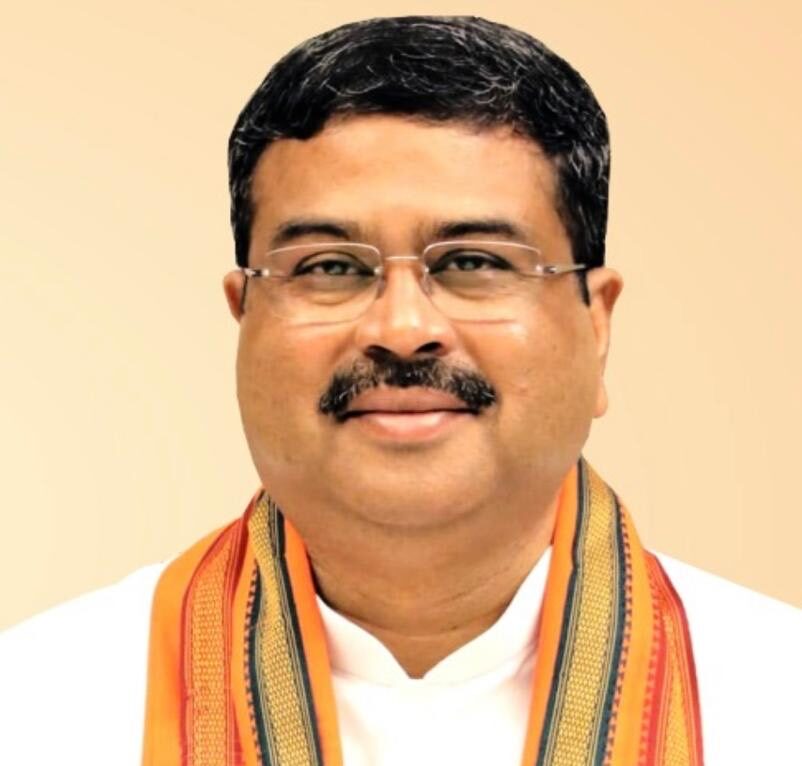
New Delhi: Union Education Minister Dharmendra Pradhan on Wednesday launched the School Management Committee (SMC) Guidelines 2026, underscoring the need for stronger community participation, improved school infrastructure and updated pedagogy in line with the National Education Policy 2020.
Addressing the inaugural event here attended by education ministers from several states and senior officials, Pradhan underlined that SMCs are not a new concept but have evolved overtime and remain central to improving learning outcomes and governance in schools.
He said that as the academic cycle progresses, “we first review what was taught in the previous year — this becomes the foundation for the next phase of learning.”
“As we move into the second month of the 2026-27 academic year, which begins in April, we are also approaching the summer vacation period, after which schools will resume in July. During this time, our focus is on preparation — how to organise teaching effectively in the coming academic year, how to improve learning outcomes, and how to enhance students’ competencies,” he said.
The minister said the implementation of the National Education Policy (NEP) 2020 will complete six years in a few months and it will enter its seventh year. He said that the National Council of Educational Research and Training (NCERT) has made textbooks available up to Class 9, and added that new textbooks for Classes 10, 11, and 12 will be introduced in the coming years.
“With the introduction of new textbooks, there is also a shift towards new pedagogy, new examples and a new approach to learning. Keeping in mind the needs of the time, we have also introduced computational thinking and basic knowledge of artificial intelligence from Class 3 onwards,” the minister said.
Describing SMCs as a bridge between society and schools, he said, “The School Management Committee must act as a bridge between society, education, students and teachers.”
Emphasising collective responsibility in education, Pradhan said, “The School Management Committee should become a social movement. The success of the National Education Policy 2020 depends on society taking ownership of it.”
He further noted that government efforts alone are not sufficient.
“Governments have limitations; but beyond that, who will provide the ‘extra push’? That is the role of the School Management Committee,” he said
Pradhan also highlighted inclusion, noting that support for children with special needs must be strengthened, and said awareness of changing skill demands is crucial as “new technologies are replacing old jobs while also creating new opportunities”.
Pradhan said India’s education and examination systems have become significantly stronger, citing large-scale exam management as an example.
“Recently, I visited a NEET-UG examination monitoring centre. Around 22.5 lakh students appeared for the exam across more than 5,400 centres nationwide. Every district had examination centres,” he said.
Highlighting technological advancement, he added, “India’s technological capacity has improved significantly. Today, we can monitor large-scale examinations and educational processes in real time.”
The minister said that the government aims to strengthen digital governance in education.
“In the coming years, we aim to achieve last-mile monitoring of nearly 25 crore students through digital platforms,” he said.
“In the coming days, India’s progress in education will depend on one key factor — society stepping beyond its limited role and actively participating in education as a collective responsibility. The concept of School Management Committees is based on this very idea,” he said.
The School Management Committee Guidelines 2026 introduced several key reforms, including a single SMC for all classes from Balvatika to Class 12, aimed at strengthening school-level governance and continuity in decision-making.
The guidelines clearly define the roles and responsibilities of SMCs and Member Secretary, with a focus on improved accountability, transparency and financial oversight in school management.
They also emphasise proactive monitoring of student attendance and teacher engagement to enhance learning outcomes.
A key feature of the framework is school development planning and social audit mechanisms, designed to enhance community participation and ensure better oversight of school functioning.
The guidelines further promote a whole-of-government convergence approach, integrating multiple departments and schemes for more effective implementation at the school level.
In addition, they incorporate several ongoing initiatives such as Vidyanjali, Eco-Clubs, Understanding of Lifelong Learning for All in Society (ULLAS), PRASHAST App, School Infrastructure Safety, and Disaster Preparedness programmes, aimed at making schools safer, more participatory and learning-focused environments.
The guidelines state that “every school should constitute an SMC within one month of the start of the academic year” and that elections of SMC must be conducted “in a democratic, transparent, and inclusive manner”.
The number of members of the committee may be decided based on the enrolment of the children — 12 to 15 members for schools with up to 100 students, 15 to 20 members for enrolments between 100 and 500, and 20 to 25 members for schools with over 500 students.
The guidelines mandate that 75 percent of an SMC’s strength must comprise parents or guardians of children, while 50 percent of all members must be women. Proportionate representation has also been mandated for Socio-Economically Disadvantaged Groups (SEDGs), including SC, ST, OBC communities and children with special needs (CwSN).
The term of the members of the SMC shall be for two years. The SMC may continue beyond the term of two years till the new committee has been reconstituted, it added.
On financial management, the guidelines specify that “all civil works costing up to Rs 30 lakh may be executed by the SMC”. All SMC funds are to be maintained in a separate joint bank account in the names of the chairperson and member secretary, it added.