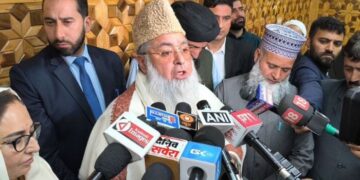
Leh: Chief Principal Census Officer and Director Census Operations for Jammu and Kashmir and Ladakh, Amit Sharma, on Friday, unveiled the roadmap for Census 2027 in Ladakh, describing it as a major step towards data-driven governance in the Union Territory.
Addressing a press orientation meet in Leh, Sharma said Census 2027 would be the first census exercise conducted in Ladakh after it was carved out as a Union Territory in 2019.
He said the exercise would provide accurate and comprehensive data for the region, enabling targeted development and better policy planning.
Sharma said Census 2027 would also be India’s first fully digital census, with data collection to be carried out through mobile applications and an online self-enumeration portal.
The first phase, involving house listing operations, will be conducted from June 1 to June 30, 2026. It will be preceded by a 15-day self-enumeration period from May 17 to May 31, during which residents can fill in their details through the portal “se.census.gov.in”.
He said the self-enumeration questionnaire would contain 33 questions and urged that awareness about the portal be spread across Ladakh.
The second phase, involving population enumeration, will be carried out in September 2026 in Ladakh along with other snow-bound areas of Jammu and Kashmir, Himachal Pradesh and Uttarakhand.
In a major development, Sharma announced that two dedicated census data workstations would be established in the offices of the Planning, Development and Monitoring Department in collaboration with the Office of the Registrar General and Census Commissioner of India.
He said the workstations would provide access to granular, micro-level data and help strengthen planning and policy formulation at the grassroots level.
Sharma said the census would be supported by a web-based Census Management and Monitoring System developed by C-DAC to enable real-time monitoring and smooth implementation.
Clarifying doubts, he said Census 2027 is entirely different from the Special Intensive Revision of electoral rolls, adding that while the latter concerns voter lists, the census is meant for broader socio-economic data collection.
He said enumerators would visit households during normal working hours and would carry valid identification cards, advising residents to verify their credentials.
Sharma also said that training of senior officers, including Principal Census Officers, District Census Officers and Charge Officers, has already been completed, while training for master trainers, field trainers, enumerators and supervisors would be held before field work begins.
On data security, he said strong safeguards, including end-to-end encryption, secure transmission and protected data centres, have been put in place to ensure privacy of citizens.
Sharma urged people of Ladakh to actively participate in the exercise, saying the data collected through the census would play a key role in shaping the future development of the Union Territory.