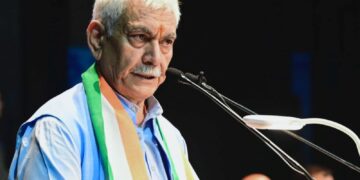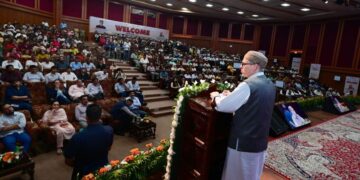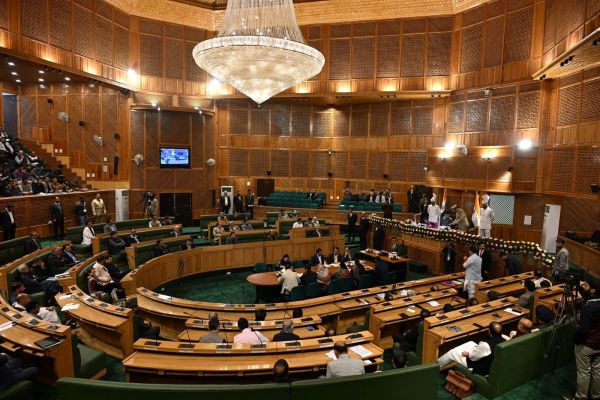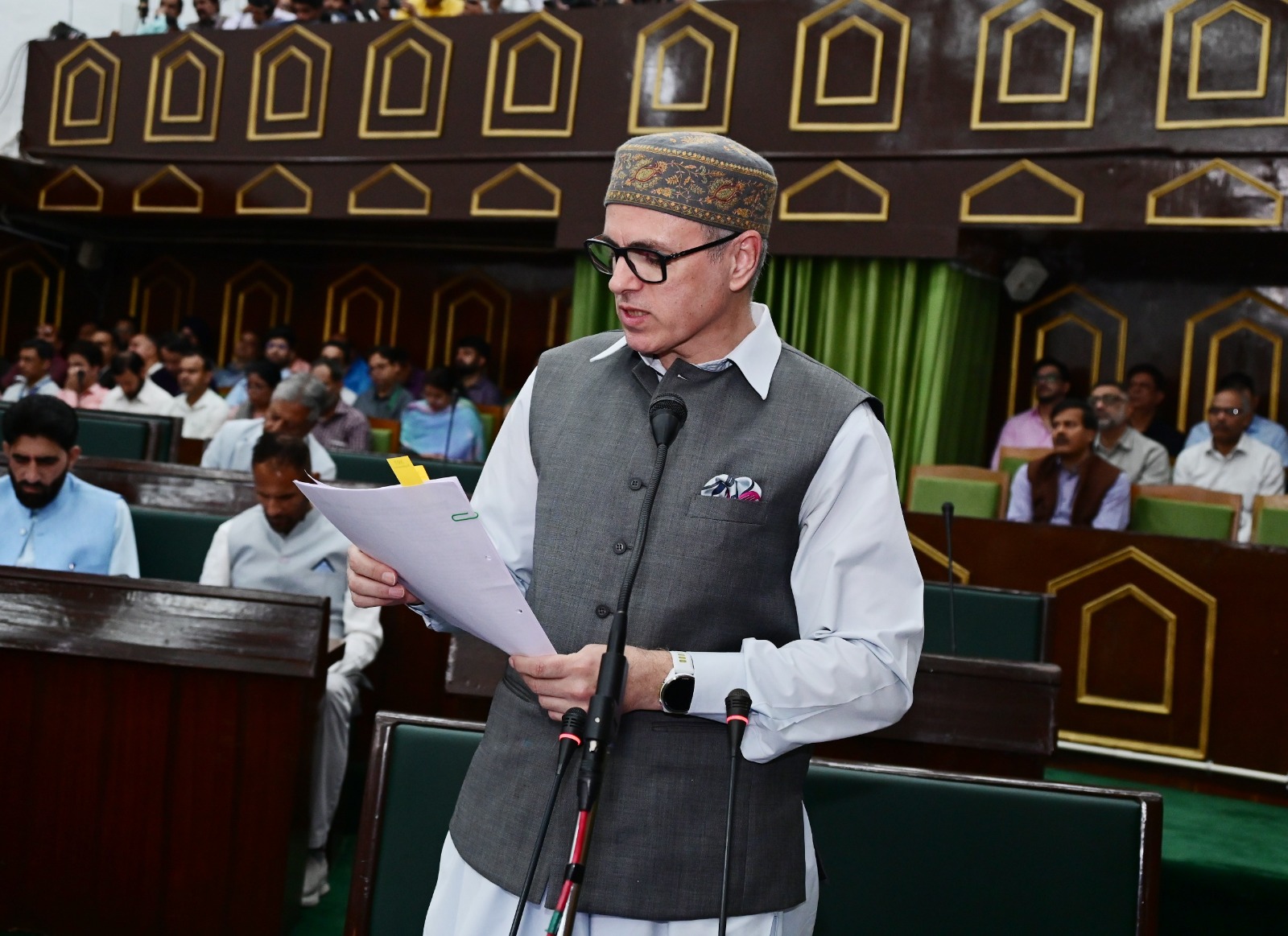
Jammu: Chief Minister Omar Abdullah on Monday said the government does not oppose any private members’ bills without due consideration, emphasising that all proposals are examined in detail before a view is taken.
Opposing a private member’s bill tabled by Congress legislator Nizam-ud-Din Bhat in the Assembly seeking equitable opportunity of employment in the civil services, Abdullah said remarks made during the discussion could give an impression that bills are not read and are opposed routinely without application of mind, which he described as “somewhat unfair”.
“It may appear as if we pick up a slip marked ‘oppose’ and stand up to reject a bill, but that is not the case,” the chief minister said.
He said whenever a proposal reaches the government-whether through the Assembly or any other route — it is scrutinised in detail.
“We examine its feasibility and weigh its advantages and disadvantages. If the benefits outweigh the drawbacks, we do not oppose it,” the chief minister said.
Nearly a dozen of the 33 private members’ bills listed in the Assembly were introduced, with most later withdrawn by their sponsors and some rejected by voice vote following the government’s response.
Referring to Bhat, Abdullah said his private member’s bill, after examination, appears to have more disadvantages and potential problems than advantages.
Acknowledging the genuine concern of the MLA, the chief minister said confining recruitment or postings to the local level would create administrative difficulties, including additional cadres, shortage of suitable candidates at the block level and the need for relaxations, which could lead to arbitrariness.
It would also make it difficult to meet reservation requirements and limit promotion avenues in smaller blocks, leading to disparities among employees recruited at the same time, Abdullah said.
He said that while the issue raised by the member requires attention, the bill was not an appropriate solution and urged its withdrawal, adding that the government would explore alternative measures to address the concern.
Indiscriminate felling of walnut trees not allowed, says CM
Chief Minister Omar Abdullah on Monday said his government cannot permit indiscriminate felling of walnut trees as it could severely impact the region’s economy and identity.
He said the Union Territory is contributing nearly 3.5 lakh tonnes – over 90 percent of the country’s total walnut production.
Opposing the private members’ bill moved by National Conference legislator Altaf Ahmad Wani seeking amendment in the Jammu and Kashmir Preservation of Specified Trees Act, to grant owners the free will to cut Walnut trees on their land, Abdullah said, while land and trees may belong to individuals, restrictions on cutting them exist for valid reasons, including conservation and long-term economic interests.
He said similar protections extended to chinar trees and several other species are safeguarded under existing frameworks.
Highlighting the economic stakes, he said walnuts form a significant component of the region’s economy.
“If unrestricted permission is given, people may cut walnut trees, but may not replant them. Instead, there is a risk of land being diverted for construction, which would reduce walnut production to negligible levels,” he said.
The chief minister acknowledged concerns about corruption in the permission process, stating that such issues arise wherever restrictions exist.
He suggested that bringing permissions for tree felling under the Public Services Guarantee Act with fixed timelines could help reduce delays and curb corruption.
However, he made it clear that any relaxation must be linked to safeguards and proposed that if old or non-productive trees are to be cut, it should be mandated through legislation that only high-density walnut plantations be raised on that land, with no alternative land use permitted.
“Until such safeguards are in place, we cannot allow indiscriminate cutting of trees or diversion of land. This would endanger a key identity and economic asset of Jammu and Kashmir,” he said, urging the member to withdraw the Bill.
The chief minister assured that a well-structured proposal ensuring replantation with high-density varieties could receive the House’s approval in future.
Satisfied with the response of the chief minister, the MLA later withdrew his bill.