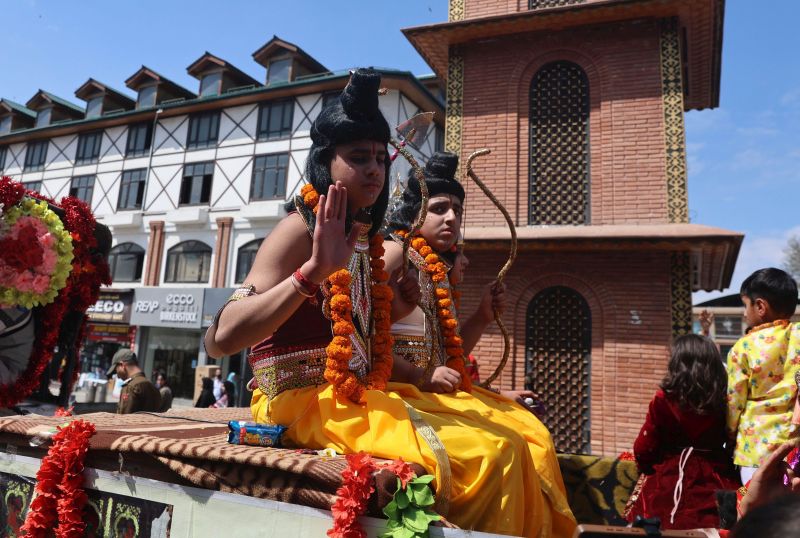
Srinagar/Jammu: Ram Navami was celebrated with religious fervour across Jammu and Kashmir on Thursday, with devotees taking out ‘Shobha Yatras’ in Srinagar and several districts of the Valley.
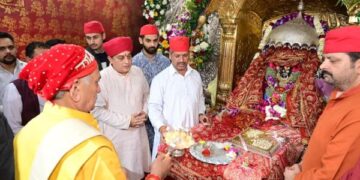
According to the reports, the historic Raghunath Temple was also reopened for prayers after nearly 36 years today, marking a significant moment for the local Pandit community.
The reopening of the temple in the old city’s Haba Kadal area coincided with the festival, drawing devotees from different parts of the Valley for special prayers and rituals.
“This is a historic and emotional moment. We never thought we would see prayers being held here again in our lifetime,” said a devotee, adding that the reopening has rekindled a sense of belonging among the community.
The temple, dedicated to Lord Ram, is a centuries-old heritage structure believed to have been built in the 19th century by Dogra ruler Maharaja Gulab Singh and later completed by Maharaja Ranbir Singh.
It had fallen into disuse and disrepair in the early 1990s, remaining shut for decades before restoration efforts were taken up by the authorities.
Officials associated with the renovation said the structure has been carefully restored to preserve its original architecture while making it functional again for worshippers.
Another devotee, Neelam Raina, said the reopening goes beyond religion. “It is about reconnecting with our roots and history. Today’s celebration feels like a new beginning,” she said.
Eyewitnesses said Shobha Yatras in Srinagar as well as districts including Anantnag, Baramulla and Kupwara and elsewhere passed off peacefully through designated routes amid tight security arrangements.
Devotees were seen chanting ‘bhajans’ and carrying religious flags.
Reports from other districts said similar religious gatherings and prayers were held in several parts of south and north and central Kashmir, with authorities ensuring smooth arrangements.
Meanwhile, Chaitra Navratri has drawn a huge rush of pilgrims to the Mata Vaishno Devi shrine in Jammu and Kashmir’s Reasi district, with over 2.69 lakh devotees offering prayers at the cave shrine during the ongoing festival.
“The yatra is going on smoothly. There is a huge rush. As many as 2,69,716 pilgrims have paid obeisance at the temple till March 25,” a senior official of the Mata Vaishno Devi Shrine Board told PTI.
Hundreds of devotees, chanting ‘Jai Mata Di’, are trekking along the serpentine pathway to the Mata Vaishno Devi temple to pay obeisance.
Chaitra Navratri, being observed from March 19 to March 27, is dedicated to the worship of Goddess Navdurga and holds special significance at the Mata Vaishno Devi shrine, which records one of its highest pilgrim footfalls during this period.
According to the data, 31,815 pilgrims paid obeisance at the temple on the first day of Navratri on March 19, while 34,805 devotees visited the shrine on March 20, 41,078 on March 21, 43,482 on March 22, 45,478 on March 23, 38,158 on March 24 and 34,900 on March 25.
The registration of pilgrims was suspended twice for brief periods to manage the heavy rush of pilgrims, they said.
Katra, the twin routes and the Bhawan temple area, dazzling with lights and flower-decked decorations, resonate with spiritual fervour and traditional gaiety as the nine-day-long festival of Chaitra Navratri began amid multi-tier security.
Authorities have put in place multi-tier security arrangements at the Katra base camp and en route to the shrine to ensure a safe yatra.
The Board has deployed volunteers to guide pilgrims, manage the anticipated rush and ensure smooth movement along the 13-km yatra route, the official said.
This year, the Shrine Board introduced wireless communication to enhance coordination and communication along the yatra route. A multi-tier security grid involving the police, CRPF, other paramilitary forces and quick-response teams (QRTs) is in place throughout the festival, officials said.
The sacred Shat Chandi Maha Yagya commenced at the revered Mata Vaishno Devi shrine on March 19, heralding the auspicious beginning of Chaitra Navratri, officials said.
The divine vibrations of Vedic chants and rituals at the holy cave are invoking blessings of peace, prosperity and well-being for all humanity, they said.