Kashmir is known for its rich heritage, stretching back to antiquity. Almost every nook and corner of the Valley is marked by shrines and sacred spaces that cut across religious affiliations, reflecting Kashmir’s long tradition of spiritual coexistence. The stretch from Baramulla town to Muzaffarabad is particularly significant, as it is dotted with numerous ancient temples and places of worship. This is largely because the route connecting Kashmir with the rest of world served as a major corridor of communication, trade, and commerce from ancient times until the partition in 1947. Among these sites, one important yet largely overlooked monument is the temple at Boniyar. Located about 20 kilometres from Baramulla, on the banks of the River Vitasta (Jhelum) and at the foothills of the Pir Panjal range, this modest structure quietly bears testimony to the Valley’s rich religious and cultural past.
According to local tradition—often narrated by elders—the temple is believed to have been built by the Pandavas of the Mahabharata. However, historical evidence suggests that the structure dates back to the Karkota dynasty, which ruled Kashmir between the seventh and ninth centuries CE. Alexander Cunningham, a British Army engineer and the first Director-General of the Archaeological Survey of India noted that local Pandits referred to the site as Bhawaniyar, which led him to identify the monument as a shrine dedicated to the goddess Bhawani. His assessment, however, was constrained by the fact that the structure was partially buried under snow at the time of his visit. William Garden Cowie, Bishop of Auckland, who served as a chaplain in Kashmir in 1865, recorded local traditions attributing the construction of the temple to a figure named Bonadutt, from whom the locality was believed to have derived its name, and noted that Bonadutt’s brother was said to have built another temple at Venapora near Sopore. Cowie referred to the site as Bhaniyar, a variation that reflects phonetic shifts over time as well as the persistence of local tradition, according to which the temple was venerated as a Bhawani shrine. In due course, the name evolved into Boniyar, by which the locality is known today. Two principal explanations are generally offered for this evolution in nomenclature. One associates the name directly with the temple itself, suggesting that the settlement derived its identity from the shrine traditionally known as Bhawaniyar. The other explanation links the name to the region’s natural environment, particularly the abundance of chinar trees (boonyi) that once grew along the riverbanks and surrounding landscape. Over time, this ecological association may have influenced the name of the settlement, eventually assuming its present form, Boniyar. The continued presence of chinar trees in and around the area lends support to this interpretation and reflects the close relationship between local geography and historical memory.
The ruins of the temple first attracted scholarly attention in the early nineteenth century. Karl Alexander von Hügel, who visited the site in 1835, mistakenly identified it in his book Travels in Kashmir and the Panjab, as a “well-preserved Buddhist structure,” while G. T. Vigne, writing in his book Travels in Kashmir Ladakh, Iskardo, 1844, referred to it more cautiously as a “Hindu ruin situated along the road.” A more systematic examination of the monument was undertaken in November 1847 by Alexander Cunningham. The first detailed and reliable account of the temple was provided in 1865, when William Garden Cowie surveyed the site following its excavation. Cowie conducted a detailed survey of the shrine, recording an interior measuring approximately thirteen square feet, walls supported on a four-foot-high basement, and a surrounding cloistered quadrangle measuring about 145 by 120 feet. His observations were published in “Notes on Some of the Temples of Kashmir” (Journal of the Asiatic Society of Bengal, Vol. XXXV, Issue II, 1867). He drew attention to the pale, coarse granite used in the structure and, noting the absence of nearby quarries on the left bank of the Jhelum, cited the view of Mr. Drew, a geologist in the Maharaja Ranbir Singh’s (1856-1885) service, that the stone blocks were likely transported from valleys on the opposite bank via the river Jhelum. Cowie further suggested that the central shrine may originally have been surrounded by water, based on the presence of two ancient wells near the site, and identified a drainage spout near the upper base of the temple used to carry off ritual ablutions, which he described as resembling a serpent or similar form. Subsequent observations by James Fergusson around 1876 highlighted identified Gandhāran—or Greco-Buddhist—influences in the temple’s colonnaded design, stylistic features that had developed under the Kushana rule from the first to the seventh centuries CE.
A comprehensive and authoritative description was later provided by R. C. Kak in Ancient Monuments in Kashmir (1933), in which he noted that the Boniyar temple complex comprises a well-planned architectural ensemble centred on a double-based shrine enclosed within a cloistered quadrangle measuring approximately 145 by 119½ feet. The principal gateway is a double-chambered structure articulated with trefoil arches, fluted columns with voluted capitals, and a pyramidal roof resting on a cornice decorated with kīrtimukhas and miniature trefoil niches. Access to the complex was provided by stairways on the eastern and western sides, one of which remains partially buried. The temple proper is approached through a lofty trefoil-arched entrance flanked by half-engaged columns and opens into a square sanctum measuring about fourteen feet. The original image, likely of Viṣṇu, has been replaced by small Siva-lingas brought from the river Narmada, while the domical ceiling noted in the nineteenth century has since disappeared. Surrounding the shrine are fifty-three rectangular cells, each fronted by trefoiled entrances and arranged along a colonnaded peristyle displaying Gandhāran-inspired elements. Larger chambers placed at the centre of each range suggest functional or ritual differentiation within the complex. The presence of a makara-shaped drainage spout, water troughs, and an underground drainage system indicates careful attention to ritual ablutions and water management. Additional structures and architectural variations, including side entrances and ancillary buildings of uncertain function, further attest to the complexity and ceremonial significance of the temple complex. Together, these elements reflect the architectural sophistication and religious importance of the Boniyar temple complex. In the present day, the temple is recognised as a protected monument under the Archaeological Survey of India. Although it had long remained in a deteriorated condition, conservation efforts have been undertaken by the Archaeological Survey of India in coordination with the Indian Army, as the site presently lies within a military camp.
The Boniyar temple stands as a silent witness to Kashmir’s complex religious, cultural, and historical past. Though modest in scale, it embodies centuries of architectural innovation, ritual practice, and cultural exchange along one of the Valley’s most important historical routes. Its story—from mythological associations and dynastic patronage to colonial scholarship and modern conservation—mirrors the broader orientation of Kashmir’s heritage. As attention increasingly turns towards preserving lesser-known monuments, Boniyar reminds us that Kashmir’s history is not only contained in its grand and famous sites but also in quieter spaces that await recognition, protection, and renewed public engagement.
The writer is a member of Faculty, Department of History, Govt. College VKB, Hyderabad. Sheikhzahid0001@gmail.com
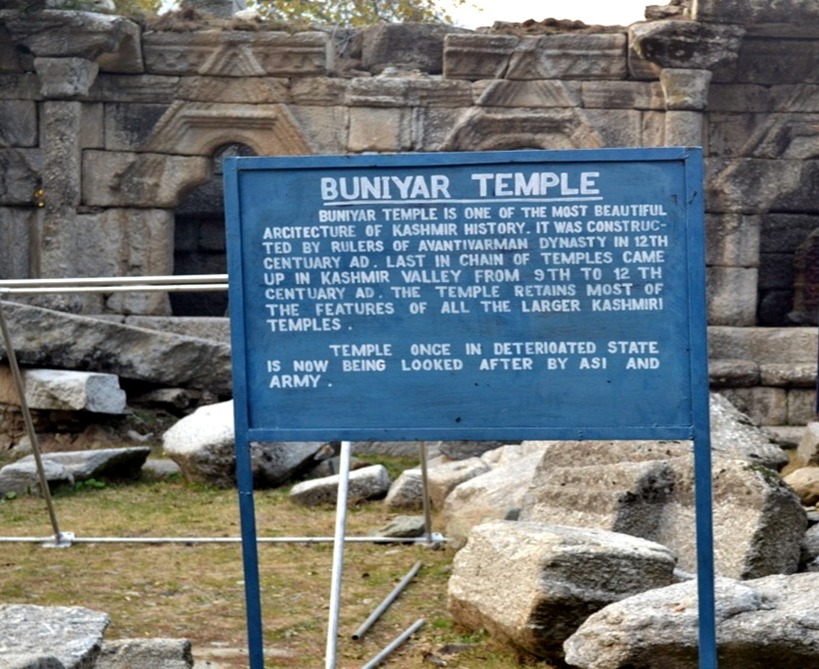
The surviving remains of the Boniyar Temple, Baramulla
.
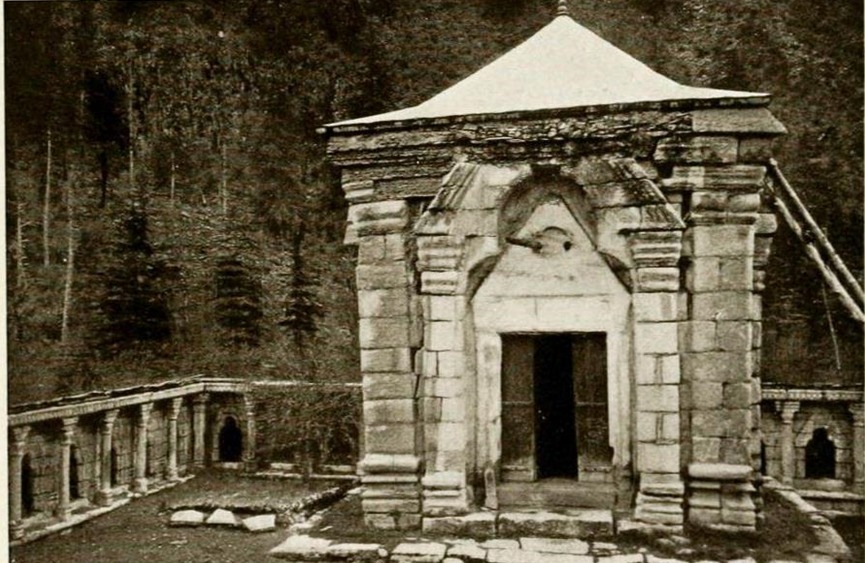
.Photograph from ‘Our summer in the vale of Kashmir’ (1915) by Frederick Ward Denys.