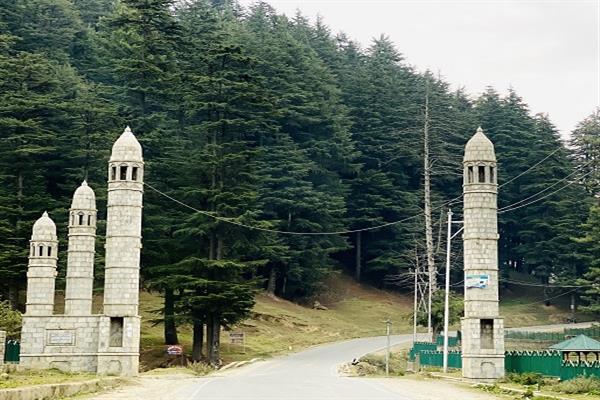
In recent years, debates around development and environmental protection have increasingly revealed a difficult truth: decisions taken at the local level often carry consequences far beyond their immediate geography. The proposed diversion of the Raika Forest in Jammu district of Jammu & Kashmir for the construction of a new High Court complex is one such decision. While the issue may appear region-specific, it reflects a broader national challenge — how India balances infrastructure expansion with ecological preservation, legal responsibility and social equity.
The proposal, first initiated in 2019, has since evolved into a subject of sustained public discussion, legal examination and administrative review. For the government, it represents an attempt to modernise judicial infrastructure and plan for institutional growth. For local communities, environmental experts and sections of the legal fraternity, it raises serious concerns about deforestation, indigenous rights and long-term urban sustainability. As the debate continues, the Raika Forest question offers an opportunity to re-examine what constitutes responsible development in an era defined by climate vulnerability and constitutional safeguards.
- A Development Question That Demands Deeper Thought
The proposal to shift the Jammu wing of the High Court from Janipur to the Raika Forest area has ignited an intense debate across Jammu & Kashmir. On one side stands the government, asserting the need for modern judicial infrastructure and long-term institutional expansion. On the other are environmentalists, legal professionals, indigenous communities and concerned citizens who fear that this move will irreversibly damage one of Jammu’s last remaining urban forests.
This debate is not recent or reactionary. The demand to shift the High Court to Raika dates back to 2019, when the Law, Parliamentary and Justice Affairs Department formally initiated the proposal. Over the past five years, the issue has moved through administrative files, departmental meetings and legal scrutiny, gradually transforming from a planning decision into a broader public concern. The longevity of the demand itself makes it imperative to reassess whether earlier assumptions still hold relevance in the face of today’s environmental and social realities.
This is not a simple contest between development and resistance. It is a complex issue that sits at the intersection of environmental sustainability, indigenous rights, legal consistency and urban planning. Any decision taken today will shape Jammu’s ecological and social future for decades.
- The Government’s Argument: Infrastructure and Institutional Growth
From the government’s perspective, the proposed shift of the High Court is driven by administrative and infrastructural concerns. The existing High Court complex at Janipur, constructed over two decades ago, is viewed as increasingly inadequate to meet future judicial requirements. With a rising caseload, expanding judicial machinery and the need for modern facilities, authorities argue that a new, purpose-built complex is essential.
Raika, being a relatively open and government-controlled area, is seen as a location that can accommodate long-term expansion without the constraints faced in congested urban spaces. Officials also argue that institutional development contributes to regional growth, employment and improved access to justice. In this view, infrastructure development is not an option but a necessity, and difficult choices must sometimes be made in the interest of governance.
- Environmental Concerns: An Urban Forest Under Threat
Those opposing the move argue that Raika Forest is not an ordinary land parcel. Spread across 813 kanals, the project entails the clearance of approximately 38,006 trees, making it one of the largest forest diversions proposed in Jammu’s recent history.
The forest supports over 150 species of trees and shrubs, including Phullai, Shisham, Jamun, Khair, Babul, Dhaman, Siris, Chir Pine, Pansar and Katari — species that have evolved over decades to stabilize soil, regulate temperature and sustain biodiversity. Beyond vegetation, the forest sustains a diverse wildlife population — peacocks, foxes, porcupines, rabbits, mongooses, wild pigs, snakes, leopards, and the musk deer, an endangered species.
Environmental experts warn that large-scale deforestation will lead to soil erosion, disrupt natural water absorption, and increase the risk of flooding in downstream areas. As wildlife habitats shrink, animals are pushed into human settlements, increasing human–animal conflict, a phenomenon already witnessed in Jammu’s urban periphery.
Raika also functions as a major carbon sink for Jammu city, mitigating air pollution and moderating rising temperatures. Critics caution that once this forest is opened for development, it will not stop at a single project. Markets, offices and private construction will follow, eventually transforming the entire region into an urban sprawl and depriving the city of its last natural buffer.
- The Human Dimension: Gujjar Livelihoods and Indigenous Rights
Perhaps the most sensitive aspect of the issue is its impact on the Gujjar community, an indigenous forest-dwelling group that has lived in and around Raika for generations. Official records mention 22 houses as encroachments, but local assessments indicate that nearly 59 households will be affected, directly threatening livelihoods tied to forest resources.
The government’s classification of these residents as encroachers has been strongly contested. Members of the community possess land records and girdawaris dating back to the pre-Independence era, along with cultural markers such as an ancestral qabristan within the forest area. With the extension of the Forest Rights Act, 2006 to Jammu & Kashmir, indigenous communities like Gujjars and Bakarwals are legally empowered to claim rights over forest land they have traditionally inhabited.
Supporters of the community argue that Gujjars are not adversaries of the forest but its traditional custodians. Their livelihood patterns are closely interwoven with forest conservation, making their displacement not only a social injustice but also an ecological setback. At present, there is little clarity on rehabilitation, compensation or alternative livelihood arrangements — a gap that continues to fuel mistrust.
- Legal Questions and Institutional Contradictions
The legal dimension of the project raises further questions. Bahu and Raika were declared Bahu Conservation Reserve and Ramnagar Wildlife Sanctuary in 1981, explicitly to protect the region’s ecology. Critics argue that diverting such land for non-forest use undermines the very rationale behind its protected status.
Since the proposal has been under consideration for over half a decade, legal experts point out that laws, environmental priorities and constitutional interpretations have evolved during this period. What may have appeared administratively feasible in 2019 now faces heightened scrutiny in an era of climate accountability and strengthened forest governance.
Moreover, concerns have been raised regarding compliance with forest conservation laws. Provisions restricting large-scale diversion of forest land and the classification of the area as eco-sensitive have been cited as inconsistencies in the approval process. Reports submitted before judicial bodies have pointed to the presence of rare flora and fauna, intensifying scrutiny over whether due diligence was adequately followed.
From the legal fraternity’s standpoint, the move also poses logistical and economic challenges. Lawyers have invested heavily in chambers near the existing Janipur complex, while shopkeepers and service providers depend on the current court ecosystem. Managing cases across multiple distant court locations may complicate access to justice rather than enhance it.
- Is Relocation the Only Option?
Another central question remains unresolved: Is relocating the High Court the only viable solution? The existing Janipur complex is only 22 years old, not an unusually short lifespan for public infrastructure. Urban planners argue that expansion, vertical development and redevelopment could address capacity concerns without sacrificing forest land.
Traffic congestion — frequently cited as justification — is a broader urban planning issue. Shifting the court may not eliminate traffic problems but merely relocate them. Investing in road infrastructure and public transport around Janipur could provide a more sustainable solution.
- Finding a Middle Path
The Raika Forest debate, ongoing for more than five years, is not about rejecting development, nor about ignoring institutional needs. It is about ensuring that development is lawful, environmentally responsible and socially just. Forests, once destroyed, cannot be recreated by policy amendments or court orders.
A transparent reassessment, genuine public consultation, and exploration of alternative sites could help bridge the widening trust gap between the state and the people. Development that disregards ecology and indigenous rights risks becoming a burden rather than a benefit.
The decision on Raika Forest will not merely determine the location of a High Court. It will signal how India balances justice with sustainability, and whether progress is defined by short-term convenience or long-term wisdom.
The columnist is a published writer in daily leading newspapers of J&K and an Independent Researcher. He can be contacted at shahidhakla360@gmail.com