

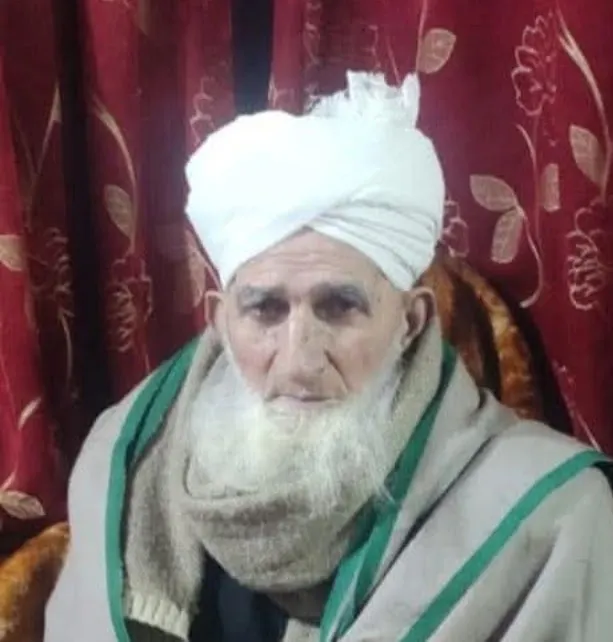
On the morning of 30th December, I received a WhatsApp message stating that Mirwaiz Molana Muhammad Sultan Shah had responded to the divine call and departed for his heavenly abode. A train of memories began to pass through my mind. My eyes welled up, and my lips instinctively began murmuring prayers for him.
I never had a direct conversation with him, nor did I have any separate or special occasion to be in his company. However, I had long been interested in him. In fact, he was among the few personalities of our hometown for whom our family had unwavering, exceptional, and profound regard. Therefore, my attraction to him was only natural.
During our school days, I would often see my paternal and maternal grandfathers rushing to Khanqah-e-Faiz Panah (Seer Hamdan) for Friday prayers, which is situated right in front of our school, Hanfia Islamic Education Institute. At that time, my friends and I were not particular about mosques; we would perform Friday prayers wherever we felt convenient. Once, my paternal grandfather asked me, “Where do you perform Friday prayers?” I replied, “Anywhere my friends decide.” In response, he said, “It is better to offer them at the Khanqah.”
I attended the gathering the following Friday. What I saw was a man with a white beard, his distinctive white turban, and a long coat. He appeared physically fragile, yet his voice was remarkably strong. Most striking was his resplendent face, which compelled listeners to gaze at him attentively.
He delivered the sermon. To be honest, it was difficult for me to comprehend; at that time, it felt rather arid. However, when he rose to lead the prayers and began reciting the Qur’an, I experienced something entirely different. His style of recitation was unique—unlike anything I had heard before. It was deeply engrossing and captivating. My eyes moistened, despite not understanding the meanings of the verses. After the supplication, we dispersed. That was my first encounter, and it was the moment when my heart began to take a shine to him.
I continued to pray behind him regularly, and gradually I began to understand what he preached. I realized the strength of his command over Qirā’at (Qur’anic recitation) and gained insight into what Fiqh (Islamic jurisprudence) truly stands for.
I consider myself fortunate to have been born into a family where Islamic discussions were a norm, where the biographies of Awliya-ul-Allah were taught, and where great religious personalities were admired and praised. This environment helped me learn much more than just who Muhammad Sultan Shah Sahib was. He was a scholar of immense depth, who pioneered religious teaching in Anantnag. Yet his humility, piety, and ethics concealed his scholarship to such an extent that it rarely became apparent—except perhaps through his dignified attire.
Mirwaiz Muhammad Sultan Shah Sahib was a blessed member of the educated and respectable Shah dynasty of Seer Hamdan. He was a Molvi Fazil and had received proper guidance from luminaries such as Allama Syed Muhammad Qasim Shah Bukhari (R.A.). Historical records of Anjuman Tableeg-ul-Islam include his name as a member, further substantiated by the continued affiliation and devotion of his sons to the organization even today.
He chose the noble profession of teaching and served for a long time in one of the Islamic seminaries of district Anantnag. He is credited with having taught hundreds of students, including prominent figures such as Dr. Qazi Nisar (R.A.). In his hometown, he faithfully discharged the duty of Imamate for decades at Khanqah-e-Faiz Panah, one of the resting places of Hazrat Syed Ali Hamdani (R.A.) during his visit to Kashmir.
As mentioned earlier, he was the epitome of humility; therefore, his scholarship remained partly hidden from many. Yet whenever he chose to speak, streams of knowledge would flow, quenching the thirst of inquisitive minds and hearts.
Molana Mushtaq Ahmad Khan, a reputed scholar, shared a deep association with him and always showed profound reverence towards him. I vividly remember that whenever Molana Mushtaq found him present in a local gathering, he would sometimes vacate the microphone and at other times even relinquish the prayer mat in his honor. On one occasion, Molana Mushtaq convened a special religious gathering at his home, where the chief guest was none other than Mirwaiz Molana Muhammad Sultan Shah Sahib. This reflected Molana Mushtaq’s deep admiration for him.
That day, I closely observed their conversation. Aware of Shah Sahib’s academic calibre, Molana Mushtaq posed several questions in Arabic, and Shah Sahib responded fluently, accompanied by his characteristic gentle grin. These two erudite personalities left everyone else astounded. For me, it was a defining moment in understanding the intellectual depth of Mirwaiz Sahib.
Mirwaiz Sahib exemplified piety, fear of Allah, sincerity, humanity, humility, and steadfast adherence to Sharia. I believe no one could ever accuse him of breaching even a Sunnah, let alone an obligatory command. The town of Seer Hamdan witnessed numerous religious and social disturbances, yet he always remained aloof—fully engaged in his teaching and mission. This approach was not born of weakness, but of wisdom. He preferred reconciliation over conflict, peace over confrontation, and reason over senselessness.
He has left this world, but his legacy will, God willing, continue through his humble, dignified, and educated progeny; through his students and listeners; and through those who silently followed him—people expected to guide the masses back towards the religious path amid the prevailing confusion of our times.
May Allah bless his soul and grant him the highest place in Jannah. Ameen.
The writer is a Columnist and can be reached at mohdzeeshan605@gmail.com


