
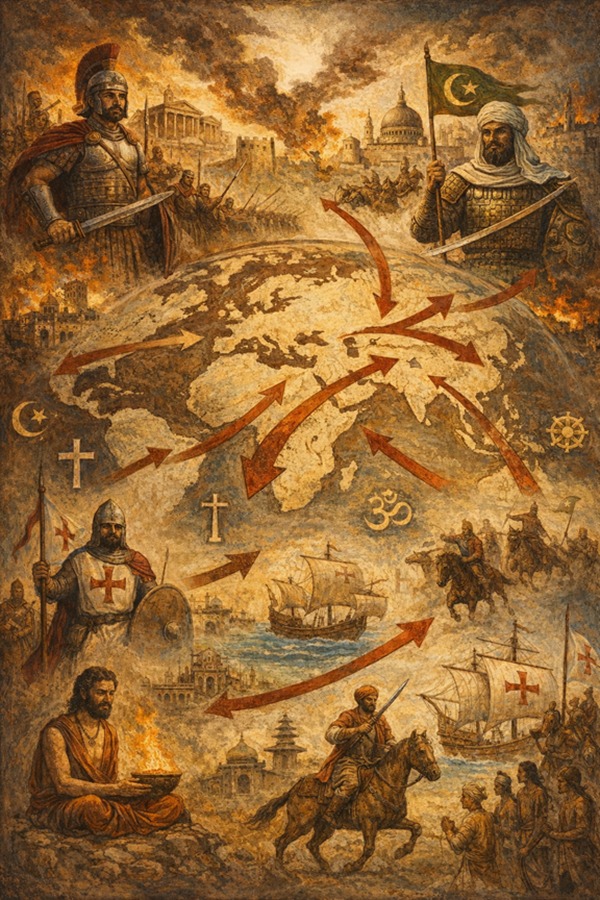
Despite the long evolution of communication technologies, the most decisive forces shaping cultures for thousands of years were not peaceful exchanges but the movement of people, whether by migration, trade, or conquest.
Migration and Trade:
Early human migrations out of Africa seeded the world’s initial civilisations. Later movements, such as the Indo-European and Bantu expansions, carried languages and customs across continents.
Trade routes like the Silk Road and the Indian Ocean networks connected empires and facilitated the spread of Buddhism, Islam, and a wealth of scientific and technological innovations. Merchants, monks, and scholars carried ideas as readily as they carried spices, silk, and gold.
Invasions and Conquests:
Empires, however, played the most forceful role in shaping cultures. They imposed languages, religions, and political systems across large territories.
- The Indo-Aryan arrival in India (1800–1500 BCE) laid the foundations of Vedic culture.
- Persian and Greek invasions created cultural fusions, including the famed Gandhara art.
- The Roman Empire spread Christianity across Europe, North Africa, and the Near East.
- Islamic conquests after 632 CE expanded the religion across the Middle East, North Africa, Spain, and parts of India, although in some regions, such as Kerala, Islam spread peacefully through trade.
- The Mongol Empire, brutal in war, created unmatched cultural and technological exchanges across Eurasia.
- The Crusades reshaped relations between Christian Europe and the Islamic world for centuries.
- European colonialism from the 15th century onward imposed Western languages, Christianity, and new administrative structures on Asia, Africa, the Americas, and Australia.
- Modern mass migrations, including the World Wars and the Partition of India, transformed cultural and religious landscapes.
For millennia, to influence another civilisation required armies, ships, caravans, and generations of time.
A New World Without Armies:
Today, the dynamics have dramatically shifted. Cultural influence no longer requires armies or centuries-long migrations. The internet and mass media can project ideas across the planet in seconds.
What once demanded force now requires only: an online video, a viral post, a compelling narrative, or a persuasive idea shared on social platforms.
Time and space have collapsed. Cultures interact instantly rather than evolving over centuries. Influence has moved from the battlefield to the digital screen.
Conclusion: From Invasions to Information:
As humanity enters an age where communication outruns conquest, we are witnessing a civilisational shift unprecedented in history. For thousands of years, cultures spread largely through invasions, migrations, and coercion. Armies carried not just weapons, but languages, laws, and religions. Borders shifted, identities reshaped, and societies reorganised under new cultural orders.
As history shows, cultures once spread primarily through invasions. Today, a message rooted in humanity does not need war, occupation, or coercion to reach the world. It can travel through communication channels and inspire the emergence of a culture of humanity. But for such cultures to be embraced, their values must be demonstrated in behaviour and action, visible, consistent, and compelling enough for others to believe and adopt.
The cultures that have historically spread through invasions or through societies shaped by violence will see a sharp decline in their influence over future generations. Violence repels rather than attracts; younger generations, empowered by global awareness, will judge cultures not by their scriptures or ideals, but by the behaviours and practices of their adherents. Even cultures with profound messages and noble values will struggle to gain acceptance if their expression is tainted by aggression or exclusion. The future belongs to non-violent cultures and value systems that nurture peace, cooperation, and integrated, harmonious societies.
Humanity has never been so interconnected, so aware, and so capable of learning from one another without conflict.
If past civilisations were shaped by the force of invasions, the civilisation of the future will be shaped by the force of ideas, by empathy shared through stories, by ideals communicated through global media, and by wisdom exchanged across digital networks.
The next chapter of human civilisation will not be written by conquerors, but by communicators.
Aijaz Qaisar Azad
The author has over 25 years of experience in leadership roles with major global Semiconductor companies working on AI. Visit LinkedIn to know more about the author: https://www.linkedin.com/in/aijazqaisar/