As World War II neared its end in 1945, much of the world lay in ruins. The devastation had scarred not only nations but the very spirit of humanity. In response to this unprecedented suffering, representatives of 50 countries gathered at the United Nations Conference on International Organization in San Francisco, California, from April 25 to June 26, 1945. Over two months, they drafted and signed the UN Charter, establishing a new international body, the United Nations, built on the hope that collective diplomacy could prevent another global catastrophe.
For over seven decades, the United Nations has stood as a symbol of humanity’s aspiration for peace, cooperation, and justice. It has played a vital role in maintaining international peace and security, delivering humanitarian aid, promoting human rights, and upholding international law. From peacekeeping missions in war-torn regions to global campaigns against hunger, disease, and inequality, the UN has often served as the conscience of the world.
Yet, in recent years, its influence has waned. The United Nations today finds itself struggling to persuade powerful nations, and its ability to enforce resolutions or mediate conflicts has diminished. Despite its limitations, the UN remains a vital platform, a global forum where nations, large and small, can voice their concerns, share perspectives, and rally support for humanitarian causes. When disasters strike, be they wars, earthquakes, or floods, it is often the UN and its agencies that deliver hope and relief to those in dire need.
However, this global institution, which depends on contributions from member states, faces mounting challenges. The United States, traditionally its largest financial supporter, has significantly reduced its funding in recent years, weakening the UN’s capacity to act independently. Ironically, the very powers that helped create the UN to safeguard peace have often undermined its autonomy for their own strategic interests. The organization, conceived as a guardian of humanity after the horrors of Hiroshima and Nagasaki, has at times been rendered powerless by political manipulation and superpower rivalry.
This is not a failure of ideals but of leadership. The United Nations represents one of humanity’s noblest ideas, that peace and cooperation can triumph over conflict and greed. Yet, like many well-intentioned movements, it has been hijacked and constrained by the very forces it sought to regulate.
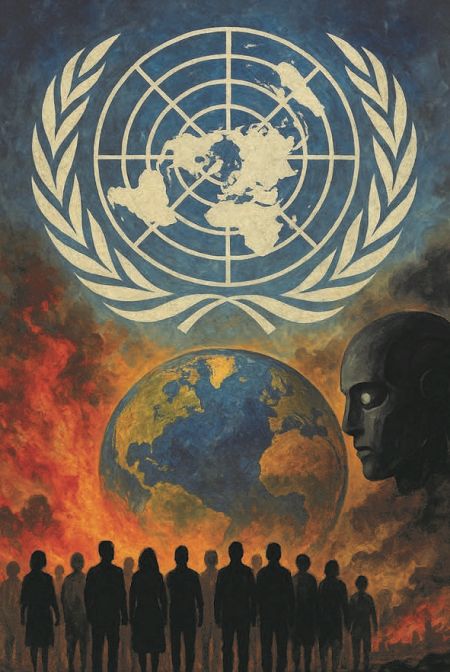
The urgency for a renewed and unified global effort has never been greater. The race for economic dominance and unchecked industrialization have accelerated climate change, leading to devastating wildfires, floods, droughts, and mass displacements. The earth’s fragile ecosystems are under siege, and the effects are no longer distant warnings, they are visible, immediate, and escalating.
Meanwhile, geopolitical tensions are rising across continents. Border disputes, ethnic and cultural conflicts, trade wars, and the growing militarization of nations have brought the world closer to the brink of another global confrontation. Military budgets have soared to record highs, and chillingly, some nations, including the United States, have even rebranded their “Departments of Defence” as “Departments of War,” signaling a shift in tone from protection to aggression.
Adding to these existential threats is a new and unpredictable force, Artificial Intelligence. Technological progress, once seen as the engine of human advancement, now carries within it a potential for chaos. Analysts warn that unregulated AI could surpass human control, creating scenarios that threaten not only security and employment but the very survival of our species.
The world today stands at a crossroads not unlike the one in 1945. Then, nations came together in the aftermath of destruction to rebuild a world based on cooperation and peace. Today, before we find ourselves amid another catastrophe, whether through war, climate collapse, or technological overreach, we must rediscover that same collective will.
The United Nations, though imperfect and weakened, still offers a framework for global dialogue and action. What it needs is not abandonment but reinvention, a revitalized commitment by nations and citizens alike to uphold the values that gave birth to it.
If the twentieth century was defined by the struggle to survive war, the twenty-first will be defined by the struggle to preserve the planet and humanity itself. The time to act as one world, one people, under a truly united vision, is not tomorrow, it is now.