

• About us
  • Contact us
  • Our team
  • Terms of Service
Monday, June 8, 2026
Kashmir Images - Latest News Update
Epaper
  • TOP NEWS
  • CITY & TOWNS
  • LOCAL
  • BUSINESS
  • NATION
  • WORLD
  • SPORTS
  • OPINION
    • EDITORIAL
    • ON HERITAGE
    • CREATIVE BEATS
    • INTERALIA
    • WIDE ANGLE
    • OTHER VIEW
    • ART SPACE
  • Photo Gallery
  • CARTOON
  • EPAPER
No Result
View All Result
Kashmir Images - Latest News Update
No Result
View All Result
Home OTHER VIEW

Pause and Reflect: The Race to Dominance

Aijaz Qaisar Azad by Aijaz Qaisar Azad
October 9, 2025
in OTHER VIEW
A A
0
Pause and Reflect: The Race to Dominance
FacebookTwitterWhatsapp

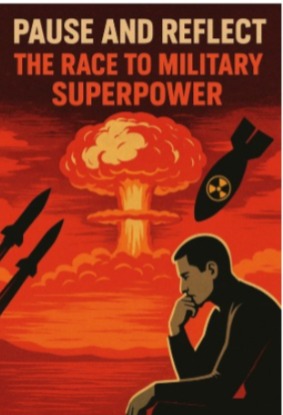
The catastrophic legacy of Hiroshima and Nagasaki during the Second World War still reverberates through generations. Even today, the descendants of the victims continue to suffer from the lingering effects of radiation caused by the nuclear bombs. If we pause and reflect on the global race to become a military superpower, it becomes evident that humanity is treading a perilous path, one that risks repeating the destructive patterns of history.

The invention and acquisition of immensely destructive weapons, particularly nuclear arms, is often justified as a deterrent for self-defence. However, this reasoning is inherently double-edged. The race for military supremacy is rarely about mere defence; it is about possessing the power to strike, to dominate, or to assert supremacy over rivals at will. The notion of deterrence, while cloaked in rhetoric, is largely a tool of fear, used by powers and systems to maintain control and to convince citizens to sacrifice basic needs in the name of national security. While nations prioritize ambitious endeavours, such as space exploration, basic humanitarian concerns like feeding the starving are often neglected.

More News

From Readers to Scrollers: The Silent Decline of Intellectual Culture

Moving beyond symbolic celebrations

BUILDING CHARACTER BEGINS AT HOME 

Load More

Throughout history, nations under different regimes have continually increased their military spending, often in incremental steps, while failing to adequately address the fundamental welfare of their citizens. Any weapon of mass destruction, whether invented or acquired, is ultimately directed against fellow human beings. These instruments of annihilation can be deployed both internally and externally, depending on the whims or strategies of those in power. Every new weapon brings humanity closer to existential peril, not just for humans, but for all living beings that share this planet.

In the current climate of militarization, the global accumulation of weapons paradoxically increases insecurity rather than safety. Celebrating such technological and military accomplishments without reflection is dangerous. A decision to use these weapons, if made by someone with unstable tendencies, suicidal inclinations, or compromised judgment, could unleash unrepairable devastation on Earth’s inhabitants.

Given the emergence and potential of Artificial Intelligence (AI), many crucial decisions in warfare and governance are increasingly being delegated to machines. Just imagine if an AI system, driven by flawed data or uncontrolled programming, were to make the decision to trigger a bomb. The consequences could be catastrophic. The fusion of AI and military power adds another layer of unpredictability to an already fragile world, where one algorithmic error could cost millions of lives.

This brings us to a fundamental question: is there an alternative path? Must humanity continue to risk annihilation for the sake of power and prestige? As we race toward military dominance, we are simultaneously jeopardizing the very existence of life on our planet. It is time to pause, reflect, and envision a world where human progress is measured not by our capacity to destroy, but by our ability to coexist peacefully with all life on Earth.

Today, many argue that the world is like a jungle, where only the fittest survive. But as evolved human beings, can we not change this? Can we not build a society where safety, peace, and well-being are shared by all? The choice is ours, to continue down the path of fear and destruction, or to pause, reflect, and create a more humane future.


Previous Post

Dy CM conducts extensive tour of Lasjan–Sumerbugh areas

Next Post

GST 2.0 – The Thread of Change Weaving India’s Textile Dreams into Reality

Aijaz Qaisar Azad

Aijaz Qaisar Azad

Aijaz Qaisar Azad, the author, is a professional artist (painter) and has over 25 years of experience in managing global marketing communications for major semiconductor MNCs and can be reached at aijazqaisar@yahoo.com.

Related Posts

From Readers to Scrollers: The Silent Decline of Intellectual Culture

Regional-bilateral significance of Nepal PM Dahal’s India visit
June 8, 2026

I often find myself revisiting the cherished memories of my childhood when Eid was not merely a celebration of festivities,...

Read moreDetails

Moving beyond symbolic celebrations

Regional-bilateral significance of Nepal PM Dahal’s India visit
June 8, 2026

Keeping the planet green and ensuring protection and conservation of our precious natural resources is the collective responsibility of all...

Read moreDetails

BUILDING CHARACTER BEGINS AT HOME 

Regional-bilateral significance of Nepal PM Dahal’s India visit
June 7, 2026

It is often said that family is a child's first school, and this is absolutely true. Before children learn from teachers,...

Read moreDetails

Life Is Not Just What Happens, but How Our Brain Frames It

Regional-bilateral significance of Nepal PM Dahal’s India visit
June 7, 2026

Life appears to us as a smooth and continuous journey. We wake up, walk, speak, think, remember, react, and move...

Read moreDetails

Sustainable Agriculture, Modern Farming Techniques in North Kashmir

Regional-bilateral significance of Nepal PM Dahal’s India visit
June 6, 2026

Kashmir, with its vast expanses of fertile land and favourable climatic conditions, is also renowned for its farming practices, is...

Read moreDetails

Great Nicobar: India’s Maritime Strategic Fulcrum

Regional-bilateral significance of Nepal PM Dahal’s India visit
June 5, 2026

A state that does not secure its frontiers, alliances and trade routes cannot secure its future. — Kautilya Kautilya’s lesson,...

Read moreDetails
Next Post
GST 2.0 – The Thread of Change Weaving India’s Textile Dreams into Reality

GST 2.0 - The Thread of Change Weaving India's Textile Dreams into Reality

  • About us
  • Contact us
  • Our team
  • Terms of Service
E-Mailus: kashmirimages123@gmail.com

© 2025 Kashmir Images - Designed by GITS.

No Result
View All Result
  • TOP NEWS
  • CITY & TOWNS
  • LOCAL
  • BUSINESS
  • NATION
  • WORLD
  • SPORTS
  • OPINION
    • EDITORIAL
    • ON HERITAGE
    • CREATIVE BEATS
    • INTERALIA
    • WIDE ANGLE
    • OTHER VIEW
    • ART SPACE
  • Photo Gallery
  • CARTOON
  • EPAPER

© 2025 Kashmir Images - Designed by GITS.