

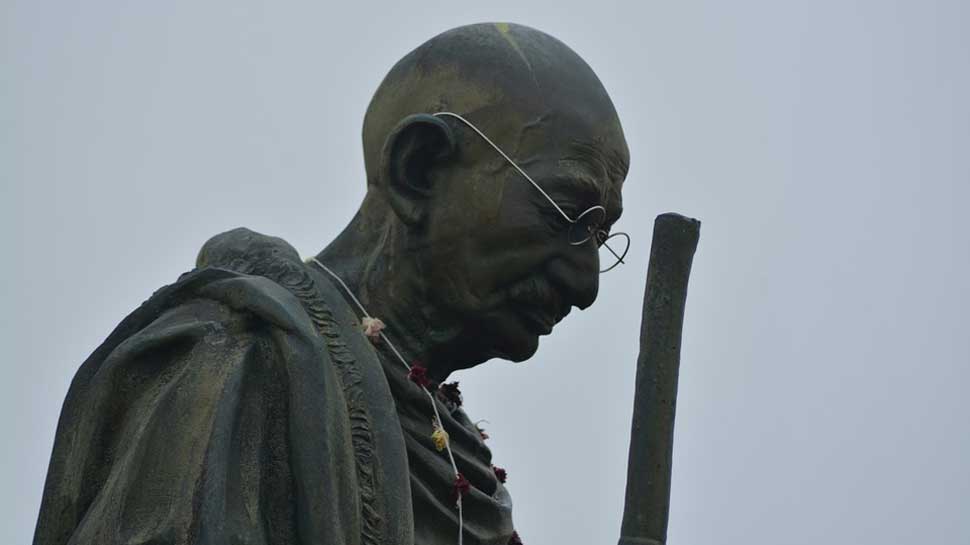
Mohandas Karamchand Gandhi, revered as the Mahatma, was not merely the architect of India’s political freedom; he was the sculptor of its national conscience. His life, a breathtaking testament to commitment and sacrifice, stands as a singular act of lifelong devotion to the idea of India—a devotion rooted not in power or ambition, but in an uncompromising pursuit of Truth (Satya) and Non-violence (Ahimsa). The magnitude of his sacrifice is best understood not in the triumphant moment of Independence, but in the radical transformation he wrought in the political, spiritual, and moral fabric of an entire nation.
The Vow of Self-Purification: Dedication to the Lowliest
Gandhi’s dedication to India was unique because it began with an almost ascetic devotion to self-purification. He believed that a leader could not command; he could only serve and lead by example. His transition from a London-trained barrister to a loincloth-clad fakir was a deliberate, powerful political and spiritual statement. By adopting the simple, handspun Khadi, he symbolically rejected the exploitative machinery of the British Empire and embraced the most marginalized of India’s population—the village weaver and farmer. This act was the ultimate expression of Swadeshi (self-reliance), turning the spinning wheel (Charkha) into a potent symbol of economic freedom and national unity.
His commitment to India’s people was inextricably linked to his faith in the ‘last man’ (Antyodaya). The plight of the untouchables, whom he called Harijans (Children of God), became a central, non-negotiable mission. He challenged the deeply entrenched orthodoxy of Hinduism, fasting and campaigning to ensure temple entry and equal dignity for the marginalized. This relentless battle against the internal rot of casteism demonstrated a profound devotion to building an India that was morally worthy of political freedom. For him, freedom from the British was meaningless without freedom from social injustice.
The Weapon of Soul-Force: Satyagraha and the Mass Awakening
Gandhi’s greatest contribution was providing India with a moral grammar for resistance through Satyagraha—literally, “Truth-Force” or “Soul-Force.” This was not passive resistance; it was active, fearless, and disciplined non-violent action designed to convert the wrongdoer, not to coerce them. It demanded extraordinary courage, self-discipline, and a willingness to absorb violence without retaliation.
Through a series of mass movements—the Non-Cooperation Movement, the dramatic Salt March (Dandi March) that challenged the economic foundations of the Raj, and the final Quit India Movement—Gandhi transformed the nationalist struggle from an elite debate into a mass phenomenon. He travelled the length and breadth of the subcontinent, speaking to millions in their own language, awakening the peasantry, bringing women into the political sphere, and instilling a sense of collective purpose.
His devotion was not only to the cause of freedom but to the purity of the means. He famously called off the Non-Cooperation Movement after the violence at Chauri Chaura, proving that his allegiance to Ahimsa transcended even the immediate goal of independence. This insistence on purity of means was the ultimate act of devotion, ensuring that the foundation of the future Indian Republic would be built on ethical, not violent, ground.
The Loneliness of the Final Sacrifice
Gandhi’s devotion reached its tragic, magnificent zenith in the final years of his life. After leading India to the brink of freedom, he stood alienated and despairing on the eve of Independence, heartbroken by the communal violence that accompanied the Partition. His final battles were not against the departing British, but against the hatred and fanaticism consuming his own people.
While others celebrated the midnight hour of August 15, 1947, Gandhi was in Noakhali and Calcutta, fasting and walking barefoot through riot-torn villages, placing his own frail body as a human shield between warring communities. He sought not to govern the new nation, but to heal its broken heart. This act of ultimate sacrifice—choosing to live among the suffering and risk his life for the cause of communal unity—was a devotion that transcended political achievement.
His assassination in January 1948 by a fellow countryman, a direct result of his unwavering stand for an inclusive, secular India, sealed his martyrdom. As Jawaharlal Nehru lamented, “The light has gone out of our lives.” Yet, the very nature of this sacrifice ensured the light would never truly die, for it etched the ideals of tolerance and pluralism deep into the nation’s founding charter.
The Living Legacy: A Timeless Devotion
The legacy of Gandhi’s devotion is not confined to history books; it is a living challenge to every generation of Indians. His principles continue to serve as the yardstick against which national progress is measured:
Environmental Devotion:His critique of rampant industrialism and his insistence on living simply—“Earth provides enough to satisfy every man’s needs, but not every man’s greed”—is the ultimate charter for global sustainability.
Political Morality:His fusion of politics and ethics ensures that India’s democracy remains one where citizens can claim the moral right to dissent and protest non-violently.
True Swaraj: His vision remains a call for perpetual vigilance, reminding India that true self-rule is an ongoing process of self-improvement and ensuring justice for the last, the weakest, and the poorest.
Mahatma Gandhi’s life was an offering. He stripped himself of material possessions, relinquished power, and ultimately gave his life for the nation. His devotion was not merely to a geographical entity called India, but to the spiritual ideal of what India could be: a beacon of truth and peace for the world. To follow his path is difficult, as he knew, but to honour him is to recommit to the enduring values that forged a nation out of disparate peoples. His soul-force endures, illuminating the path whenever the nation stumbles.




