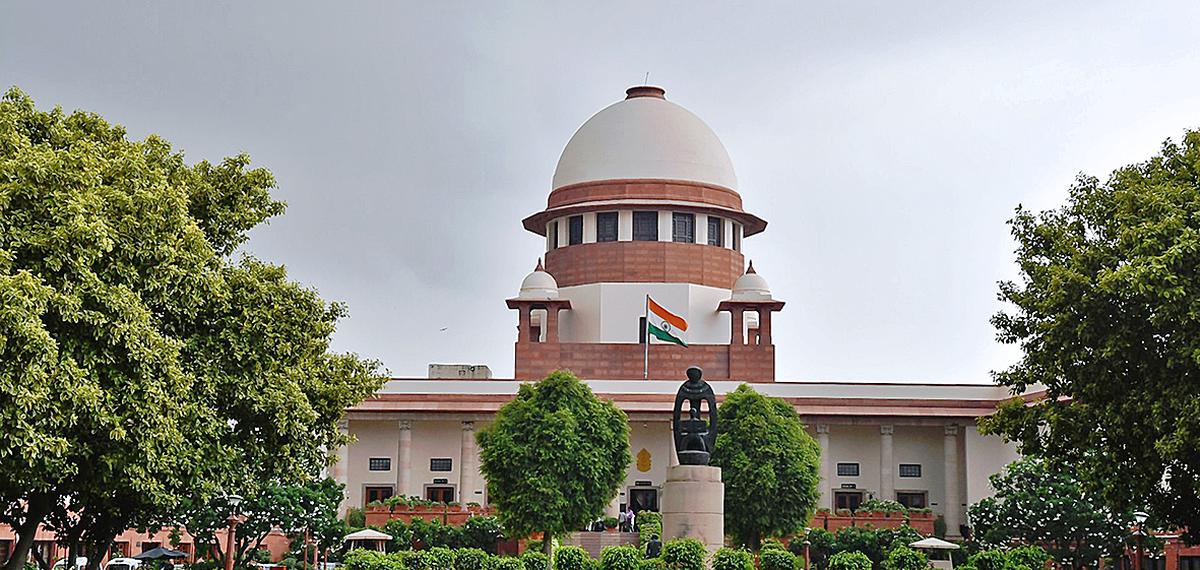
New Delhi: The Supreme Court on Thursday said the term ‘as soon as possible’ used in Article 200 of the Constitution in deciding the fate of bills will serve no practical purpose if Governors are allowed to withhold consent for “eternity”.
A five-judge Constitution bench made the observation even as the Centre submitted that state governments cannot invoke writ jurisdiction in moving the apex court against the actions of the President and the Governor in dealing with the bills passed by state Assemblies for violation of fundamental rights.
The top court also said the framers of the Constitution deliberately replaced an earlier six-week limit with the phrase ‘as soon as possible’ in Article 200 and asked the Centre whether this phrase can be ignored in deciding the fate of bills.
Article 200 provides for the powers of the Governor regarding bills passed by the State Legislature, allowing them to either assent to the bill, withhold assent, return the bill for reconsideration or reserve the bill for the consideration of the President.
A proviso of Article 200 says the Governor may, as soon as possible after the presentation to him of the Bill for assent, return the Bill, if it is not a Money Bill, to the house for reconsideration and shall not withhold the consent after the assembly reconsiders and sends it back to him.
“The question is when the Governor sits over a Bill passed by the legislature and keeps sitting over it. The words used were ‘as soon as possible’ .. earlier it was six weeks and later made as soon as possible and one of the members in the drafting committee stated ‘as soon as possible’ would mean immediately.. if this was the view of the constitution makers then can we ignore that,” Chief Justice of India B R Gavai asked.
Senior advocate Abhishek Singhvi, appearing for Tamil Nadu, said the argument that Governors can withhold assent even to money bills passed by the assembly would effectively make them a “super Chief Minister” of a state.
Withholding of a Bill must lead to returning it to the Assembly and if the Governors are allowed to withhold his assent permanently then it will make mockery of the whole Article 200 and it will be swallowed by this proviso, he said.
“Otherwise, the word as soon as possible will be rendered otiose(serving no practical purpose) if you withhold (assent) for eternity,” the CJI said.
Responding to submissions that Governors can withhold assent to even money bills, Singhvi told a bench, also comprising justices Surya Kant, Vikram Nath, PS Narasimha, and AS Chandurkar, that “It is in sync with the submission that the governor is not in a dominating position rather he is a super Chief Minister”.
Referring to Constituent assembly debates, Singhvi said Governors and the President are “titular heads” who have no discretion on executive decision-making, save and except a very few ones.
There is strong material to show that in each of three options in Article 200, the Governor is bound by the council of ministers in returning or referring it to the President, he said.
Earlier in the day, Solicitor General Tushar Mehta, appearing for the Centre, told the bench that he has got the instructions to submit that the President is of the opinion that the top court render its views on the questions whether states could invoke Article 32 to move the apex court seeking a mandamus to the Governor or the President for clearing a Bill.
Mehta had said he would seek instructions and inform the bench and pointed out that in a federal structure the dispute between the States and the Centre should be resolved politically or a suit under Article 131 of the constitution can be filed.
The bench also heard the solicitor general on the presidential reference concerning the powers of Governors and the President in dealing with bills passed by state legislatures, focusing sharply on whether the court can impose a timeline on Constitutional authorities for assent to legislation.
The court is deliberating issues including the key one which is whether courts can direct Governors or the President to act within a specified time-frame on bills placed before them?
Mehta said the Constitution does not envisage judicial directions binding the President or Governors to act within a time-frame on legislative matters.
He said the state government cannot invoke writ jurisdiction under Article 32 in moving the top court against the actions of the President and the Governor in dealing with the bills passed by assemblies for violation of fundamental rights.
Article 32 deals with “Right to Constitutional Remedies” and allows any citizen to directly approach the top court for enforcement of their fundamental rights when violated.
Mehta said the President would also like to have an opinion on the scope of Article 361 of the Constitution which says the President, or the Governor will not be answerable to any court for the exercise and performance of the powers and duties of his office or for any act done.
The solicitor general referred to the April 8 Tamil Nadu verdict in which states were given liberty to approach the apex court directly in case the time-line is not adhered to by the Governor in clearing the bills passed by the Assembly.
The CJI said it will not make any comments with regard to the two-judge verdict of April 8 but observed that the Governor would not be justified in sitting over bills for six months.
Mehta submitted that one constitutional organ not discharging his duties, does not entitle the court to direct another constitutional organ.
The CJI said, “Yes. We know what your argument is? If this court does not decide the matter for 10 years, would it be justified for the President to issue an order.”
The CJI pointed out that the framers of the Constitution had deliberately replaced an earlier six-week limit with the phrase “as soon as possible” in Articles 111 and 200.
“The Governor is the vital link between the state government and the central government. That is what the framers had envisioned,” the bench said.
Singhvi submitted that the Governor and President are largely titular heads with no independent discretion in legislative matters, except in narrowly defined situations.
Citing Article 200, the senior lawyer said, “In each of these three, the Governor is bound by the advice of the Council of Ministers. The discretion is minimal, and strong material shows that these are not unfettered powers.”
“There is no fourth option to sit over a bill or to allow it to fall through. Such a reading would negate Article 200 entirely,” Singhvi said.
Referring to the Constituent Assembly debates, Singhvi emphasised that the framers consciously curtailed the wide discretion earlier available under the 1935 Act.
“The opening words granting discretion were deleted. The intention was clear that the Governor is ornamental, not a parallel executive,” he said, quoting Ambedkar.
“The concept of broad discretion will only create chaos,” Singhvi warned, adding that constitutional design did not envisage the Governor as an independent adjudicator of bills.