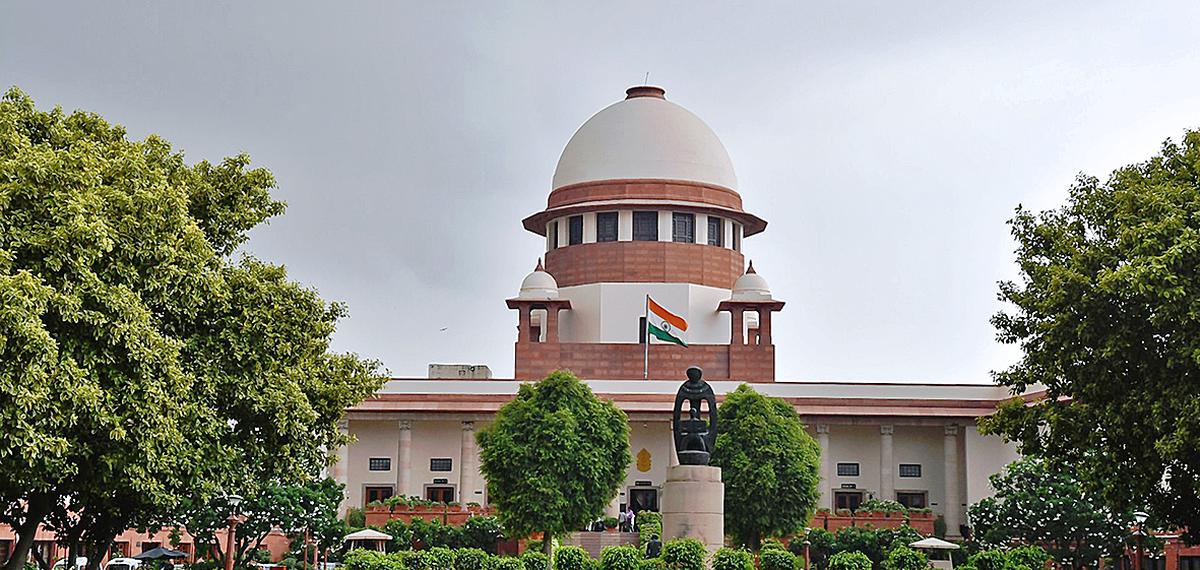
New Delhi: For the first time, the Supreme Court has prescribed that the president should decide on the bills reserved for her consideration by the governor within a period of three months from the date on which such reference is received.
Four days after the top court cleared 10 bills, which were stalled and reserved by Tamil Nadu Governor R N Ravi for the president’s consideration, and set a timeline for all governors to act on the bills passed by the state assemblies, the judgement running into 415 pages was uploaded on the apex court’s website at 10.54 pm on Friday.
“We deem it appropriate to adopt the timeline prescribed by the Ministry of Home Affairs… and prescribe that the President is required to take a decision on the bills reserved for his consideration by the Governor within a period of three months from the date on which such reference is received.
“In case of any delay beyond this period, appropriate reasons would have to be recorded and conveyed to the concerned State. The States are also required to be collaborative and extend co-operation by furnishing answers to the queries which may be raised and consider the suggestions made by the Central government expeditiously,” the top court said.
A bench of Justices JB Pardiwala and R Mahadevan on April 8 set aside the reservation of the 10 bills for the president’s consideration in the second round holding it as illegal, erroneous in law.
Without mincing words, the court said “where the Governor reserves a Bill for the consideration of the President and the President in turn withholds assent thereto then, it shall be open to the State Government to assail such an action before this Court”.
Article 200 of the Constitution empowers the governor to give assent to the bills presented to him, withhold the assent or to reserve it for the consideration of the president.
“The Bills, having been pending with the Governor for an unduly long period of time, and the Governor having acted with clear lack of bona fides in reserving the Bills for the consideration of the President, immediately after the pronouncement of the decision of this Court in State of Punjab (supra), are deemed to have been assented to by the Governor on the date when they were presented to him after being reconsidered.
“There is no expressly specified time-limit for the discharge of the functions by the Governor under Article 200 of the Constitution. Despite there being no prescribed time-limit, Article 200 cannot be read in a manner which allows the Governor to not take action upon bills which are presented to him for assent and thereby delay and essentially roadblock the law-making machinery in the State,” the bench said in its judgement.
Observing that the governor is required to abide by the aid and advice tendered by the Council of Ministers, the top court said it is not open for the governor to reserve a bill for the consideration of the President once it is presented to him in the second round, after having been returned to the House previously.
“There is no expressly specified time-limit for the discharge of the functions by the Governor under Article 200 of the Constitution. Despite there being no prescribed time-limit, Article 200 cannot be read in a manner which allows the Governor to not take action upon bills which are presented to him for assent and thereby delay and essentially roadblock the law-making machinery in the State,” the bench said while directing the registry to send a copy each of this judgment to all the high courts and the principal secretaries to the governors of all states.
The apex court set timelines and said failure to comply with it would make the inaction of the governors subject to judicial review by the courts.
“In case of either withholding of assent or reservation of the bill for the consideration of the President, upon the aid and advice of the State Council of Ministers, the Governor is expected to take such an action forthwith, subject to a maximum period of one-month,” the court said.
“In case of withholding of assent contrary to the advice of the State Council of Ministers, the Governor must return the bill together with a message within a maximum period of three months.
“In case of reservation of bills for the consideration of the President contrary to the advice of the State Council of Ministers, the Governor shall make such reservation within a maximum period of three months,” the bench said.
In case of presentation of a bill after reconsideration, the governor must grant assent forthwith, subject to a maximum period of one-month, the court said.
The bench said that the governor couldn’t sit over bills and adopt the concept of “absolute veto” or “pocket veto”.
“There is no ‘pocket veto’ or ‘absolute veto’ available to the President in discharge of his functions under Article 201. The use of the expression “shall declare” makes it mandatory for the President to make a choice between the two options available under the substantive part of Article 201, that is, to either grant assent or to withhold assent to a bill.
“The constitutional scheme does not, in any manner, provide that a constitutional authority can exercise its powers under the Constitution arbitrarily,” the bench said.
The top court exercised its plenary power under Article 142 of the Constitution to make the bill re-presented to the Tamil Nadu governor, as deemed to have been passed.
The apex court had previously framed questions to answer in a dispute between Tamil Nadu government and the governor over the delay in assent to bills passed by the legislative assembly.
The delay in giving assent by the governor prompted the state government to move the top court in 2023, claiming 12 bills, including one from 2020, were pending with him.
On November 13, 2023, the governor declared he was withholding assent to 10 bills following which the legislative assembly convened a special session and re-enacted the very same bills on November 18, 2023.
Later, some of the bills were reserved for the president’s consideration.