
In today’s fast-paced digital world, the innocence and joy of childhood is rapidly being overshadowed by the digital gadgets and the virtual world. Gone are the days when children roamed freely in their neighborhoods, playing traditional folk games and engaging in physical activities. This nurtured them well and both their bodies and minds were actively engaged while as the ambience too played its part. In Kashmir, the landscape of childhood play has dramatically changed, and with it, an important piece of our cultural heritage is being lost.
In the past, neighborhoods in Kashmir, like many places around the world, were alive with the sound of children’s laughter. Kids would gather in open spaces, fields, and narrow lanes, playing games that required nothing but their imagination and energy. They would play for hours, uniting children of all ages, creating friendships that often lasted a lifetime. Parents knew each other’s children, and neighbors looked out for one another, forming a close-knit community.
However, this closeness has slowly been eroded. Today’s children spend more time indoors, confined to the glow of screens. Social media, video games, and streaming platforms have replaced the physical spaces where friendships once bloomed. As children withdraw into these virtual worlds, they are losing touch with the very real world just outside their doors. It is not uncommon now to see children living for years in the same locality without knowing the names of their neighbors or ever playing together in the neighborhood.
The loss of proximity to neighbors is also the loss of safety and community. In the past, when children played outdoors, there was a natural sense of watchfulness—parents knew other families in the area and felt reassured that there were always familiar eyes looking out for their children. This sense of shared responsibility created safe spaces for children to explore and play freely. Now, with the decline in outdoor play and neighborly interaction, that feeling of security is fading. Children are growing up in isolated bubbles, unaware of the supportive networks that once existed just beyond their homes.
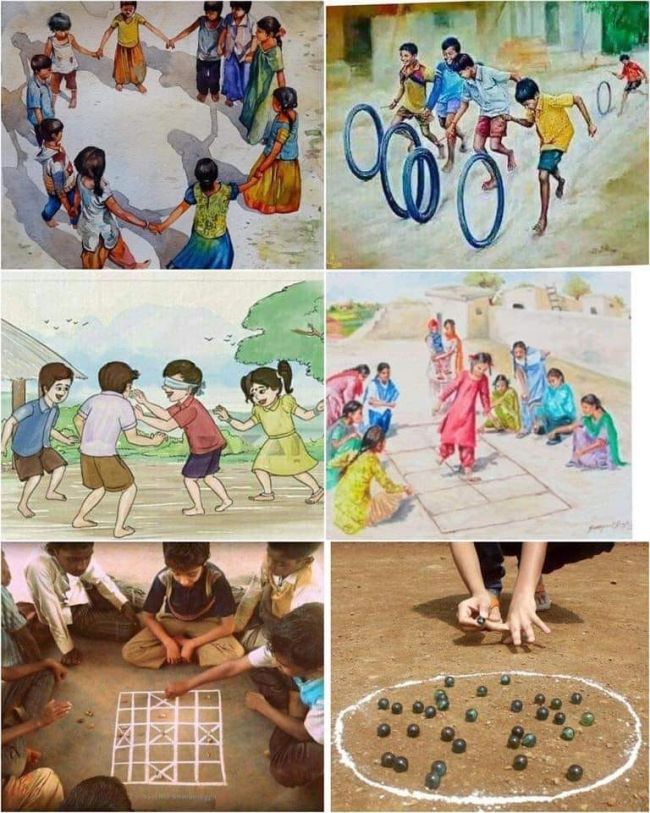
There was a time when children in Kashmir would fill the streets and fields with laughter, chasing after rubber tires, hand-driven carts, and playing games like hopscotch and hide-and-seek. One of the fondest memories for many was making ‘Hagur’, a hand-driven cart crafted from simple materials. Children would gather dry leaves and twigs in these carts, preparing for the winter months, while also collecting apple waste to use as fuel. These activities not only provided entertainment but were a vital part of the children’s upbringing, teaching them about resourcefulness and the rhythm of rural life.
In the past, playing in the lanes, streets, orchards, and paddy fields was a daily routine. Children would collect fallen walnuts, pluck fruits from the trees, and engage in outdoor games for hours on end. Simple pleasures like running after wire-made tires, playing with stone pebbles, and throwing cloth balls or snowballs in winter are now a distant memory. Today’s children are rarely seen engaging in these activities, confined instead to their homes by the allure of screens and electronic devices.
This shift has broader implications for children’s development. Play is not just about entertainment; it is essential for physical health, social skills, and emotional well-being. Through playing with neighbors, children learn how to cooperate, resolve conflicts, and build relationships. These experiences, which help shape their sense of identity and community, are slowly being lost in the digital age.
The increase in screen time is not only affecting children’s physical health but also depriving them of the sense of community that comes from knowing their neighbors and playing outdoors. Physical activity, once an integral part of a child’s day, has drastically decreased. Playgrounds and streets that once buzzed with the sounds of play now stand silent, as children mostly stay indoors glued to mobile phones, tablets, or video games.
This loss of play is more than just a shift in activities; it’s a loss of connection to the environment and to each other. The folk games that once taught teamwork, creativity, and problem-solving are being forgotten. The thrill of outdoor adventure, of exploring the neighborhood and experiencing the changing seasons, is being replaced by virtual worlds.
The decline in traditional play not only impacts physical health but also affects emotional and social development. Through these simple games, children learned cooperation, resilience, and a sense of belonging. They bonded with friends, siblings, and neighbors while discovering their own strengths and abilities.
As we move deeper into the digital age, it is crucial to reflect on the consequences of this shift. Childhood is meant to be a time of exploration and play. While technology has its place, it should not come at the cost of losing the simple joys of being a child. We must encourage our children to step outside, to rediscover the beauty of their surroundings, and to engage in physical activities that build not only strong bodies but strong communities as well.
As neighborhoods grow quieter and children become more disconnected from their surroundings, the question arises: what are we losing in the process? The decline of neighborhood play and connection means that children are missing out on the invaluable experience of belonging to a community. Knowing one’s neighbors used to be a natural part of growing up, where children would gather after school to play until dusk. Now, even in densely populated areas, there’s a growing sense of isolation.
It is time we re-examine our priorities. While technology has undoubtedly brought many conveniences, it should not come at the cost of the human connections that form the foundation of strong communities. Encouraging children to step outside interact with their neighbors, and engage in physical play is crucial—not just for their health, but for rebuilding the social fabric that once united neighborhoods.
Let us encourage our children to rediscover the joy of simple outdoor play, to know the families living next door, and to experience the richness of community life. In doing so, we may not only restore lost traditions but also bring back the sense of belonging and safety that comes from knowing and caring for one’s neighbors.
In Kashmir, the sight of children running through orchards, gathering walnuts, and pushing homemade carts may be fading, but it is not too late to revive these traditions. Let the child play, let childhood be filled with wonder, and let us bring back the lost play of generations past.
The author is an Educator, Innovator and Writer working at Government Boys Middle School Sheeri Payeen Zone Fatehgarh Baramulla.