By: Dr. Jitendra Singh
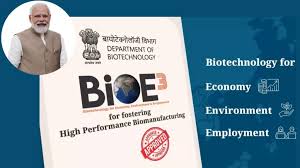
In a landmark initiative with far reaching futuristic implications, the Union Cabinet headed by Prime Minister Narendra Modi has approved the BioE3 (Biotechnology for Economy, Employment and Environment) Policy of the Department of Biotechnology (DBT) to foster high-performance biomanufacturing for a clean, green, prosperous, and self-reliant Bharat. This will ensure for India a pioneering role in the global arena as one of the earliest torch-bearers of world’s future economic growth.
The unsustainable pattern of material consumption, excessive resource utilization and waste generation have led to global cataclysms such as forest fires, melting glaciers, and declining biodiversity. Keeping in view the national priority of steering India on the path of accelerated ‘Green Growth’, the integrated BioE3 (Biotechnology for Economy, Environment and Employment) Policy is a positive and decisive step towards sustainable growth in the challenging backdrop of climate change, depleting non-renewable resources, and unsustainable waste generation. A major aim of this policy is to stimulate the transition of chemical-based industries to more sustainable bio-based industrial models. It will also promote a circular bioeconomy and provide an impetus to achieving net-zero carbon emissions by encouraging the utilization of waste from biomass, landfills, green house gases, etc.by microbial cell factories to produce bio-based products.
In addition, the BioE3 Policy will create novel solutions for fostering the growth of India’s bioeconomy, facilitating scale-up and commercialisation of bio-based products; reducing, reusing, and recycling waste materials; expanding India’s cohort of a highly skilled workforce; driving a surge in job creation; and intensifying entrepreneurial momentum. Salient features of the Policy include: 1) Encouragement and support to indigenous research and development-focused entrepreneurship across thematic sectors such as high-value bio-based chemicals, biopolymers & enzymes; smart proteins & functional foods; precision biotherapeutics; climate resilient agriculture; carbon capture and its utilization; and marine and space research;2) Acceleration of technology development &commercialization by establishing bio manufacturing facilities, bio foundry clusters, and bio-artificial intelligence (Bio-AI) hubs; 3); Prioritizing regenerative models of economic growth and job creation with an emphasis on ethical & biosafety consideration; 4) Harmonizing regulatory reforms with global standards.
India has demonstrated strong economic growth in the past decade and has tremendous potential to be amongst the global leaders of the 4th industrial revolution. Our bioeconomy has grown 13 folds from $10 billion in 2014 to over $130 billion in 2024. It is further expected to reach a market value of $300 billion by 2030. The implementation of BioE3 Policy across diverse sectors is likely to further boost the country’s bioeconomy, while promoting ‘Green Growth’. The foundation for this will be laid by leveraging emerging technologies and innovationsthat result from nurturing the country’s high-performance biomanufacturing initiatives.Biomanufacturing is primed to become an important pillar of the ‘Make in India’ initiative and will provide a transformative approach to meet the demands of 21st century. As a multidisciplinary endeavour, it has the power to unlock the potential of microbes, plants, and animal cells including human cells to develop bio-based products cost-effectively with a minimal carbon footprint.
It is envisioned that biomanufacturing hubs will serve as centralized facilities that catalyze the production, development, and commercialization of bio-based products through advanced manufacturing technologies, and collaborative efforts. This will create a community where resources, expertise, and technology can be shared to drive scalability, sustainability, and innovation of biomanufacturing processes. These biomanufacturing hubs will bridge the gap between ‘lab-to-pilot’ and ‘pre-commercial scale’ manufacturing of bio-based products. Start-ups will play a pivotal role in this process by bringing and developing novel ideas and feedingthem into small and medium-sized enterprises (SMEs) and established manufacturers.
Biofoundry refers to the creation of advanced clusters for making biological engineering processes scalable – from the initial design and testing stages to pilot and pre-commercial production. Large-scale manufacturing of mRNA-based vaccines and proteins for a wide variety of applications aresome appreciable examples for which biofoundries could be valuable. These clusters will specialize in designing, constructing, and testing biological systems and organisms using standardized and automated processes.
Bio-AI hubs will serve as a focal point for encouraging and incentivizing the integration of AI in research and development. These Bio-AI hubs will provide biotechnological expertise, cutting-edge infrastructure, and logistical support for the integration, storage, and analysis of large-scale biological data using AI and machine learning. Making these resources accessible to experts from various disciplines (biology, epidemiology, computer science, engineering, data science, for example.)will facilitate the creation of innovative bio-based end products – be it a new variety of gene therapy, or a new food processing alternative.
Through these coordinated initiatives, the BioE3 policy will bring a surge in employment, particularly in tier-II and tier-III cities, where bio manufacturing hubs are proposed to beset up due to their proximity to biomass sources. By investing in India’s economy, environment, and employment, this comprehensive policy will contribute towards the nation’s sankalp of ‘Viksit Bharat’. This policy will serve as a benchmark that highlight show an effective science policy can actively contribute towards nation-building and development.
The writer is Minister of State (I/C) Science and Technology.
Courtesy PIB Srinagar