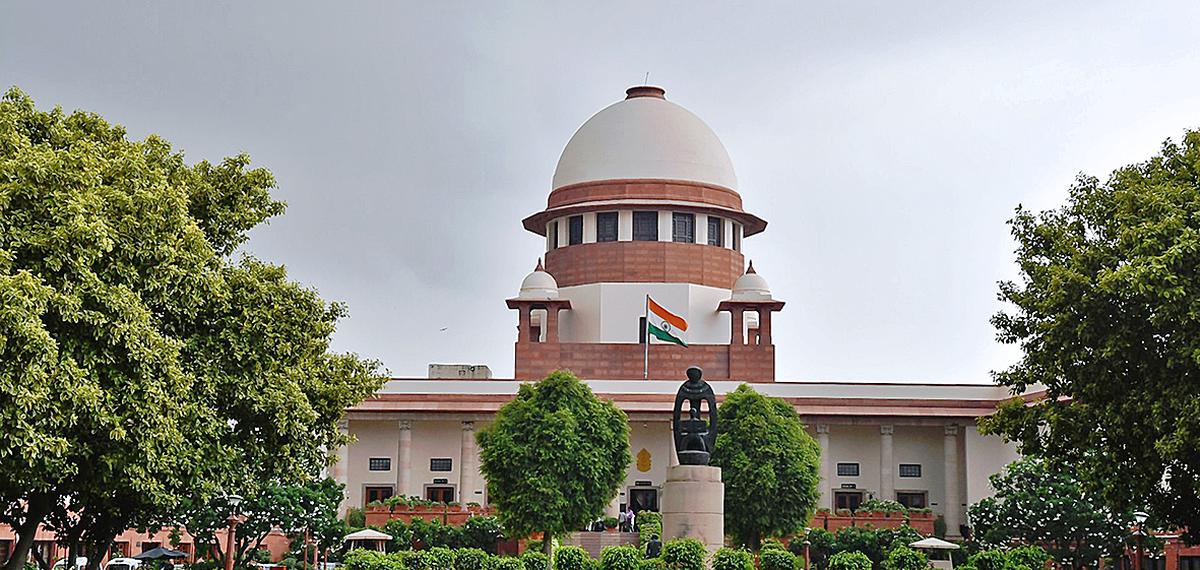
New Delhi: In a landmark verdict, the Supreme Court on Thursday held that states are constitutionally empowered to make sub-classifications within the Scheduled Castes, which form a socially heterogeneous class, for granting reservation for the uplift of castes that are socially and economically more backward.
A seven-judge constitution bench headed by Chief Justice D Y Chandrachud, by a majority of 6:1, set aside the apex court’s five-judge bench verdict of 2014 in the EV Chinnaiah vs State of Andhra Pradesh case which had held that no sub-classification of Scheduled Castes (SCs) can be allowed as they are a homogeneous class in themselves.
“The State in exercise of its power under Articles 15 (non-discrimination against any citizen on grounds of religion, race, caste, sex, place of birth) and 16 (equality of opportunity in public employment) of the Constitution is free to identify the different degrees of social backwardness and provide special provisions (such as reservation) to achieve the specific degree of harm identified,” held the CJI in his 140-page judgement.
“Historical and empirical evidence demonstrates that the SCs are a socially heterogeneous class. Thus, the state in exercise of the power under Articles 15(4) and 16(4) can further classify the SCs if (a) there is a rational principle for differentiation; and (b) the rational principle has a nexus with the purpose of sub-classification,” the CJI held.
The six judgements, running into 565 pages, were penned on the contentious issue by the CJI, who wrote for himself and Justice Manoj Misra, and Justices BR Gavai, Vikram Nath, Pankaj Mithal, Satish Chandra Mishra and Justice Bela M Trivedi.
Except for Justice Trivedi, the other five judges concurred with the findings of the CJI.
Justice Trivedi, in her 85-page dissenting judgement, said it is only Parliament which can include a caste in the SC list or exclude it, and states are not empowered to tinker with it. The SCs, she ruled, are a “homogeneous class” incapable of being sub-classified further.
“The States have no legislative competence to enact the law for providing reservation or giving preferential treatment to a particular caste/castes by dividing/sub-dividing/sub-classifying or regrouping the castes, races or tribes enumerated as the ‘SCs’ in the notification under Article 341,” Justice Trivedi wrote.
The CJI, in the majority verdict, held, “If the SCs are not similarly situated for the purposes of the law (or the specific harm identified), there is nothing in Articles 15, 16 and 341 (President’s power to classify SCs) which prevents the State from applying the principle of sub-classification to the class.
“Thus, the SCs can be further classified if: (a) there is a rational principle for differentiation; and (b) if the rational principle has a nexus with the purpose of sub-classification,” Justice Chandrachud said.
The CJI made it clear that any decision to sub-classify SCs to grant more quota benefits to a particular caste inside the category can be reviewed judicially.
He held that the states, for a valid exercise of power to sub-classify under Article 16(4), are required to collect “quantifiable data with respect to the inadequacy of representation of the sub-categories in the services”.
“The inadequacy of representation is an indicator of backwardness and thus, to use the cadre as a unit to determine representation alters the purpose of the indicator itself. The state while deciding if the class is adequately represented must calculate adequacy based on effective and not quantitative representation,” it said.
He said Article 14 (right to equality) of the Constitution permits sub-classification of a class which is not similarly situated for the purpose of the law.
The court, while testing the validity of sub-classification, must determine if the class is a homogeneous integrated class for fulfilling the objective of the purpose.
Referring to the Mandal judgement on quotas, the CJI said it did not limit the application of sub-classification only to the other backward classes (OBC).
The apex court judgement held Article 341(1) of the Constitution does not create a “deeming fiction” and the operation of the provision does not create an integrated homogeneous SCs class.
Article 341(1) grants the President the power to notify castes, races or tribes which shall be deemed to be SCs for a state or a Union Territory.
“Sub-classification within the SCs does not violate Article 341(2) because the castes are not per se included in or excluded from the (SCs) List. Sub-classification would violate the provision only when either preference or exclusive benefit is provided to certain castes or groups of the Scheduled Castes over all the seats reserved for the class,” it said.
Article 341(2) says Parliament can include or exclude any caste, race, or tribe from the list of SCs.
Overruling the Chinnaiah verdict, the CJI dealt with the scope of sub-classification of SCs and said the objective of any form of affirmative action, including the sub-classification, is to provide “substantive equality of opportunity for the backward classes”.
“The state can sub-classify, inter alia, based on inadequate representation of certain castes. However, the state must establish that the inadequacy of representation of a caste/group is because of its backwardness,” it said.
The state will have to collect data on inadequacy of representation in government jobs because it is used as an indicator of backwardness, it said.
A dispute over sub-classification arose after certain states, including Punjab, made laws to sub-classify SCs to grant more quota benefits to certain castes.
The top court had reserved the verdict on February 8 on pleas seeking review of the Chinnaiah judgement, which had ruled all SCs which suffered ostracisation, discrimination and humiliation for centuries represented a homogeneous class incapable of being sub-categorised.