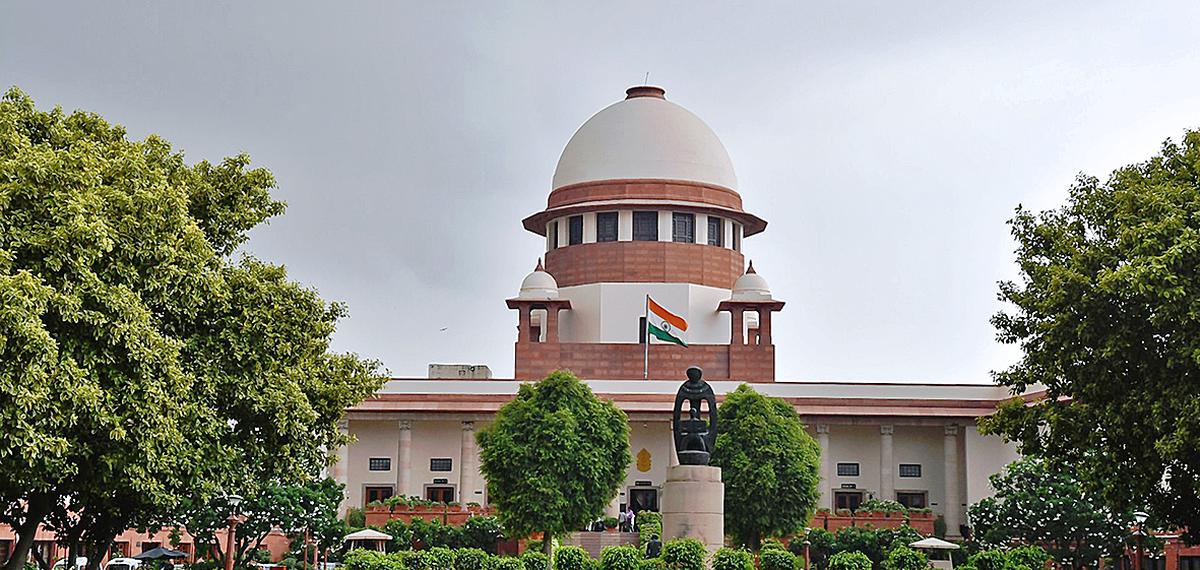
New Delhi: The legislative power to tax mineral rights vests with the states and the royalty paid on minerals is not a tax, the Supreme Court ruled on Thursday in a landmark judgement which will give a huge revenue boost to mineral-rich states.
A nine-judge constitution bench headed by Chief Justice D Y Chandrachud, in a majority 8:1 verdict, said Parliament does not have the legislative competence to tax mineral rights under Entry 54 of List I of the Constitution which pertains to regulation of mines and mineral development by the Centre.
The pronouncement, which came as a setback to the Centre, however, said that Parliament can still legislate to impose “any limitations” on states’ power to levy tax on mineral rights.
It referred to the term “any limitations” under Entry 50 of List II and said its scope is wide enough to include imposition of “restrictions, conditions, principles, as well as a prohibition”.
Entry 50 of List II pertains to taxes on mineral rights subject to any limitations imposed by Parliament by law relating to mineral development.
Justice B V Nagarathna, in her dissenting verdict, said royalty is in the nature of a tax or an exaction and the Centre does have the power to levy it.
After the bench pronounced its verdict, the counsel appearing for various states urged it to decide on recovery of taxes worth thousands of crores of rupees levied by the Centre on mines and minerals till now.
They urged the court to make its verdict operational with retrospective effect to ensure refund of taxes from the Centre.
Solicitor General Tushar Mehta, appearing for the Centre, vehemently opposed the submissions saying it will have wide-ranging impact and sought the verdict to be made effective prospectively.
The bench, which asked the Centre and the states to file written submissions on this aspect, said it will consider the issue on July 31.
The 200-page majority verdict was penned by the CJI for himself and on behalf of justices Hrishikesh Roy, Abhay S Oka, JB Pardiwala, Manoj Misra, Ujjal Bhuyan, Satish Chandra Sharma and Augustine George Masih.
“Royalty is not a tax. Royalty is a contractual consideration paid by the mining lessee to the lessor for enjoyment of mineral rights. The liability to pay royalty arises out of the contractual conditions of the mining lease. The payments made to the Government cannot be deemed to be a tax merely because the statute provides for their recovery as arrears,” the majority verdict said.
It said, “The legislative power to tax mineral rights vests with the State legislatures. Parliament does not have legislative competence to tax mineral rights under Entry 54 of List I, it being a general entry.”
The majority verdict also said since the power to tax mineral rights is enumerated in Entry 50 of List II, Parliament cannot use its residuary powers with respect to that subject.
The apex court said Entry 50 of List II envisages that Parliament can impose “any limitations” on the legislative field created by that entry under a law relating to mineral development.
It said the Mines and Minerals (Development and Regulation) Act (MMDRA), 1957, as it stands, has not imposed any limitations as envisaged in Entry 50 of List II.
The majority verdict said the state legislatures have legislative competence under Article 246 read with Entry 49 of List II, which pertains to taxes on lands and buildings, to tax lands which comprise mines and quarries.
“Mineral-bearing land falls within the description of ‘lands’ under Entry 49 of List II,” it said, adding, “The yield of mineral bearing land, in terms of the quantity of mineral produced or the royalty, can be used as a measure to tax the land under Entry 49 of List II.”
Entries 49 and 50 of List II deal with distinct subject matters and operate in different fields, the majority verdict said, adding that mineral value or mineral produce can be used as a measure to impose a tax on lands under Entry 49 of List II.
“The ‘limitations’ imposed by Parliament in a law relating to mineral development with respect to Entry 50 of List II do not operate on Entry 49 of List II because there is no specific stipulation under the Constitution to that effect,” it said.
The majority judgement overruled the 1989 verdict of a seven-judge bench and said the observation in that judgement to the effect that royalty is a tax is “incorrect”.
Justice Nagarathna, who dissented from the majority view, however, concurred with the CJI that scope of the expression “any limitations” under Entry 50 of List II is wide enough to include imposition of restriction, conditions, principles as well as a prohibition by Parliament by law.
“The State legislatures have legislative competence under Article 246 read with Entry 49-List II to tax lands and buildings but not lands which comprise of mines and quarries or have mineral deposits as mineral bearing lands do not fall within the description of lands (under Entry 49-List II),” she said in her 193-page verdict.
The nine-judge bench had begun hearing the matter because of two apparently conflicting constitution bench decisions, including the 1989 verdict, in a dispute over imposition of a cess between India Cement Ltd and Tamil Nadu government.
A seven-judge bench had in 1989 decided in favour of India Cement and ruled that the Centre was the primary authority under the MMDRA.
However, in 2004, a five-judge bench, while hearing another dispute over imposition of cess, held there was a typographical error in the 1989 verdict and that royalty was not a tax.