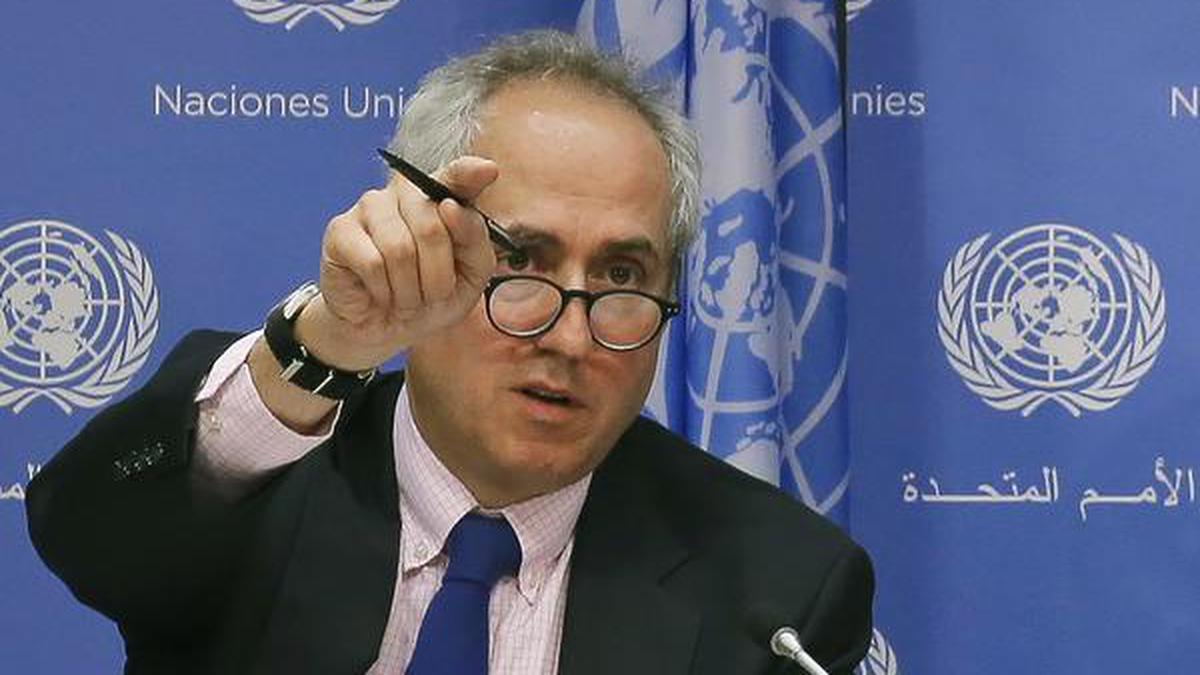
Singapore: United States Secretary of Defence Lloyd Austin told a gathering of top security officials Saturday that war with China was neither imminent nor unavoidable, despite rapidly escalating tensions in the Asia-Pacific region, stressing the importance of renewed dialogue between him and his Chinese counterpart in avoiding “miscalculations and misunderstandings.”
Austin’s comments at the Shangri-La defence forum in Singapore came the day after he met for more than an hour on the sidelines with Chinese Defence Minister Dong Jun, the first in-person meeting between the top defence officials since contacts between the American and Chinese militaries broke down in 2022 after then-U.S. House Speaker Nancy Pelosi visited Taiwan, infuriating Beijing.
Neither side budged from their longstanding positions on Taiwan — which China claims as its own and has not ruled out using force to take — and on China’s sweeping claims in the South China Sea, which has led to direct confrontations between China and other nations in the region, most notably the Philippines.
While declining to detail the specifics of their conversation, Austin said the most important thing was that the two were again talking.
“As long as we’re talking, we’re able to identify those issues that are troublesome and that we want to make sure that we have placed guardrails to ensure there are no misperceptions and no miscalculations … that can spiral out of control,” he said.
“You can only do that kind of thing if you are talking.”
Addressing the same forum on Friday night, Philippine President Ferdinand Marcos Jr. bluntly outlined what could be at stake, saying that if a Filipino were killed as China confronts his country’s coast guard and merchant fleet to press its claims in the South China Sea, it would be “very, very close to what we define as an act of war and therefore we will respond accordingly.”
Marcos added that he assumed the Philippines’ treaty partners, which include the US, “hold the same standard.”
In his own speech, Austin lauded how Marcos “spoke so powerfully last night about how the Philippines is standing up for its sovereign rights under international law.” But when pressed later, he would not say how the U.S. might react if a Filipino were killed in a confrontation with China, calling it hypothetical.
He did say the US commitment to the Philippines as a treaty partner is “ironclad,” while again stressing the importance of dialogue with China.
“There are a number of things that can happen at sea or in the air, we recognize that,” he said. “But our goal is to make sure that we don’t allow things to spiral out of control unnecessarily.”
Beijing in recent years has been rapidly expanding its navy and is becoming growingly assertive in pressing its claim to virtually the entire South China Sea.
Australian Deputy Prime Minister and Defence Minister Richard Marles noted that not only had Philippine ships been rammed and hit with water cannons by China, but said a Chinese warplane dropped flares above an Australian helicopter earlier in the year, and in November a Chinese navy ship injured Australian divers in Japanese waters with sonar.
“In the face of these multiple sources of tension, it’s even more imperative that every country plays its part in managing increasing strategic risk,” he said.
The US, meantime, has been ramping up military exercises in the region with its allies to underscore its “free and open Indo-Pacific” concept, meant to emphasize freedom of navigation through the contested waters, including the Taiwan Strait.
Chinese Senior Col. Cao Yanzhong, a researcher at China’s Institute of War Studies, asked Austin whether the U.S. was trying to create an Asian version of NATO with its emphasis on partnerships and alliances, a common Chinese claim. He suggested that could trigger conflict with China, citing ally Russia’s claim that NATO’s eastward expansion was a threat, which President Vladimir Putin has used as an excuse for his invasion of Ukraine.
“The eastern expansion of NATO has led to the Ukraine crisis,” Cao said. “What implications do you think the strengthening of the U.S. alliance system in the Asia-Pacific will have on this region’s security and stability?”
Austin said the U.S. is simply cooperating with “like-minded countries with similar values” and not trying to create a NATO-type alliance, while rejecting Cao’s interpretation of the cause of the Ukraine war.
“The Ukraine crisis obviously was caused because Putin made a decision to unlawfully invade his neighbor,” Austin said.
Expressing the concerns of some in the region, Indonesian academic Dewi Fortuna Anwar said any de-escalation of tensions “would be very welcome to this part of the world,” but wondered whether the U.S. would allow China’s assertive military posture to grow uncontested if Washington’s main emphasis was now dialogue.
“We are also worried if you guys get too cozy, we also get trampled,” she said.
Austin said that many of those issues were best addressed through talks, but also assured that Washington will continue to ensure that the rights of nations in the region were protected and that they continued to have access to their exclusive economic zones.
“War or a fight with China is neither imminent, in my view, or unavoidable,” Austin said.
“Leaders of great power nations need to continue to work together to ensure that we’re doing things to reduce the opportunities for miscalculation and misunderstandings,” he said. “Every conversation is not going to be a happy conversation, but it is important that we continue to talk to each other. And it is important that we continue to support our allies and partners on their interests as well.”