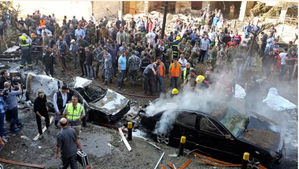
A blame game has been orchestrated by Iran to target Israel for allegedly playing a part in the terrorist attack in the Iranian city of Kerman, last week. Though the Daesh claimed responsibility for the attack, Iranian officials reject it and instead blame Israel for its complicity.
Iranian President Ebrahim Raisi joined mourners in the southern city of Kerman on Friday last week for the funerals of 89 people killed in twin blasts claimed by the Islamic State (Daesh), according to the Iranian media.
Suicide bombers struck crowds gathered near the tomb of Revolutionary Guards General Qasem Soleimani to mark the fourth anniversary of his killing in Baghdad in a targeted US drone strike. The terrorist attack on 3 January killed 89 people, which included many women and children as well as at least a dozen Afghans, state television said.
Raisi vowed to avenge the killings; saying, the time and place will be determined by our (Iranian) forces. Whereas, Revolutionary Guards chief Hossein Salami said, we will find you wherever you are.
In a statement published on Thursday 6 January on Telegram, the Daesh claimed two of its members ‘activated their explosives vests’ at the gathering. A staunch enemy of Daesh, Soleimani headed the Guards’ foreign operations arm, the Quds Force, overseeing Iranian military operations across the Middle East.
Though some Iranian officials have already hinted at Israel’s involvement in the attack, journalists and active media members have also started bringing to the limelight the differences between Daesh’s latest statement and its previous ones to prove a second party’s complicity.
The Tehran Times reported that the extremist group acknowledged responsibility for the assault more than 30 hours following the explosions. This departs from its usual pattern, as the group typically asserts its role in acts of terror immediately after their occurrence.
Also, Daesh generally precedes attacks with ominous posts on its social media platforms shortly before they unfold. Surprisingly, no such forewarning preceded the blasts in Kerman, contrasting with the group’s established modus operandi.
More over, in the image disseminated by Daesh, faces of both the attackers are completely obscured, with their faces fully covered and their eyes deliberately blurred. While previous attacks carried out by Daesh members featured images of the perpetrators in full clarity.
An Iranian journalist Mona Hojat Ansari analysing the evidence says that the text of the recent statement also exhibited notable disparities from prior declarations made by the extremist group.
Historically, Daesh has consistently referred to Iran as the ‘land of Persians’ or the ‘state of Khorasan’. However, the latest communication from the terrorists explicitly uses the country’s actual name: Iran. This shift has sparked suspicions regarding the origins of the statement, prompting questions about whether it might have been authored by an external entity and subsequently handed over to the group for dissemination on its social media platforms.
Further the characteristics of the attack also raised suspicions about Israel’s potential involvement, Iranian media pointed out. As per an Iranian lawmaker who inspected the blast site, the explosives employed to trigger the suicide vests were identified as RDX, which has frequently been associated with Israel’s past use in carrying out targeted assassinations within Iranian territory.
Despite the claim from Daesh, Iranian officials have continued to accuse Iran’s arch foes Israel and the United States of complicity in the attack. “IS has disappeared nowadays”, Salami said, adding that its remaining members, “only act as mercenaries” for US and Israeli interests.
They assert that Israel has been trying to weave a web of provocations to turn the whole region into chaos, leading to an all out war in the Middle East. Further, the US wants to involve Iran first, in this foreseeable confrontation The Iranian media claims that following its significant setback on 7 October by Hamas, Israel has grown increasingly desperate for direct involvement from Washington in the on going war.
Despite the US’s diplomatic support and provision of weaponry used in Gaza, it has, thus far, displayed reluctance to escalate the conflict beyond Gaza. In fact, reports suggest that the US has been pressuring Israel to halt its fruitless campaign by the end of January.
Iranian media claims that recognising its inability to eliminate Hamas and its deteriorating international standing, Israel now views a regional war as necessary to permanently eliminate the so-called Axis of Resistance. From Israel’s perspective, the opportunity to draw the US into a war with Iran and its allied groups may not arise again.
This motive has led to a series of orchestrated attacks in recent weeks aimed at provoking Iran and triggering a full-scale regional conflict. The sequence began with the assassination of a top Iranian military advisor in Syria, followed by an attack targeting a Hamas leader in Beirut. While some analysts anticipated a similar assault on Iranian soil, the direct targeting of civilians in a terrorist attack was largely unforeseen.
Meanwhile, tensions remain heated on the Israel-Lebanese border. An Israeli strike on southern Lebanon on Monday, 8 January killed a top Hezbollah commander, the Iran-backed group said in a statement. Clashes between Hezbollah and the Israeli army have intensified since the war in started.
While it is still debatable who carried out the attack or on whose instructions, it is clear that any direct American entry in the region may escalate the Gaza conflict, besides bringing chaos to the whole region. So far, the US has rejected any suggestion that it or its ally Israel were behind the bombings, while Israel has not commented on the issue.
However, one should not pay heed to the provocative statements by Israel against its other Arab neighbours and by Iran against Israel, the collective aim should be to get the Palestinian issue resolved at the earliest, as per the aspersions of the Palestinian people and try to limit the war and stop its spread in the region, as any further confrontation or attacks may prove catastrophic for the global peace.
(Asad Mirza is a Delhi-based senior political and international affairs commentator.)