By: Dar Javed
After the Kargil war, the AtalBihari Vajpayee-led BJP government sent then Foreign Minister Jaswant Singh to Israel for the first bilateral visit in 2000. LK Advani, then home minister, also visited Israel the same year.
India felt the need to modernise its defence infrastructure after the Kargil war and sought the help of Israel, which is known for its advanced defence technology. India signed its first defence deal with Israel in 2000 for the Barak-1 surface-to-air missile system.
The Barak missile system was primarily designed for naval defence, and it was intended to be installed on Indian Navy warships. The deal not only involved the sale of the Barak missile system but also included technology transfer, which allowed India to produce the missiles domestically. Not only defence, but India and Israel have collaborated on other sectors like agriculture, technology and R&D.
Two State Solution
The strengthening of ties has meant that while India stands by its support for the two-state solution and creation of Palestine, it isn’t harsh on Israel at international forums. This was observed when New Delhi abstained from a vote at the UN Human Rights Council that approved their Gaza Commission of Inquiry report in July 2015. Forty-one countries voted in favour of adopting the findings of the report, and India was one of only five nations that abstained.
Again in 2021, India participated in the United Nations Security Council debate on clashes between Israel and Hamas- operating from Palestinian territory of Gaza. TS Tirumurti, India’s former Permanent Representative to the UN, reiterated India’s “unwavering” commitment to the two-state solution. However, he also “condemned” the “indiscriminate” rocket firing from Gaza and called the Israeli strikes “retaliatory” in nature and not an act of aggression.
Now, in the face of the latest aggression by Hamas against Israel, where it launched airstrikes, killed and abducted Israeli citizens, India has explicitly supported Israel. “The people of India stand firmly with Israel in this difficult hour. India strongly and unequivocally condemns terrorism in all its forms and manifestations,” PM Modi said in a social media post condemning the attack.
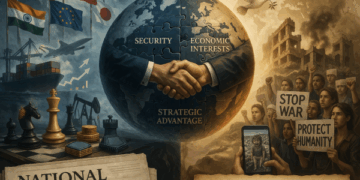
Since the end of the Cold War, India’s foreign policy approach has seen a notable shift in its engagement with Israel while maintaining its support for the Palestinian cause. This nuanced stance does not emerge out of a vacuum but is rooted in a complex web of geopolitical and moral considerations.
Geopolitically, India’s relationship with Israel has strengthened due to shared strategic interests. Both nations face common threats, such as terrorism, and have cooperated in areas like defense, counter-terrorism, and intelligence sharing. Israel’s expertise in technology and agriculture has also been of immense value to India’s development goals.
However, India’s support for the Palestinian cause has been a consistent aspect of its foreign policy. It stems from its historical ties with the Non-Aligned Movement and solidarity with other developing nations. India also recognizes the importance of a just and lasting solution to the Israeli-Palestinian conflict, which is essential for stability in the region and global peace.
Moral considerations play a significant role in India’s approach. As a diverse and secular democracy, India upholds principles of justice, human rights, and self-determination. This compels it to advocate for the rights and aspirations of the Palestinian people while maintaining a pragmatic relationship with Israel.
In essence, India’s post-Cold War foreign policy toward Israel and Palestine is a delicate balancing act, guided by a mix of geopolitical interests and moral principles. It seeks to engage with Israel for mutual benefit while upholding its commitment to the Palestinian cause, reflecting a multifaceted approach that aligns with its role on the world stage
What are the things India must keep in mind before endorsing Israel?
An article Published by clearias.com mentions The important areas of concern by India before endorsing Israel are as follows:
India’s energy security still relied upon the Arab Nations.
India should consider its relations with Saudi Arabia and Iran before going for closer ties with Israel. Saudi has not yet recognised Israel as a country and Iran supports the Palestinian cause. Any direct stake in Israel would affect our relationship with these countries. Also experts in Brookings ar of the opinion that , India is seeking permanent UN Security Council membership, requiring support from the Arab world and developing countries more broadly. India’s strategic interests in ties with Gulf Arab states and Iran are also expanding with growing foreign energy dependence and the increasing multipolarity of the Middle East resulting in competition with China. These are of course in addition to the BJP’s perennial need to win over more to Muslim voters, thereby continuing the older Congress-era template of calibrating the diplomatic message on Palestine with domestic political needs.
The way forward:
There is a need for leadership change in both Israel and Palestine. A part of the conflict is also driven by domestic political compulsion. New leadership in both countries will give new hope for the peace process. Successful negotiation of the US-Iran nuclear deal will also help in de-escalating the tensions, given Iran’s support to Hamas. Looking at the ground situation, the resolution of the Israel Palestine conflict is still elusive. The only way forward is peace talks between the two countries as suggested by India and further negotiations on the two-state solution proposed by the United Nations.
Conclusion:
India has termed the conflict as an internal matter of Israel and Palestine and has called for a peaceful resolution of the conflict. India now follows dehyphenation policy when it comes to Israel and Palestine. It means India’s relationship with Israel would stand on its own merits, independent and separate from India’s relationship with the Palestinians. It would no longer be India’s relationship with Israel-Palestine, but India’s relationship with Israel, and India’s relationship with the Palestinians.
With the West shying away from its responsibilities to solve the Israel-Palestine conflict and the trust deficit with China, Palestinian leader Muhammad Abbas in 2014 had called for India to play the role of interlocutor in resolving the conflict.
India can be part of the peace process to end this conflict under the overall leadership of the United Nations.
The writer is a columnist and writes on Polity, Governance, security and culture.