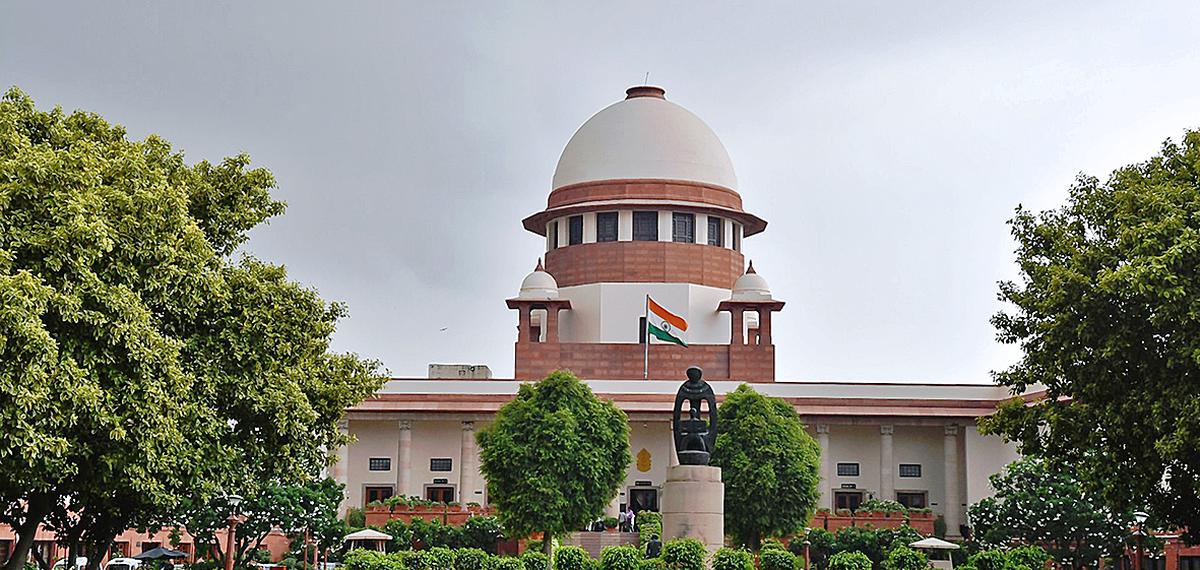
New Delhi: Who can recommend the revocation of Article 370 in Jammu and Kashmir when no constituent assembly exists there? The Supreme Court Wednesday put this question to the petitioners who have challenged the abrogation of the constitutional provision that bestowed special status on the erstwhile state.
A five-judge constitution bench headed by Chief Justice DY Chandrachud today commenced hearing a batch of pleas challenging the Centre’s August 5, 2019 decision to abrogate Article 370, a move that had come in for vicious attack by some major opposition parties but earned fulsome praise from those supporting the BJP.
The bench, also comprising Justices Sanjay Kishan Kaul, Sanjiv Khanna, BR Gavai and Surya Kant asked senior advocate Kapil Sibal, the lead counsel for the petitioners, as to how can a provision (Article 370), which was specifically mentioned as a temporary provision in the Constitution, become permanent after tenure of the Jammu and Kashmir constituent assembly came to an end in 1957.
The top court referred to proviso 3 of Article 370 which says, “Notwithstanding anything in the foregoing provisions of this article, the President may, by public notification, declare that this article shall cease to be operative or shall be operative only with such exceptions and modifications and from such date as he may specify, provided that the recommendation of the Constituent Assembly of the State referred to in clause (2) shall be necessary before the President issues such a notification.”
The CJI asked Sibal, “What happens when the tenure of constituent assembly comes to an end? No constituent assembly can have an indefinite life. The proviso to clause (3) of Article 370 refers to the recommendation of the constituent assembly of the state, and it says before the President issues notification the recommendation of constituent assembly is required. But the question is what would happen when the constituent assembly ceases to exist?”
Sibal responded, saying it was precisely their point and their whole case is about whether the president cannot issue any notification revoking Article 370 without the recommendation of the constituent assembly.
Justice Gavai interjected and asked the senior lawyer whether the argument being made is that nothing could have been done about Article 370 after 1957, when the tenure of the Jammu and Kashmir constituent assembly came to an end.
Sibal said the court is currently interpreting a constitutional provision and it is not here to legitimise the process which is unknown to the Constitution.
“Through a political act Article 370 was tossed out of the window. This was not a constitutional act. Parliament took upon itself the role of constituent assembly and revoked Article 370 saying it is exercising the will of the people of Jammu and Kashmir. Can such a power be exercised?” said Sibal contesting the way Article 370 was repealed.
He added that nobody can deny that people of Jammu and Kashmir are an integral part of India but there is a special relationship which is unique and drafted in Article 370 itself.
“You can’t jettison that relationship except by following a process ordained by law,” he said, adding, “You can change the boundary of a state, you can bifurcate boundaries of a large state to make smaller states. But never in the history of this country has a state been converted into two union territories.”
“So, you move away from representative democracy, convert it into a union territory under your direct rule, and now five years have passed. Every day we hear soon there will be elections. There has to be a constitutional basis for doing this. In May 2019, parliamentary elections were held in Jammu and Kashmir but they keep on saying that state elections cannot be held,” Sibal said.
He said the repeal of Article 370 was a “political act and decision” which the government may take but Parliament cannot be an instrument for that.
“That political act cannot be exercised by the Parliament, which is a legislative body. Because that legislative body is controlled by the Constitution. It can’t go beyond that,” the lawyer said.
He contended the scheme of Article 370 says that on four items- defence, communication, external affairs, and ancillary matters- the consultation with the state is necessary and for all other matters concurrence of the state is necessary.
“If you want to abrogate Article 370, you have to get a recommendation from the constituent assembly,” he said. The CJI responded with a terse remark “so long as it existed”.
The senior counsel said the constituent assembly had served its term once it framed the Constitution for J&K.
“In which case, Article 370, which is a temporary provision, assumes the character of permanent provision by virtue of the fact that there is no constituent assembly,” the CJI asked Sibal.
“Absolutely,” the lawyer replied and added no Parliament can convert itself into a constituent assembly.
“Where does Parliament get such power and under what provisions? There was a unique structure in place which was changed on August 5, 2019 and Article 370 was tossed out of the window,” he said.
According to him, Justice Kaul told Sibal, Article 370 sub-clause 3 became otiose after 1957 as it served no purpose.
The CJI said Article 370 was included in part 21 of the Constitution which contains Articles that were transitional, temporary and special provisions which shows it was a temporary provision.
Justice Kaul said even a state assembly, which is an elected body, cannot recommend revocation of Article 370.
Sibal replied in the affirmative and said Article 370 states the ordinary law making power of Parliament shall be limited to matters in the Union list and the Concurrent list, which will be done in consultation with the state government.
The hearing remained inconclusive and will continue on Thursday.
The top court is conducting day-to-day hearing in the matter and will hear arguments except on Mondays and Fridays, which are days for hearing miscellaneous matters in the apex court. Only fresh petitions are taken up on these days for admission hearing and regular matters are not heard.
Several petitions challenging abrogation of the provisions of Article 370 and the Jammu and Kashmir Reorganisation Act, 2019, which split the erstwhile state into two union territories – Jammu and Kashmir, and Ladakh- were referred to a Constitution bench in 2019.