By: Harunur Rasid
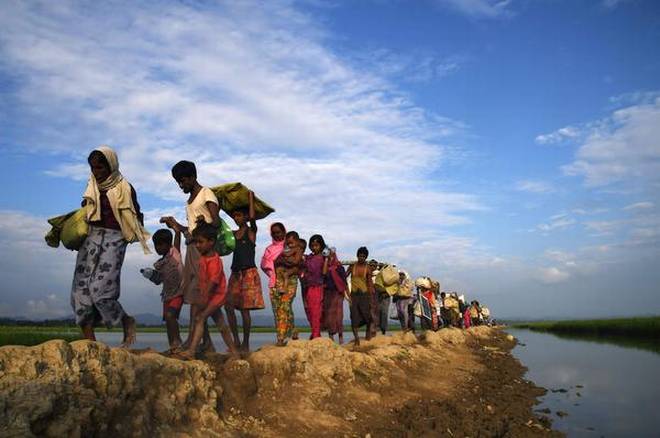
Currently, more than 1.2 million Rohingya are living in camps in Cox’s Bazar, Teknaf. Although Bangladesh sheltered these Rohingyas for humanitarian reasons, it has been making strong demands to the international community to take this oppressed population back to Myanmar safely, sustainably and with dignity. The United Nations has described the operation as an act of ethnic cleansing.
Foreign aid for the Rohingya is coordinated by the Joint Response Plan or JRP. According to them, in 2022, the United Nations Refugee Agency or UNHCR asked for 881 million dollars in aid, but only 285 million dollars came until August.
The United Nations Refugee Agency, the United Nations Migration Agency and the World Food Program have been supporting the Rohingyas in the camps with food, clothing, shelter, fuel and medical care. And UNICEF takes care of education. They mainly spend money through various organizations working with Rohingyas.
Officials at the Office of the Commissioner for Refugee Relief and Repatriation, the government agency managing Rohingya refugees, also said that international aid has not been coming in as expected for the past few years, and is now coming even less. According to the information of the Bangladesh government, on the one hand, the foreign aid for the Rohingya is decreasing, on the other hand, the Bangladesh government has already spent about two and a half thousand crore rupees from its own funds for the refugees.
In the 74th session of the United Nations General Assembly, Hon’ble Prime Minister Sheikh Hasina presented a four-point demand. Former UN Secretary-General Ban Ki-moon criticized the Myanmar authorities for showing laxity in taking back the Rohingya. UN Secretary General Antonio Guterres expressed deep concern over the ongoing Rohingya crisis.
On December 27, 2019, the United Nations passed a resolution condemning the human rights violations against Rohingya Muslims and other religious minorities in Myanmar. In other words, the Rohingya issue is an international problem, everyone agrees on this, but the relevant units are failing to take action to solve the problem and implement the decision at a fast pace.
Expenditure in various sectors of the country has increased due to 1.2 million Rohingyas who have taken refuge in Bangladesh. In addition to economic costs, infrastructure-environmental development, environmental protection and social balance protection costs have also increased. The administrative expenditure of the government has also increased to properly manage the large population.
This is putting additional pressure on the economy of Bangladesh. According to the report of the Committee on Identification of Rohingyas taking refuge in the country, about 165,000 shelter camps have been built for more than 1 million Rohingyas. Infrastructure has been established by cutting mountains and forests. Because of this, about five thousand acres of protected forest land in Cox’s Bazar has been destroyed. In this there has been loss of biodiversity equivalent to 397 crores 18 lakhs 37 thousand 393 rupees.
According to sources from the Ministry of Finance, 2 thousand 323 crore rupees have been spent for the construction of one thousand 440 barracks and 120 shelters in 120 cluster villages in Bhasanchar under the approval of housing construction project in Bhasanchar of Noakhali to build permanent housing for Rohingyas. All provided from the government’s own funds.
According to a report of the United Nations, the per capita expenditure of the people of Bangladesh is about 700 dollars. But the Rohingya have no legitimate source of income even if they have expenses. As such, the government may spend at least 600 million dollars a year for these more than 1 million Rohingyas. This is a major hindrance in keeping the wheels of the economy moving.
It is known that due to the Rohingyas, an average of more than 1 billion dollars is being lost annually. Recently, in a meeting of the Parliamentary Standing Committee on the Ministry of Environment and Forestry of the Government of Bangladesh, it was claimed that forest resources worth Tk 150 crore have been spent so far due to the Rohingya refugee camps.
If the whole matter is taken into account, the amount of this expenditure will be more than 10 thousand crore rupees. Therefore, by sheltering the Rohingyas, Bangladesh has suffered financially in many ways and will have its repercussions for a long time in the future.
The United Nations High Commissioner for Refugees, Filippo Grandi, visited Bangladesh in May and said that the countries that have influence in Myanmar should continue to work together to solve the Rohingya problem properly. He left predictions like sociologists, but he could not outline when and how Myanmar’s allies would begin to act. The Rohingyas who took refuge in Bangladesh want to confirm their rights and return to Rakhine, but since the current situation in Rakhine is not safe, the repatriation of the Rohingya will not be right, said Michelle Bachelet, the United Nations High Commissioner for Human Rights. The High Commissioner advised the Rohingyas to be patient for their repatriation to Rakhine and assured the UN to repatriate the Rohingyas by guaranteeing their rights. Such misleading and vague statements do not seem to have much impact on Rohingya repatriation.
Michel Bachelet’s statement on Rohingya repatriation is very conventional. In other words, the positive attitude of repatriation of Rohingyas is not revealed from such statements. Bengalis hope that the Rohingyas will be sent back to Myanmar as soon as possible on the basis of justice.
Bashelat’s statement is that the Rohingyas want to go back, the environment has not been created, it will take time; All enemies and allies of Rohingya are saying these words. No one appeared to come forward to create the necessary pressure on the Myanmar junta, the perpetrators of the crime. Bashelet also talked about education, work opportunities etc. in Rohingya camps. All these comments are indicative of the long term. In other words, to put it bluntly, it can be said that the international community is failing to take strong initiatives in the case of Rohingya repatriation.
Assurance and implementation can never be the same. Such assurances have no future, no boundaries. Bangladesh has given shelter to the Rohingyas on humanitarian grounds, which has been appreciated by all.
But Bangladesh has expressed its opinion by presenting statements in the diplomatic process in all concerned places for the rapid repatriation of the Rohingyas as per the plan after granting asylum. The international community has been limited to mere assurances in this regard, the issue is by no means acceptable. Then people will question the work of the UN Human Rights Commission and one thing will be fairly established and that is that the unit is busy in the process of fulfilling its responsibilities only by making statements, at least on the Rohingya issue.
If you notice on the contrary, it can be seen that many people are good at making statements with strange information about the human rights situation in Bangladesh.
They talk about Bangladesh’s RAB; they give clearance on the acceptance of RAB. But the law-and-order situation in their own countries is turbulent, heated, common people are insecure without licensed arms and terrorist attacks are happening in educational institutions. Meanwhile, the Rohingya problem is a global problem, everyone is aware of it, Bangladesh has set a precedent of human rights by sheltering the Rohingyas for a long time, which is a rare event in the world history in contemporary times.
However, they are unable to take any effective role in solving the problem. Then there is clear evidence of their duality policy. Moreover, they are praising Bangladesh for providing shelter to the Rohingyas in the talks, now we can see the scorn of this praise. Contrary to praise, they are trying to undermine the clean image of the country by presenting their statements without knowing the real truth about the internal situation of Bangladesh. In particular, it can be clearly said that the lack of sincerity of the United Nations Human Rights Commission in the matter of Rohingya repatriation is also noticeable.
The writer is a London-based Bangladeshi expatriate who is a Bangladesh and Myanmar affairs observer, analyst, and researcher.