By: Gazi Muzamil
The Islamic calendar- the Hijri calendar is a ‘lunar visibility’ calendar based on the moon’s cycles, varying from 29 to 30 days. This is unlike the Gregorian calendar, which is based on the solar year. Islamic festivals including Ramadan and Eid are determined on the sighting of crescent moon.
The moon sighting is considered the least controversial subject in Islamic jurisprudence as conditions for Hilal Sighting and its reporting are slightly lenient than those required for other matters of Shariah yet it is the most contentious subject in Muslim countries, especially during the holy month of Ramadan and Eid.
The Moon is a non-luminous, natural satellite of earth that revolves around it. As moon orbits the earth, different portions of its surface are lit up by sunlight and become visible to us on earth. The moon appears to change its shape in eight different phases beginning with the ‘New Moon’ positioned between the sun and earth, and it is invisible to us because of Sun’s glare. Then the moon’s shape seems to grow or wax.
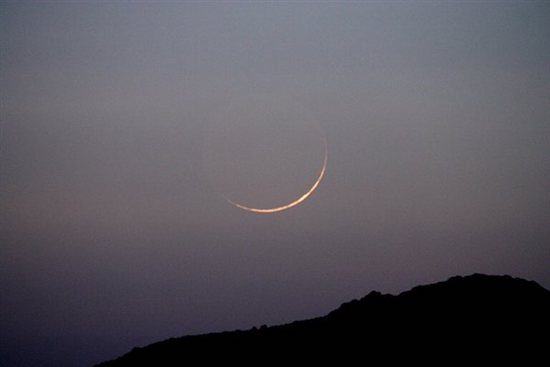
A ‘New Crescent Moon’ or ‘waxing crescent’ is the first time the moon can be seen following a New Moon. At this stage, the moon is only the slimmest curve in the sky, with just a fraction of its near side illuminated by the sun. In the Islamic calendar, the new crescent moon marks the start of a new month.
The phases continue to ‘first quarter’, ‘waxing gibbous’, and then ‘full moon’ where the entire face of the moon seen from the earth is fully lit by the sun. The moon appears to get smaller, going through ‘waning gibbous’, ‘last quarter’, and ‘waning crescent’ phases before the cycle begins once more with a new moon. It takes 29.5 days for us to see the same phase of moon in the sky again. Hence it isn’t practical for a month to have half a day. An Islamic month therefore can have either 29 days or 30 days. It can’t be of 28 or 31 days like a Gregorian calendar.
In Islamic jurisprudence, there are two schools of thought on the determination of the new moon: those who believe Ramadan must be determined by the visibility of the new crescent with the naked eye and those who believe scientific measurement and calculations are sufficient. By applying advanced technology and scientific measurement, it may be determined when the crescent will be formed.
However, visibility of the new crescent by the naked eye is only possible 8-10 hours after it forms. The New Crescent Moon marks a new month, it is difficult to see it clearly from earth, as only a minuscule of it is illuminated by the sun. In Kashmir where skies usually remain cloudy and no separate or proper department or institute is responsible for moon sighting, or are the proper resources available, it becomes a difficult task to sight moon.
Of late Kashmir doesn’t have its own RuetHilal Committee or the machinery to clear the air. Since Pakistan controls the majority of Kashmir’s territory, the central RuetHilal Committee, which reports the sighting of the new moon and has a sophisticated system and staff for doing so in accordance with Shariah Law, frequently gathers testimony from that region of Kashmir as well. As a result, marking and celebrating Islamic months and festivals on their announcement became the norm for decades.
Unfortunately, the needless dispute over the Ramadan moon sighting caused confusion and chaos in Kashmir. While the majority of people observed the first day of Ramadan on March 23rd, a minority of individuals sided with Kashmir’s Grand Mufti (considered the official decree) who categorically dismissed any moon sighting accounts. Anjuman-e-SharianShian issued a proclamation declaring March 23 as the first day of fasting. In the absence of a credible local authority, the ijma is formed by the majority. The Ulemas (scholars) were unable to reach an agreement on the matter. The crescent moon appeared bright the following day, indicating that its age or phase was longer than one day. Individuals who did not fast on the first day of Ramadan may have lost a day. There was no grand mufti pronouncement or fatwa on the subject.
Mufti Nazir Qasmi, a renowned Islamic scholar, attempted to settle the debate by citing Islamic history and stating that it is permissible to begin fasting on two different days in a questionable situation, but his examples were of two different geographical entities, Syria and Madina, not the same geographical entity celebrating it on the same day. The start of Ramadan on two separate days in the same location has implications for Aitqaf, shab-e-qadr, and other key Ramadan days. The need arises for a fatwa from ulemas to avert the confusion on the Night of Qadr and start of Atiqaf.
As a Muslim-majority state, neither ulemas nor organisations in J&K have a stable structure or the necessary resources for observing the crescent. Traditionally, the official decree was issued here after it was confirmed by external radio and television stations. Different opinions on moon sighting, a lack of scientific devices to see the moon, and reliance on other countries for crescent sighting have all eroded the credibility of Kashmir’s Islamic scholars. On March 23rd, for instance, the “Grand Mufti” suffered a reaction following a comment that was completely personal or related to his few associates and had no scientific basis.
If future uncertainties are to be avoided, J&K requires a thorough and impartial RuetHilal Committee that operates year-round, not just around Eid and other key occasions. To reach an agreement (ijma), it must include space scientists, MeT officials, mathematicians, and eminent Kashmiri Islamic scholars.
(Gazi Muzamil is a Student and can be reached at gazimuzamil102@gmail.com)