New Delhi: Prime Minister Narendra Modi on Wednesday said that in the last seven years, his government gave ‘pucca’ houses to three crore poor people and made them ‘lakhpatis’, underlining that most of such houses were in the name of women who became “malkins (owners)”.
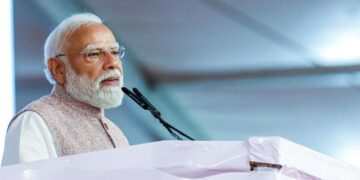
Addressing the ‘Atmanirbha Arthavyavastha’ (self-reliant economy) symposium organised by the BJP, he said a big dream of poor persons is having their own home.
In this year’s budget, it has been stated that 80 lakh ‘pucca’ houses will be built for the poor and on this about Rs 48,000 crore will be spent, Modi said noting that this was also a way to bring people out of poverty.
“When one gets a home, a poor person gets courage…We did not know the power of power people, there have been plenty of people in this country who used poor for political gains,” he said.
Modi also cited the example of Jan-Dhan Yojana to state that the self-respect of the poor rose when they got accounts in their names.
“When a Jan-Dhan account can change poor persons’ life then what changes getting a roof, a house would bring in their lives would be there for everyone to see,” he said.
The houses that the government builds for the poor in a way makes them ‘lakhpati’.
“When i was small lakhpati word used to sound very overwhelming….But the houses we have given to the poor, if you look at it from the point of view of its value, then in in the last seven years, by giving ‘pucca’ houses to three crore poor people, we made them ‘lakhpatis’,” Modi said.
“Those who were poor, lived in slums, have their own houses. Compared to the past, our government has increased the allocation amount and size of these houses so that there is space for education of children. It is also a big thing that out of these houses, most of them are in the name of women. We have also made women ‘malkins’ (owners),” he said.
“We always work for social justice and consider it our responsibility,” he added.
Modi said that like social justice is necessary for for the welfare of society, similarly balanced development is also important for the welfare if the country,
In his address on the union budget, Modi also said the focus of the budget is on providing basic amenities to the poor, middle class and youth.
He asserted that it is imperative that India becomes self-reliant.
Finance minister Nirmala Sitharaman on Tuesday announced allocation of whopping Rs 48,000 crore for completion of 80 lakh houses under the Pradhan Mantri Awas Yojana (PMAY), both rural and urban, during the next fiscal year.
‘Digital rupee can be exchanged for cash’
Prime Minister Narendra Modi on Wednesday said the digital rupee, proposed in the union budget, could be exchanged for cash and will open new opportunities in the fintech sector.
Addressing the ‘Atmanirbha Arthavyavastha’ (self-reliant economy) symposium organised by the BJP, he said the central bank digital currency or the digital rupee will make online payments more secure and risk free and boost digital economy in the years to come.
“The digital rupee will be the digital form of our physical rupee and will regulated by the RBI. This will be such a system that will enable exchange of physical currency with digital currency,” Modi said at the virtual symposium that was attended by chief ministers of BJP-ruled states and party workers across the country.
“Central Bank Digital Currency (CBDC) will strengthen the digital economy… If anyone makes a payment in digital currency, you will be able to change it to cash,” he said.
Modi said the launch of CBDC will make digital payments and online transfer of funds more secure and risk free.
“This will also lead to ease in development of global digital payment systems,” he said.
He said the digital rupee will revolutionise the fintech sector by creating new opportunities and lessen the burden in handling, printing, logistics management of cash.
Finance Minister Nirmala Sitharaman had announced that India will launch a ‘digital rupee’ in 2022-23 using blockchain and other technologies.