By: Partha Pratim Mitra
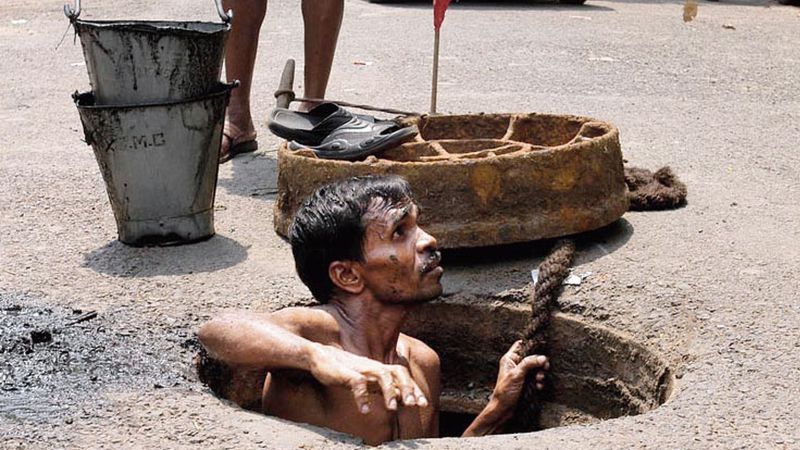
The death of five sanitation workers in Delhi is a grim reminder of the hostile conditions that confront manual scavenging in India. Manual scavenging has been prohibited by law. Yet, it remains unchecked. There is also a distinct lack of effort to make this objectionable occupation safe and dignified. This is the net result of institutional indifference.
The socio-economic and caste census of 2011 had identified 1,80,657 households of manual scavengers across India. The Safai Karmachari Andolan, an organization that works for the rights of sanitation workers, argues that the real figure is closer to more than six times the SECC’s estimate. At around 1.2 million, the figure matches the census’s estimate of 2.6 million dry latrines in the country.
The working conditions of these sanitation workers have remained virtually unchanged over the years. Apart from the social stigma that they face, sanitation workers are also exposed to certain health problems by virtue of their occupation. These health hazards include exposure to harmful gases, cardiovascular degeneration, musculoskeletal disorders, hepatitis, leptospirosis and skin problems.
There have been two legislations concerning this particular occupation.The first — the Employment of Manual Scavengers and Construction of Dry Latrines (Prohibition) Act 1993 — provides for the prohibition of employment of manual scavengers and the construction of dry latrines. However, a clear conflict of interest was created on account of certain provisions in the act, which stated that prosecution for any offence under it shall not be instituted except with the previous sanction of the executive authority, and that no court shall take cognizance of any offence under this act save for a complaint made by a person authorized by the executive authority. The judiciary was hardly allowed to intervene and the executive, by virtue of the two provisions, ensured that very few prosecutions were filed in the court of law to punish offenders.
The second legislation was the Prohibition of Employment as Manual Scavengers and their Rehabilitation Act, 2013, which came into effect from December 6, 2013. Manual scavenging — the cleaning of dry latrines — was outlawed in the country in 1993 but it was only in 2013 that the law recognized the other hazardous aspects of the work. However, the executive retained the power of prosecution, diluting the legislation. Incidentally, in Safai Karamchari Andolan and Ors versus Union of India, the Supreme Court made it clear that entering sewers without safety gear is a crime even in an emergency.
Manual scavenging must be done away with. Lessons could be learnt from other professions that are modernizing themselves with the infusion of technology and skills. Moreover, why should manual scavenging be considered a vocation for the weakest and the socially oppressed castes only?
Similar changes would have to be brought in to maintain sewage systems. They would do away with human exposure to toxic gases and other harmful material. Efforts to replace human participation with the help of robots have started already. The Kerala Water Authority, which manages the sewage department in the state, has reportedly placed orders for 50 robots, christened Bandicoot, by a start-up called GenRobotics. It works along the following lines. After gauging the problem, the robot dismantles itself from the main machine and enters the sewer and cleans it with the requisite tools. The use of robots in a labour surplus country is debatable. But it may be beneficial in this case.
Courtesy www.telegraphindia.com