By: Manjari Katju
The State of Uttar Pradesh is fascinatingly diverse and a story in contrasts. It has a history of both intense political and religious contestation and of syncretic accomplishments. The State did not witness a social reform movement of the kind that emerged in regions of present-day West Bengal, Kerala and Maharashtra or the self-respect and backward classes movement in Tamil Nadu.
What U.P. did witness during the colonial past was the blooming of secular-liberal political ideas and movements associated with the nationalist/ freedom struggle and paradoxically the assertions of religious and community identities. The revolt of 1857 against the British began here, triggered by caste/ religious considerations of the sepoys. Politics after the failure of the revolt developed two strains – one was of loyalist politics and the other of dissent and sedition. What became dominant in U.P. in the immediate aftermath of Partition and Independence was a secular inclusive politics as represented by the Indian National Congress.
Political weight
The State carries weight politically for the largest number of parliamentary (80) and Legislative Assembly (404, including one for a member of the Anglo-Indian community) seats in the country and for having given India eight of its Prime Ministers, beginning from the first, Jawaharlal Nehru.
At one point in time it was also referred to as ‘mini-India’ — a characterisation from which one has come a long way — but, there still exists a belief that whichever party gets a majority in the Lok Sabha from U.P. becomes the ruling party or wields considerable influence at the Centre. Does it hold true today?
U.P.’s economy has remained largely agrarian except for the growing IT sector in Noida (helped by its vicinity to the national capital). There exists significant internal variation of urbanisation, productivity, incidence of poverty and demography in the four regions that form the State – namely, Pashchim Pradesh (west and northwest U.P.), Awadh Pradesh (central U.P. or districts around Lucknow), Bundelkhand (south U.P.) and Purvanchal (east and southeast U.P.).
Rural-urban divide
The western region holds a much higher urban population and the lowest incidence of poverty as compared to the other regions. Bundelkhand lags behind all the regions in material well-being. The rural-urban divide is even sharper in terms of income and consumption-expenditure patterns. Across the four regions, Muslims and Dalits make up the most economically hard-up sections. The State has seen distress-induced migrations as well as outward mobility in search of higher-end jobs.
The Green Revolution brought about a marked prosperity to western U.P. This led to the politicisation of rich farmers and greater political assertions among them. Their moving away from the Congress party saw its gradual decline and that of its ‘umbrella politics’ in U.P. like in many other States. This decline was accompanied by a simultaneous process of political fragmentation. The mid-1970s saw strides by the Hindu right-wing that slowly gained a foothold among the upper castes in U.P. The short-lived Janata Party government in the State was an alignment of the upper castes and the rich/ middle peasantry. From this period onwards there was a considerable growth of the Bharatiya Jan Sangh (precursor of the BJP) and later the BJP in the State.
U.P. is a communally ‘sensitive’ State which has seen and continues to see communalisation of social relations and gruesome riots — the western and the eastern regions have been particularly vulnerable. The State has been considerably influenced by community and caste factors in politics as also by strong-arm tactics of entrenched interests that have flourished in areas of stunted growth. This has affected political mobilisation and voting patterns.
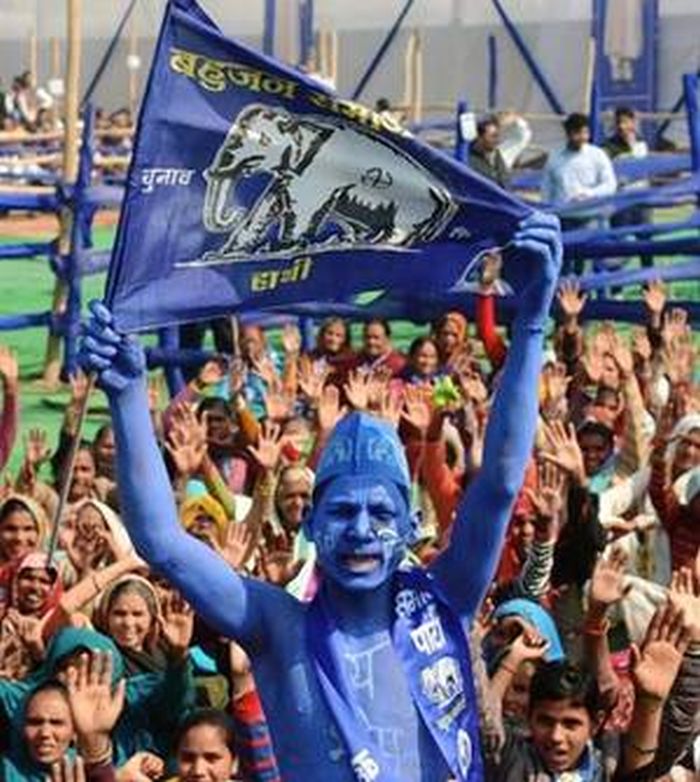
The fragmentation of politics in U.P. saw the maturing of distinct strains of politics with sectional support bases. There was a further growth of the Hindu right-wing following mobilisations on the Ramjanmabhoomi issue by the Vishva Hindu Parishad and the Rashtriya Swayamsevak Sangh. However, counter-strains running against this Hindutva-isation trend also came up. The politics of the peasant-proprietors further branched into the politics of the Backward Classes leading to the emergence of the Samajwadi Party (SP). The SP gained strength by stitching an alliance between the Yadavs and Muslims. The Dalit politicisation and assertions were represented in the Bahujan Samaj Party (BSP), which found its main support base among the Jatavs. Political expression among the Muslims found its way as strong minority voices in the SP, the BSP and the Congress. Later, a few parties like the Quami Ekta Dal and Peace Party came up with the aim of representing mainly the Muslims, but with little success.
The 1990s and early 2000s were a witness to several alliances and coalitions in the U.P. power structures. Also, formation of stable governments was interrupted several times — symptomatic of the social alignments and de-alignments in the State — leading to the imposition of President’s rule. From the year 2003 stability returned and the government alternated between the SP and BSP. In 2017, after a gap of 15 years, the BJP again formed a government in U.P. The ‘Gujarat model’ of development and religious polarisation helped the BJP win overwhelming power in the State. The processes of upward social mobility, religious antagonisms, status anxiety, regional dislocations and Hindutva propaganda prepared the ground for BJP’s success, with the party able to bring together the upper castes, backward castes, established peasantry and Dalits in its support. Yogi Adityanath, the mahant of the Gorakhnath mutt and a fiery leader of the BJP known for his communal politics, became the Chief Minister of U.P – a stark instance of fusion of religion and politics. This is perhaps the first time in India that a head of a religious institution became the head of a political institution.
This is how political configurations stand today but, scratching the surface, one cannot help noticing that the trend of splintering has picked up in the last few years. This has made the task of predicting U.P. politics a tad bit difficult. New class and sectional formations are steadily emerging.
Support bases
The politics represented by Mulayam Singh Yadav has receded and his heir Akhilesh Yadav is yet to show how the refashioned politics of the SP is going to fare under his leadership. BSP chief Mayawati saw a serious erosion in her support base in the last couple of elections and only time will tell whether the distinct class formations in the Dalit communities are going to benefit her or otherwise.
Of late there have been attempts by Pasmandas, who make up the economically lower strata among Muslims and form 85% of the Muslim population of U.P., to organise themselves. With hardly any support from the different U.P. governments, they are coming together in an exercise of political self-help and right-claims and showcasing their secular demands of education and employment. This might further eat away the support of the above mentioned parties. The BJP government, representing an arrogant religious majoritarianism, itself stands on a fragile social coalition. Also, sooner or later the emotional appeal of Hindu unity and nationhood will wear off and the demands for affordable education, healthcare, and jobs might make people look for political alternatives.
In the face of this emergent multiplicity and diffusion of interests, whether U.P. will remain the most decisive voice in the formation of governments at the Centre remains to be seen.
Courtesy The Hindu