By: KAMAL CHENOY
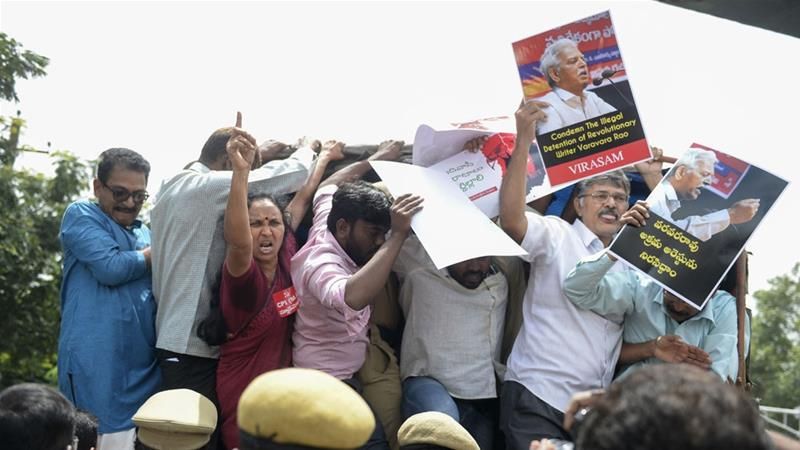
It was clear to most activists that the Supreme Court, as it was constituted, would reject the case of five activists, accused of espousing Maoist causes, arguably linked to Maoist forces. Despite Justice D.Y. Chandrachud, who from the beginning questioned the Pune police, and criticised them for showing all their documents to journalists and others, even during the pendency of the Supreme Court trial of the five activists.
Later, the many senior advocates who were present, including Abhishek Singhvi, Rajeev Dhavan, Anand Grover, Prashant Bhushan, Ashwani Kumar, Nihalsingh Rathod among many others, countered arguments by the Pune police and even by Justices (CJI) Dipak Misra and Justice A.M. Khanwilkar. As one of the senior advocates pointed out, the majority of the bench excluding Justice D.Y. Chandrachud, did not even suggest that the two retired judges P.B. Sawant formerly a senior Justice of the Supreme Court, and Judge Kolse Patil who were at a Pune meeting on the eve of the January 1, 2018 violence at Bhima Koregaon, were not asked to state what they had seen, so that could add their testimonies to the others who deposed. Senior advocates raised this issue, but the majority on the Supreme Court did not agree.
In fact, the Supreme Court majority declined to interfere in the proceedings, stating that “dissenting views expressed or difference in political ideology” had nothing to do with the case. Not only did the majority decline to intervene in support of the activists, but they clearly stated that “we are of the considered opinion that it is not a case of arrest because of mere dissenting views expressed or difference in the political ideology of the main accused, but concerning their link with members of the banned organisation and its activities.” The majority also stated that the, “investigating officer is free to proceed” against the accused, and rejected the plea to order a probe by a Special Investigation Team. The majority continued the bench’s August 29 order to keep the activists under house arrest to enable them to move the appropriate forum for bail or quashing of the case registered against them.
Once again dissenting from his colleagues in the majority of 2-1, Justice D.Y. Chandrachud observed that “voices in opposition cannot be muzzled by persecuting those who take up unpopular causes.” On Friday, September 28, he stated that “there are serious doubts” about the Pune police probe. He went on to say, “Conscious as the Court is of the public interest in the effective administration, it cannot be oblivious to the overriding Constitutional concern to secure the dignity of the individual. The key to the balance between the two lies in a fair, independent and impartial investigation of crime….” Coming down hard on Pune police, he said there is “sufficient” evidence placed before the bench to have an independent investigation…In the present case, police briefings to the media have become a source of manipulating public opinion by besmirching the reputations of individuals involved in the the process of investigation. What follows is, unfortunately, a trial by media.”
Chandrachud J. was clear that that “it is not only permissible but our Constitutional duty to ensure that the investigation is carried out by special investigation team…so that justice is not compromised.” This was a clear rebuttal of the majority which stated that there was no need for an SIT. He once again restated his support to dissent under the law. He stated that “Dissent is a symbol of a vibrant democracy. Voices in opposition cannot be muzzled by persecuting those who take up unpopular causes…”
Referring to police allegations, made during a press conference, that there was a plot against the Prime Minister, he said the Additional Solicitor (ASG) “fairly stated that there was no basis to link the five arrested individuals to any such alleged plot against the Prime Minister.” Justice Chandrachud said that when the Joint Commissioner of Police and the Additional Director of Police “cast aspersions in the public media against persons whose conduct is still under investigation” and “in disregard of proceedings pending before a judicial forum,” it is “the duty and obligation of this Court to ensure that the administration of criminal justice is not derailed.”
Justice Chandrachud’s statements are quite clear and unequivocal. The majority did not want any change in the Investigating Agency (SIT) as “the Court must exercise that power with circumspection.” On the plea to release the five activists, the majority said “the accused must pursue this relief before the appropriate court, which can be considered by the concerned court on its own merits in accordance with law.” So in other words, the Hon’ble Supreme Court passed the buck to a lower court. From examining all three judges, the majority of CJI Dipak Misra and Justice Khanwilkar appeared to be less interested in the case, indicated by their insistence that the trial be held in a lower court. Justice D.Y. Chandrachud, a minority of one, was clear that an SIT should be set up, while referring to “this Court to ensure that the administration of criminal justice is not derailed.”
Under the CJI Dipak Misra it appears that the apex court is not keen on 5-member Supreme Courts either in this case, but also the Ayodhya case which is also a 3-member bench. In the latter, Justice S. Naseer Ahmad has asked that a 5-member bench should be appointed. But the Ayodhya case goes back to December 22-23, 1949 when the Ram Lalla idol was installed in the Babri Masjid. Surely, this is an irresistible case for a 5-member bench. The CJI Dipak Misra demits office on October 6, 2018. Why this extreme hurry to solve the issues which are not yet resolved? Is the Hon’ble Supreme Court running out of steam? Seems unlikely since Justice D.Y. Chandrachud is using all his judicial skills in powerful judgements.
Courtesy www.thecitizen.in