BY; Nicole Fritz
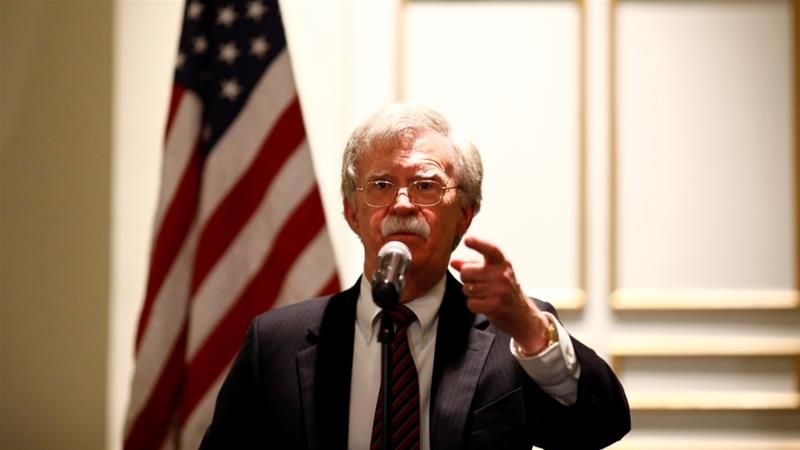
Nothing in US National Security Adviser John Bolton’s furious attack on the International Criminal Court (ICC) earlier this week can be of much surprise to anyone. Not that he prides himself on being a self-declared foe of the Court – he already demonstrated that when he served in the administration of George W Bush and engineered dozens of bilateral agreements preventing other countries from delivering US personnel to the ICC.
Nor that in his first seminal address as US national security adviser, he played fast and loose with the facts – claiming falsely that the Court’s next step would be to exercise universal jurisdiction (it does not have such power) and that US soldiers might be prosecuted for the crime of aggression (they cannot be). Disregard for facts seems emblematic of the administration in which he serves. Nor even that his justifications for opposition to the Court seemed contradictory: on the one hand, he presented the spectre of potent, many-tentacled Court, liable to reach out and grab ordinary, patriotic Americans. On the other, he argued that the Court was all but irrelevant, some effete product of the Europeans, unsupported by most of the world. Again, incoherence is likely only to endear him to his principal.
But what was perhaps surprising, or at least ironic, is seeing someone of Bolton’s political orientation attempt to rehearse, with some sympathy, what has been called the African-critique of the ICC: that it is “just the latest European neocolonial enterprise to infringe upon their sovereign rights.” Particularly, when in the same speech, Bolton asks rhetorically of his audience, the conservative US Federalist Society, whether they would consign the fate of American citizens to a committee of other nations, including the likes of the Democratic Republic of Congo?
Still, if the idea that the DRC should have as much say in respect to the fate of American citizens as the US has in respect of the citizens of the DRC seems obviously scornful to Bolton and his audience; the DRC is apparently not so odious that he wouldn’t seek to make common cause with it in protesting the ICC.
But what will African states make of this attack?
In recent years, much of the most scathing criticism of the Court has come from Africa. Currently, 10 of the 11 investigations being pursued by the Court are centred in Africa. All 37 of the named defendants are from Africa. It’s hard not to agree with the conclusion that the Court has disproportionately focused on Africa, even accepting that many of the investigations before the Court come to it by way of self-referrals from African states themselves.
And this imbalance has provided rich pickings for those on the continent who have real reason to fear accountability. Name a strongman in Africa, and he has made some politically pointed criticism of the Court.
Spokesman for Burundian President Pierre Nkurunziza called it “a political instrument and weapon used by the West to enslave”, in advance of Nkurunziza staging Burundi’s exit from the Court. Then-President Yahya Jammeh of the Gambia called it the “International Caucasian Court”. Sudan’s Omar al-Bashir, indicted by the Court for genocide, crimes against humanity and war crimes in Darfur, has said the Court should “eat” his arrest warrant and Uganda’s Yoweri Museveni has described the Court as “useless” and praised efforts by states to exit the Court.
But it would be a crude caricature to suggest that opposition to the ICC in Africa stems only from those who fear the Court may have them in its sights. In recent years, arguably, the most powerful antagonism has come from South Africa, which under President Nelson Mandela’s leadership had played a critical role in the Court’s formation – helping build the consensus needed among states to enact the Rome Statute but also, in championing the institution, lending it significant moral stature.
South Africa’s threats to leave the Court came about after it failed to effect an arrest of al-Bashir when he attended an African Union meeting in the country. After domestic Courts censured the government for allowing al-Bashir to leave the country without securing arrest, South Africa resolved to exit the Court.
Currently, an International Crimes Bill aimed at securing South Africa’s withdrawal from the Court is before Parliament, although yet to be voted on. While a change in presidential administrations may mean that there is now less fervour for such exit, there isn’t any certainty that South Africa will change course. And it is by no means just a conveniently constructed ruse to cover a diplomatic snafu, when South Africa insists before both local Courts and the ICC that its ICC obligations potentially undermine its peace-building efforts and conflict with regional undertakings towards the African Union.
But if various African states may share Bolton’s antipathy for the ICC (it is important to underline that several African states remain key supporters of the Court), there are several recent developments that might give them pause. A recent referral to the ICC by the Palestinian Administration to cover crimes committed in the occupied West Bank – a function certainly of the desperately few available avenues for justice in this region – must go some way to countering the insistence by some African detractors of the Court that it is only interested in securing Western interests and putting African leaders in the dock.
So, too, the much-anticipated authorisation likely to come from the Court for investigation into crimes committed in Afghanistan, implicating offences committed not only by the Taliban and Afghan military but also US service personnel, and almost certainly the direct trigger of Bolton’s most recent fury.
As things stand, this could make for some fairly interesting global alliances – advocates for justice in Afghanistan and in Palestine looking to engage the Court and willing it to succeed while several prominent African states are arrayed outside, alongside the likes of the US and Israel, hoping for its defeat.
The ICC is the flashpoint of the struggle for the new global order promised by the unprecedented international cooperation that characterised the late 1990s, but now looks increasingly to have been still-born. Bolton makes out that the emergence of this new regime was at the behest of an effete European elite – of the European Union where the “global governance dogma is strong”.
There’s no question that whatever vestigial hope of such an order remains can be powerfully resisted by an alliance of states like the US and various African countries. Their shared colonial histories give particular resonance to claims of the inviolability of national sovereignty: it offers powerful polemical and potentially real protection against outside interference.
But not that long ago a different vision captured African states. Twenty years ago, when the Rome Statute for the ICC was negotiated and agreed, Africa represented the largest voting bloc in support of the Court. The US was one of only seven countries to vote against the treaty. Its position has remained fairly consistent throughout. African states might want to consider long and hard before they concede that the US was right all along…
Courtesy Aljazeera