By: Sanjay Kak
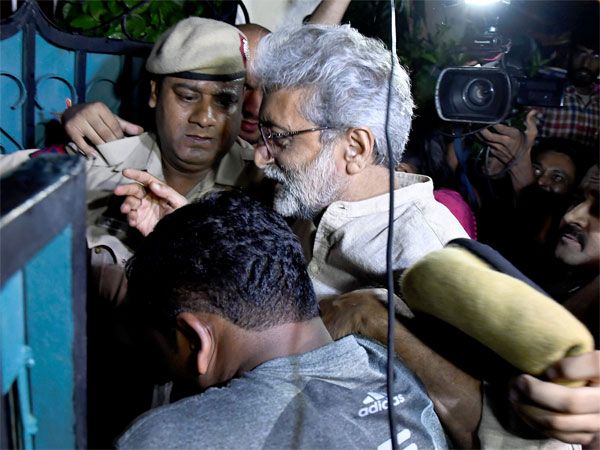
When police picked up Gautam Navlakha from his home in New Delhi two weeks ago, it was part of a string of simultaneous arrests from across the country. Sudha Bharadwaj was picked up from nearby Faridabad, Arun Ferreira from Thane, Vernon Gonsalves from Mumbai, and Varavara Rao from Hyderabad.
Colour by number
In trying to make sense of the arrests of these well-known public figures — lawyers, activists, poets, teachers — it helps to think of a game plan inspired by the ‘colour-by-number’ books that young children so enjoy. Each page is only a confusing mess of lines and shapes at first. Only when you diligently follow the numbers, and fill in the boxes with the suggested colour, does the picture begin to emerge.
In this colour-by-number exercise, which box could Mr. Navlakha be fitted into? And what colour would it be?
At the time of the arrests the charges against all five were said to connect them to the violence that followed the Elgar Parishad rally just outside Pune, on January 1, 2018. As we enter the already overheated warm-up to the 2019 general election, the possibility of a powerful assertion of Dalit politics, exemplified by Elgar Parishad, seems imminent. And it clearly puts the political status quo represented by the Bharatiya Janata Party under pressure. The impulse to connect the five activists to a conspiracy around Elgar Parishad certainly existed. But Mr. Navlakha was not in the right box here: he was not present at this rally (nor were his other four co-accused), and no other links with the violence at Bhima-Koregaon was forthcoming.
The Pune police soon produced before the media a large cache of emails, evidence they said of “a larger conspiracy by Maoist organisations to overthrow the lawfully established Indian government”. For good measure these self-incriminating emails of unproven origin threw in an attempt to assassinate the Prime Minister as well. No codes were used in these ‘top-secret’ letters of the underground (and ultra-secretive) Maoists, nor were pseudonyms deployed. This made it convenient for an obliging media to run blithely with the accusations. Inevitably there was a ‘Dear Comrade Gautamji’ letter too.
The five names had not been picked out of a hat either. In recent months each one of them had been flamed in the media, in a vituperative and sustained campaign launched and conducted by TV channels. This continued even after the arrests, and the effort to link these activists, and produce something that suggested a major conspiracy, was melded under the obliging glare of TV cameras.
Gautam Navlakha emerged as a particular favourite, and those who know him, and admire him, know why. There is nothing secret about his beliefs. He is someone who is simply unwilling, and perhaps even unable, to hold back from calling a spade a spade, whether in the context of Kashmir, or Bastar, the two issues about which he has written with the most consistency in recent years. So grainy videos of his speeches have been dug out from the archives, and with short excerpts looped out of context, an unspecified conspiracy is sought to be shaped.
The day after his arrest someone pointed out, only half in jest, that the possibility of Mr. Navlakha being part of any conspiracy was remote. For so fierce is his commitment to justice, and so highly does he value his independence, that he was certain to be a liability! It is precisely that principled intransigence, that consistency of commitment that comes shining through if you even casually rifle through his writings of the last three decades. His wide-ranging columns in the Economic & Political Weekly have covered a range of urgent issues, from human rights and civil liberties to defence and militarism. Long before the human rights community in India had even taken note of the situation in Kashmir, Mr. Navlakha had begun travelling there and produced analysis that systematically looked at the pattern and consequences of militarisation.
More recently Mr. Navlakha has written extensively about the context of the Maoist rebellion in central India, and his 2010 journey to the forests of Bastar in the company of the Swedish writer, Jan Myrdal, resulted in Days and Nights in the Heartland of Rebellion, a book where he is a witness at once “both critical and partisan”. It is that ability to stay as the outsider, and keep a distance from the rigidities both of conventional scholarship and of routine activism that make him an exceptional figure.
So what does the inclusion of someone like ‘Dear Comrade Gautamji’ in this conspiracy hope to achieve?
Convenient Act
While the recent attempt to silence people with the broad brush of #UrbanNaxal was confidently laughed off by the public at large, these arrests (as well as the earlier arrests of five activists in June this year) are clearly designed to summon a spectre, that familiar threat to the “lawfully established Indian government”. In Mr. Navlakha’s work the conspiracy has found a convenient way to link the “threat” posed by the Maoist insurgency to the disaffection and rage in Kashmir.
Much of what has transpired since the arrests would have been laughable too if the charges had not been made under Unlawful Activities (Prevention) Act, the draconian UAPA: Section 16 (punishment for terrorist acts), Section 17 (raising funds for terrorist acts), Section 18(B) (recruiting persons for terrorist acts), Section 20 (being member of a terrorist gang or organisation). It is the application of the UAPA, with the extreme difficulty of obtaining bail under it, that make even a ham-handed arrest a matter of grave seriousness, for long, debilitating stretches in prison invariably precede a trial under these sections.
In the coming months all of us will be faced with some form of the colouring book I began with, and asked to unquestioningly fill in the suggested colours. There is already enough to tell us that the predetermined picture is the wrong one. I like to think that Mr. Navlakha would have refused to follow the numbers, and gone by what he knew and understood for himself. Perhaps so should we.
Courtesy The Hindu