By: Amir Hussain
Pakistan has produced few political figures of an iconoclastic status who have been able to articulate a political discourse of transformation in the popular idiom.
A popular movement spread across the country in the 1970s that was contrary to the conventional elitism which had hitherto shaped the political landscape. The popular appeal of the new political rhetoric of ‘roti, kapra aur makaan’ (food, clothing and shelter) fostered hope for a better Pakistan. This was the golden era of political mobilisation led by Z A Bhutto.
Bhutto was undisputedly one of the most influential political leaders and his acumen, charisma, prescience and resilience were matchless. His rise to power was the beginning of ideological politics in the country. He epitomised a high-class political sense that was manifested in his passion, enthusiasm and ability to raise the rabble through his motivational oratory.
He was a socialist, a liberal, a feudal, a populist, and an egocentric and a humble fellow in equal measure. He was, perhaps, the most mysterious political leader that Pakistan has ever produced. Z A Bhutto was also an avid reader of faces, human psychologies and political situations, and possessed the extraordinary talent to turn them into political gains.
Bhutto was neither a stooge of Pakistan’s powerful establishment nor a staunch opponent of it. Zulfikar Ali Bhutto successfully presented himself as an anti-establishment messiah to the poor in Pakistan, but the reality is that his brand of politics was a mix of transformational and expediential moves that worked well amid the general pessimism that spread through the country in the aftermath of the 1971 war.
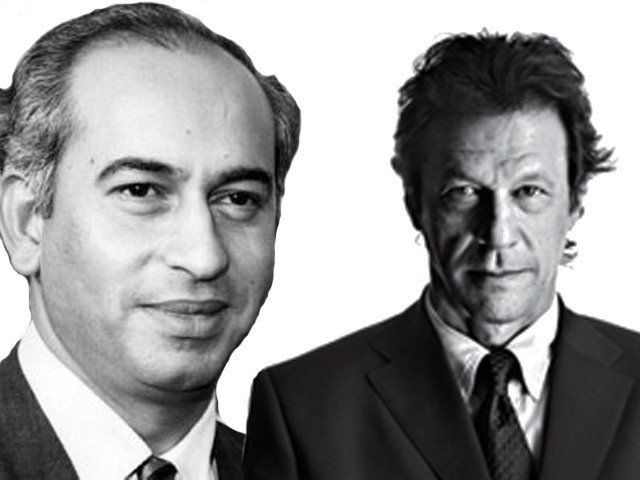
Bhutto’s legacy shaped the political movements of resistance in Pakistan that underlined the struggle against dictatorial regimes in the country because his family suffered the most. Countless political leaders have strived to imitate Z A Bhutto in their political rhetoric. But his miraculous genius was such that no one could command people’s respect in the same way that he did. Many believe that Imran Khan has emerged as a leader who has given people the hope of building a better Pakistan in the same way that Z A Bhutto did.
Imran Khan certainly appeals to millions of young people across the country who have been drawn to his anti-corruption mantra. Our youth has grown up under the shadow of a political system that is punctuated by corruption, rent-seeking, favouritism and the expediencies of conventional family dynasties.
The traditional political parties of hereditary politics failed to promote an inclusive democratic culture. While educated youth from middle-class backgrounds were excluded from political participation, the inept, powerful families held sway in connivance with the powers that be to perpetuate an exclusionary political system.
Although Imran Khan opted for the same route by seeking the support of such powers, his constant anti-corruption narrative was what made him so popular. For the middle-class youth in Pakistan, Imran Khan symbolises the hope to reconstruct the political system by emphasising meritocracy, transparency and social justice. Those who haven’t experienced the political woes of the 1970s and the 1980s tend to forgo the debate surrounding democratic transition in favour of fanciful shortcuts to improve the system of governance in the country.
The grand narrative of democracy versus its alternative hasn’t found resonance among the middle-class youth who find faults with individuals rather than the system as a whole for our current malaise. For them, Imran Khan’s persona transcends the debate of systemic and structural challenges to an inclusive democracy in Pakistan. The debate on institutional restructuring to achieve constitutional and parliamentary supremacy, which has been articulated by conventional political parties to compete with the anti-corruption narrative, has failed to win over the hearts and minds of young people.
There was certainly a palpable contradiction in the debate of parliamentary supremacy orchestrated by political parties that are run through family dynasties. Progressive and secular voices for genuine democracy were either overshadowed or subsumed in the grand narratives of parliamentary supremacy versus anti-corruption. Progressive and alternative perspectives on the significance of democratic transition didn’t find sufficient space or, for that matter, attract an audience in the privately-run electronic media. TV debates were anchored to simulate the political reality of the two mutually exclusive camps in this political rivalry insofar that the genuine voices of political alternatives were excluded.
While the patronage accorded to the PTI was visible, there was also an element of optimism for which we should give due credit to Imran Khan’s political tirades that were smartly woven together with the notion of Naya Pakistan.
The appeal for Naya Pakistan was so emphatic that it concealed the contradictions of the conventional tactics employed by Imran to gain political power. Having grown up in a depoliticised society, our young generation found this narrative more appealing than any other debate of genuine democracy. Indeed, there were no convincing and assertive vibes from liberals and secular elements to confound Imran’s ambitious move to trespass democratic norms and contain his mercurial political behaviour.
It would be misleading to believe that the young people who have been mobilised by the concept of Naya Pakistan will be content with this slogan alone. Imran Khan’s real challenge will start when he takes on the role of the country’s PM. He will have no option but to deliver on his promises for which he will have to surrender part of his individuated political ego. Introducing political and economic reforms isn’t smooth-sailing in the turbid waters of crony capitalism whose tentacles are deeply immersed in our political system of patronage.
Those who have invested to ensure Imran Khan’s victory have their own reason for doing so, and that is not to let him have a free rein. The political stakeholders of Imran’s Naya Pakistan will haunt him at every step of the way to ensure that he maintains the political propriety to survive. Imran Khan doesn’t have the luxury to sail in two boats – ie living up to popular expectations and pleasing his political patrons – at the same time. Living up to voter expectations means creating jobs, reducing inflation, broadening the tax net, introducing land reforms, and implementing many more reforms that require a strong system of political accountability.
Furthermore, these changes will be impossible to implement without making the economy competitive at the displeasure of crony capitalists who are poised to destabilise political governments. It is believed that Imran’s rise to power wouldn’t have been possible without the support and patronage of this powerful elite. If that is the case, the PTI’s reform agenda might suffer a serious blow, opening the floodgates of political agitation from an already aggrieved coalition of opposition parties.
Imran Khan will need to present a realistic political roadmap for the next five years to fix the country’s mounting economic and political problems. He will have to work meticulously to build a strong political coalition within parliament to ward off political resistance and realise his promises of Naya Pakistan.
Imran Khan isn’t a revolutionary. But he claims to be a reformist, which is also reflected in his party’s political manifesto. Nonetheless, his political tactics aren’t entirely different from those adopted by traditional political leaders – ie using all available means to assume power without any regard for ideological principles. This is perhaps the fundamental difference between Z A Bhutto and Imran Khan as the former was able to cultivate a strong ideological framework to serve as the guiding principles for his politics.
Courtesy The News