By: S Y Quraishi
The general election in Pakistan is being described as a milestone in the democratic history of the country. This is only the second transition from one full-term civilian government to another, and the first under the new Election Law, 2018. I got a great opportunity to observe the event from a ringside seat as a member of the Commonwealth Election Observers Group. The 15-member group headed by Abdulsalami Abubakar, former head of state of Nigeria, spent 12 days to observe events leading up to the election, the polling and counting day and the declaration of the results over three days.
The group met delegations from the leading political parties, civil society and the media to understand the pre-electoral environment, which was reported to point to a not-too-fair election. We were told of massive pre-poll “rigging”. Mainly, three things were cited: Forcing of certain party leaders to return their tickets, muzzling of the media, and misuse of the army and judiciary in favour of a particular party. It is difficult to understand how the changing loyalties of political leaders can be described as rigging — such political engineering is common in the Subcontinent where turncoats and horse trading are household terms. Some media representatives said that after a lot of subtle and overt intimidation, many have decided on self censorship as a wiser option. The hold of the army on institutions like the judiciary, the National Accountability Bureau, the media, etc was a common refrain. We were told naming the army was taboo, full of risks. Therefore, alternative expressions or euphemisms had been evolved, like “establishment”, “powers that be”, “khalai makhlooq” (people from outer space), “angels” and even “agriculture department”.
People who questioned the impartiality of the military and judiciary cited the timing of court cases against certain political leaders and candidates. Media were allegedly prevented from fully covering certain issues like the rights of the minorities and the role of state institutions. For the poll-day arrangements, questions were focused on the large-scale deployment of the army. Concerns were raised about the order to deploy soldiers inside the polling stations. We, therefore, decided to focus special attention on these concerns.
We observed that candidates from across parties and independents were able to campaign freely and peacefully. Maybe we arrived too late, by which time the games were already played. The overall security situation was tense, especially in Khyber Pakhtunkhwa (KPK) and Balochistan, where terrorist attacks in the preceding weeks claimed more than 170 lives, including of three candidates. However, the parties were able to organise their rallies freely as per Election Rules 2017. A lot of negative and abusive campaigning was initially reported but after the Election Commission of Pakistan’s (ECP) stern action under the model code, most people fell in line.
We found the electoral system quite robust, with a substantially reformed legal framework consisting of the Constitution of Pakistan, the Elections Act, 2017 and Election Rules, 2017, which has led to a greater autonomy of the ECP, including financial autonomy, power to make rules and punish for contempt, and to deregister or delist an existing political party. Officials deputed for election duties have now been brought under the ECP’s disciplinary control.
Some legal reforms for enhancing women voters’ participation are noteworthy. The ECP can declare an election null and void if less than 10 per cent women have voted in a constituency. This had a salutary effect in those frontier regions where women were traditionally not allowed to vote. Each party has to nominate a minimum of 5 per cent women candidates for the general seats in the National Assembly. This is in addition to 70 seats in the National Assembly (272 members) which are filled by nomination by the political parties according to the number of seats won. (Incidentally, 10 seats are reserved for minorities). Special campaigns by the National Database and Registration Authority (NADRA), political parties and civil society helped increase their enrolment as voters. Separate polling stations for women, run entirely by women, also encouraged turnout.
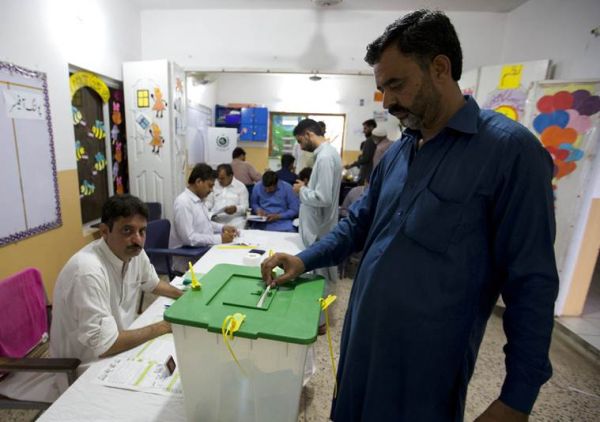
Polling day passed off peacefully much to everyone’s relief. There was a 53 per cent turnout, significantly higher than the 48 per cent in 2013.
Unlike India, the counting in Pakistan is done at the polling station itself immediately after polling closes. There were several questions raised about the counting. Some parties alleged that the polling agents were not allowed to observe the counting from close up. Some complained that their agents were thrown out of the stations. There were allegations that Form 45 (result sheet) was neither given to polling agents nor pasted on the wall of the PS. The ECP denied the first allegation clarifying that only those agents who were in excess of one per party were asked to leave. It, however, admitted to several instances of the second allegation and promised to take action. The ECP also admitted the failure of the Result Transmission System because it had not been pilot tested adequately. The foreign minister, whom we met, attributed this, in a lighter vein, to the failure of the British technology on which the app was based.
The conduct of the proscribed militant-dominated religious organisations was watched with interest, a phenomenon of special concern to India. We noted that the ECP, in accordance with the law, did not allow the registration of such entities and individuals to contest elections. However, its mechanism for filtering candidates linked to such organisations was weak which led to three candidates managing to slip through scrutiny. They were, however, delisted on the eve of the election after a hue and cry of the media and civil society. It is remarkable that religious parties with extremist connections were totally routed both in national and provincial assemblies. Tehreek-e-Labbaik managed to get only two seats in Karachi whereas the Allah-o-Akbar party drew a blank.
The elections were closely observed by a huge force of volunteers of civil society led by the Free and Fair Election Network (FAFEN) and Trust for Democracy Education and Accountability, besides international observers from the EU, Commonwealth and several diplomats. FAFEN deployed 19,683 citizen observers (including 5,846 women) at more than 65,000 polling stations (almost 80 per cent of the total). Most observers were satisfied with arrangements and conduct of elections. The Commonwealth group commended the ECP for a laudable job in the short time it had to implement its mandate for holding transparent elections on schedule. It regarded the General Election 2018 as an important milestone in strengthening democracy in Pakistan.
Courtesy Indian Express