Though the habit of comparing comes naturally to all of us, it has its own drawbacks and is thus best avoided. However, there are occasions when eluding comparison becomes practically impossible even despite the best of efforts and I faced such a situation while going through the newspaper on Monday morning. While there was nothing new in the news, what caught my eye on Page 6 of Times of India were two reports that appeared side by side. The first read, “3 militants who killed J&K cop shot in Kulgam” and the adjacent news caption mentioned “Naga talks on track, states boundaries to remain unchanged.”
While I had already read all about the Kulgam incident from digital editions of Kashmir media, the news report regarding Naga talks was, in a way, ‘breaking news’ for me and so I read it first. Having done so, my eyes automatically shifted to the Kulgam occurence as I was curious to know how this incident was covered by national media. However after reading this report I could not hold myself back from comparing the Kashmir issue with that of Nagaland since both these states have ‘independence’ movement going on. However, the similarity ends here because even though both Nagaland and Kashmir have seen an ‘armed struggle’, Nagaland is today peaceful since the Isak- Muivah faction of the National Socialist Council of Nagaland or NSCN (IM) has signed a ceasefire accord with New Delhi.
On the other hand, the ‘armed struggle’ in Kashmir continues unabated and with the Hurriyat and militant groups outrightly rejecting the center’s Ramzan ceasefire offer, it’s absolutely clear that peace will continue to elude us. On the other hand, by signing a ceasefire accord and entering into dialogue with New Delhi, the NSCN has ensured that neither have the aspirations of the people been compromised and nor are they being brutalised due to the fighting between security forces and Naga rebels. And that’s why the ordinary Kashmiri who has been bearing the brunt of the ‘armed struggle’ for three decades needs to be told why can’t the more civilised and peaceful alternative of resolving the ‘K’ issue through dialogue be given a chance?
What needs to be remembered is that death and injuries aren’t the only negative end products of violence as it has other adverse psychological effects associated with post traumatic stress disorder (PTSD) and its manifestations that have far reaching consequences. A study carried out by Medecines Sana Frontiers (MSF) in 2016 notes that one out of two people in Kashmir valley are suffering from symptoms of some type of mental disorder. This report has also reveals that 50 % of women and 37% of men were victims of “probable depression” while 36% women and 21 % men had “probable anxiety disorder.” A whopping 22% of woman and 18% of men were likely to be suffering from “probable post traumatic stress disorder (PTSD).
And though the MSF report has negated the view that Kashmiris are resorting to use of drugs as “coping strategy,” this inference may have been due to the hesitation people have in accepting being addicted to drugs. However, in his well researched paper ‘Drug Addiction and Youth in Kashmir,” M Naqshbandi has noted that the ongoing conflict was one of the prime causes drug addiction in Kashmir and in his 2007 study sponsored by Center for Study of Developing Societies, FK Sudan too has revealed that “youth of Kashmir consistently reported that they have serious psychological and social difficulties as a result of the ongoing violence and deprivation they had experienced.” He concludes that “many young men and women try to overcome their disappointment, stress, depression by shifting to different drugs.”
Besides the physical and psychological problems, the violence riddled atmosphere prevailing in Kashmir has also had an adverse effect on our societal behaviour. Kashmiri youth today display a confrontationist attitude and the lack of respect towards the elderly and openly disobeying them is proof of this. Despite being told by our leaders to observe peaceful demonstrations, the youth invariably start pelting stones; when requested not to display Islamic State (IS) flags during protests they make it a point to do so. And during the 2016 unrest several incidents of youth showing disrespect to the elderly came as a big shock to all of us as this was something no one had ever expected!
Let’s return back to Nagaland. Angami Zapu Phizo who created The Naga National Council (NNC) declared the independence of Nagaland on 14 August 1947. He was arrested on charges of rebellion and after his release Phizo became President of NNC. In 1952, an armed conflict broke out between the NNC and Indian security forces and this bloody confrontation continued for nearly two and a half decades. However, after realising the futility of violence and the hardship it was causing to the Naga people, the NNC signed a ceasefire agreement with New Delhi in 1975. Unfortunately, hawks within the NNC who didn’t approve of the ceasefire formed the Nationalist Socialist Council of Nagaland (NSCN) and continued with their ‘armed struggle’.
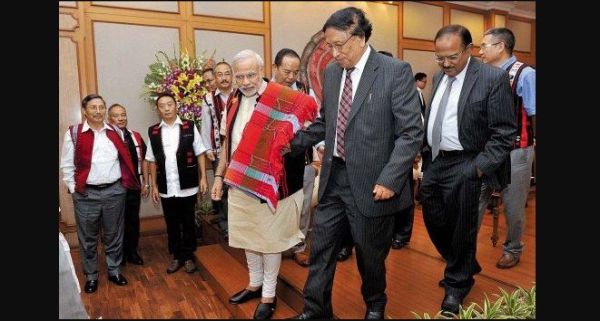
After 22 years of fighting, the NSCN also realised that their ‘armed struggle’ was taking a heavy toll of human lives and making life miserable for Naga people without giving any benefits and in 1997, the NSCN (IM) leadership entered into a ceasefire agreement with New Delhi and guns fell silent. With this peace finally returned to Nagaland after nearly four and a half decades and with normalcy prevailing, Nagaland saw considerable prosperity. Even though the Nagaland issue hasn’t been resolved as yet, but since public sentiments are against the return to guns and in favour of dialogue, the Naga leadership doesn’t have resort to theatrics or display undue haste. And this in turn creates the ideal environment for negotiations.
By eschewing violence the NSCN has gained considerable international recognition and support for its cause. It’s a member of Hague based Unrepresented Nations and Peoples Organisation (UNPO) and has opened up contacts with many other international organisations like the United Nations Human Rights Council (UNHRC) and UN Working Group on Indigenous Populations (UNWGIP). Besides this, it enjoys the support of several reputed and influential international NGOs. Due to the wise decision of putting the gun aside and seek a peaceful resolution to the Nagaland issue, the leaders and people of Nagaland are in a ‘win win’ situation!
Tailpiece: Skeptics will find innumerable reasons to reject the comparison of Kashmir with Nagaland and they may even be ‘technically’ right. However, the idea here is not to compare but learn from the ‘armed struggle’ experience of NSCN (IM). Thus, for resolving the Kashmir issue can’t we at least examine the feasibility of adopting the NSCN (IM) strategy of talking it out rather than fighting it out?