BY: Girish Shahane
A joke from the 1980s went, “Sanjay Gandhi advocated family planning and died making a loop.” Indira Gandhi’s younger son was the worst product of the Nehru dynasty, a corrupt sociopath who inherited all his mother’s flaws but none of her virtues, and led India down a dangerous path during his years in power. On his death anniversary last week, the Indian National Congress stayed true to the sycophantic culture that mother and son nurtured, by tweeting, “We fondly remember Sanjay Gandhi, visionary leader and an advocate of the poor. He championed the need for affordable cars in India.” That affordable car, named the Maruti, was a lemon that cost the government crores of rupees and emptied the pockets of a few businessmen who were pressurised to back the project. Years after Sanjay Gandhi’s death, it was resuscitated as a successful joint venture with the Japanese company Suzuki, as India’s leaders finally understood there was no point reinventing the wheel, and we were no good at it anyway.
I’ve said Indira Gandhi had virtues, and so she did, but the quality that made her stand out, her ruthlessness, could be a strength as well as a weakness. Placed on the throne as a pliant puppet, she proved herself iron willed and a master manipulator. She took up arms for the cause of Bangladesh in defiance of the United States, and carried India’s involvement to its logical conclusion, a war whose moral foundations were firmer than those of most such conflicts. Richard Nixon and Henry Kissinger both hated her with a passion. Tapes of their conversations reveal the American President wishing a famine upon India, his Secretary of State deprecating activists sympathetic to “dying Bengalis”, and both agreeing that India intended to absorb Bangladesh into itself through endless occupation. In the event, India acted honourably, leaving the new nation to its own devices and extracting few concessions from the defeated Pakistan beyond Bangladeshi independence.
Following the war, which was her finest moment, Indira Gandhi accelerated India’s acquisition of weapons of mass destruction, presiding over what was officially called the Peaceful Nuclear Explosion, though there was nothing peaceful about it. When her popularity waned thanks to double digit inflation and mass unemployment caused by misguided economic policies, she abrogated civil rights under the excuse that anarchy was being unloosed upon India’s streets. Her acolytes and those of her son threw political adversaries in jail, clamped down on the media, and oversaw tens of thousands of forced sterilisations. The Congress party has never had the honesty to admit that the Emergency was a disaster from start to finish.
Operation Blue Star
When Indira Gandhi came back to power after a spell in opposition, she faced an insurgency in Punjab, and sent troops into Sikhism’s holiest site, which had become a haven for terrorists. Operation Blue Star, as it was called, required far more force than the army chiefs had estimated. The backlash against it ended up claiming her life. The Bangladesh war, the pursuit of nuclear weapons, the Emergency, and Operation Blue Star, all arose from Indira Gandhi’s ruthless determination, but occupy very different spots on the moral spectrum. In certain situations, ruthlessness can be a virtue, or an aid to virtue; in others it is a vice.
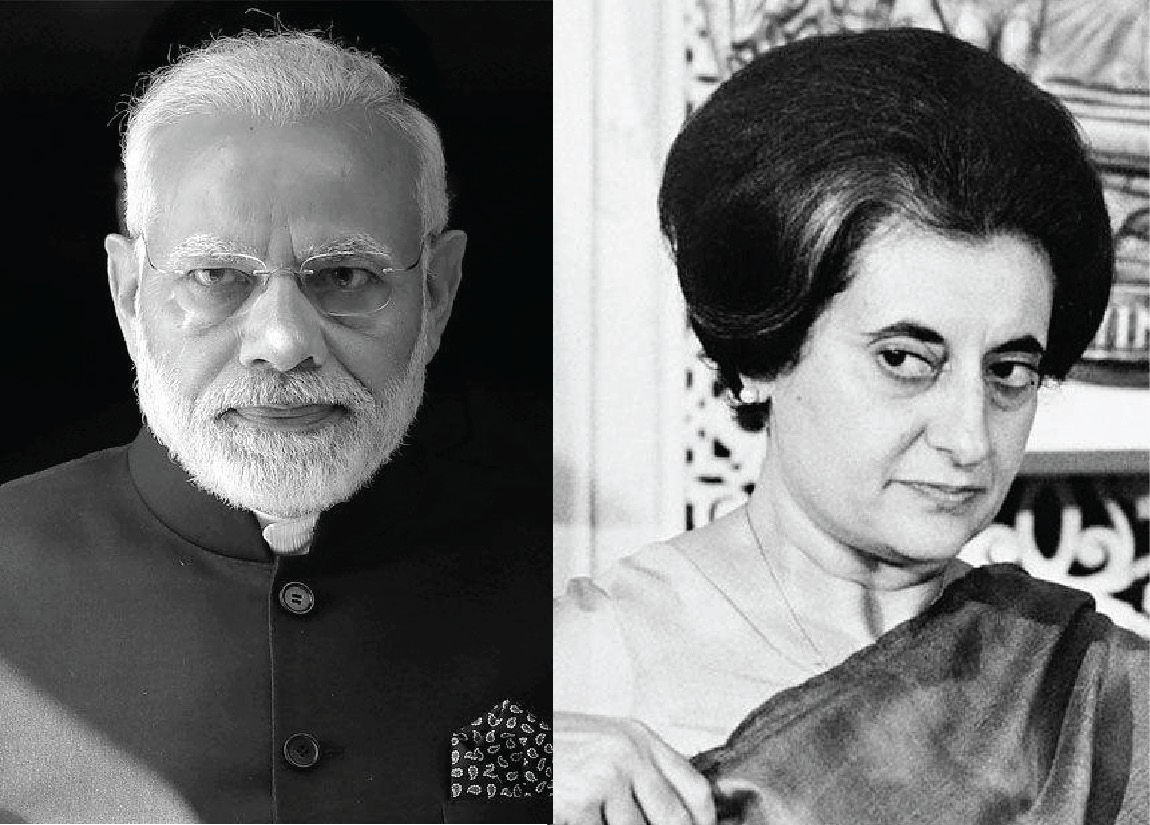
As Narendra Modi rose to power, many commentators saw in him shades of Indira Gandhi. He received any criticism of his policies as an insult to the entire state of Gujarat, an identification akin to the one made by Indira Gandhi between herself and the nation. Like her, Modi encouraged a personality cult, manipulated and threatened media outlets, and displayed an authoritarian streak. Writing about the connection between the Prime Ministers in a column three years ago, I asked whether Modi would cling to power in the manner Indira had, were his popularity to plummet. Would he curtail civil liberties, the freedom of the media and the independence of the judiciary?
That question remains open. Modi is still popular enough not to feel seriously threatened, and with the economy doing reasonably well, we have experienced no civil unrest on a scale comparable to 1974. There’s no doubt, however, that a united opposition would seriously threaten the ruling party’s power in next year’s general election, which keeps the issue relevant. My sense now is that Modi is no Indira Gandhi. While she embodied the maxim of speaking softly and carrying a big stick, he is a braggart and a bully, and we know braggarts and bullies seldom have the courage to follow through on threats. Modi has not even increased the growth rate of defence spending beyond what the previous administration established, something one would expect of any right-wing government. I wish he had been more assertive in aspects of his foreign policy, but on the whole India is best served by a weak Modi, for ruthlessness, in the contexts in which he might currently employ it, would cause much damage and provide few benefits.
Kashmir conflict
Consider the situation in Kashmir, where the Bharatiya Janata Party now proposes a more muscular approach, having pulled out of its coalition with the People’s Democratic Party. Has India been short of muscle in Kashmir? What would a more muscular policy entail? More security forces, more killing, more civilian protests, yet more killing. I am not among those who hold there can be no military solution to a political crisis. I recall a panellist mouthing that cliché in a television debate against KPS Gill, who responded, simply, “But there is peace in Punjab.” Gill and police officers serving under him killed enough terrorists to calm a troubled state at the end of the 1980s, committing hundreds of atrocities in the process, a trade-off he and his political supporters were content to defend, and which the nation at large happily accepted.
The insurgency in Kashmir, though, has deeper and wider roots than the Khalistan movement ever did, and is supported far more robustly by Pakistan, whose backing of militancy in Punjab was half-hearted, founded on an obligation to weaken India in any way possible rather than any identification with the cause. Attempting to bring calm to Kashmir Punjab-style would involve violence on a genocidal scale, with little guarantee of success.
We should be grateful, then, that Modi’s talk of a more muscular Kashmir policy is likely to remain just talk, in the manner of Make In India, Smart Cities, and the National Health Insurance Scheme.
Courtesy www.scroll.in