By: Shaikh Mujibur Rehman
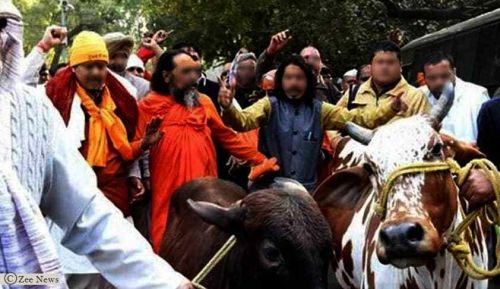
Post-2014, cow vigilante groups have emerged as the most prominent non-state actors in India in terms of their capacity to unleash violence. They strike at will even in regions not governed by the Bharatiya Janata Party (BJP). Given the shoddy nature of the allegations levelled by these groups, the objective seems more to target Muslim traders and citizens than rescuing cows. The brutal attack on two Muslims last week in Hapur, Uttar Pradesh is the latest instance of this pernicious trend. Hence, it would be more appropriate to call these groups as Muslim vigilante groups.
The cow protection movement has a long history that goes back to the colonial days. Gandhiji wrote: “But, just as I respect the cow, so do I respect my fellow-men. A man is just as useful as a cow no matter whether he be a Mahomedan or a Hindu. Am I, then, to fight with or kill a Mahomedan in order to save a cow? In doing so, I would become an enemy of the Mahomedan as well as of the cow. Therefore, the only method I know of protecting the cow is that I should approach my Mahomedan brother and urge him for the sake of the country to join me in protecting her.” (Hind Swaraj, chapter 10). Had Gandhi been alive today, he would have protested the Dadri lynching with a fast unto death. Like Nayantara Sahgal, Gandhi would have wanted a ban on man slaughter. But Gandhians like Anna Hazare are silent. While Gandhiji urged for persuasive approach, the Hindu right believes in creating a climate of fear and intimidation.
For decades the Hindu right has campaigned for cow protection as a Hindu-Muslim issue, as if Muslims took to beef eating only to humiliate Hindus. No definitive theory exists of how Muslims took to beef eating; but none approves the humiliation of Hindus as the reason for Muslims to resorting to beef eating. As Dalits too eat beef, this is a Dalit issue as well. As a cause, cow slaughter is limited to the upper castes.
A churning
A comparison of the protests triggered by the Dadri lynching in 2015 and the Una flogging in 2016 sheds crucial insights into the political churning taking place in both communities. In the first instance, artists and intellectuals, and not Muslim organisations, led the protests. Despite vigilante violence, Muslims have conducted themselves with remarkable dignity, showing their unwavering trust in India’s constitutional polity.
No doubt the cow protection movement has struck a chord with many Hindu conservatives, most of whom constituted various levels of leadership of the Congress and non-Congress parties under whose patronage anti-cow slaughter laws were passed in various States long before the BJP came into existence. The difference between the Hindu right and Hindu conservatives is their position on vigilante violence, which a majority of Hindu conservatives do not approve of. What political colour their silence takes in the future will determine the future of Hindu-Muslim relations.
Dalits, on the other hand, came together in massive protest after the Una flogging, forcing the Prime Minister to make a statement on August 6, 2016. Their protest is said to have been a major reason why Anandiben Patel resigned as Chief Minister of Gujarat a few days before this. Interestingly, the name of Dadri victim, Mohammad Akhlaq, that parliamentarian Sugato Bose described as “a beautiful name” in a parliamentary debate in 2015, has yet to be acknowledged by the Prime Minister.
Differences and the state
When Mohammad Ali Jinnah campaigned for Pakistan, Muslim settlement in “geographically contiguous areas” was a favourable factor for Muslim separatists to argue for their cause. But B.R. Ambedkar could not make a similar case for a Dalit homeland because he did not have the argument of “geographically contiguous areas”. Hence, he upheld the message, “educate, organise and agitate”. The Dalit uprising post-Una is a glorious tribute to that message of Ambedkar.
That Muslim food habits, particularly beef eating, could be a major impediment to harmonious life in a free India was foreseen by Muslim separatists. Jinnah made a categorical argument that a separate homeland was necessary on account of Muslim food habits, among others. Unconvinced by the claim that Indian Muslims as a religious minority would be granted all the freedom that they could possibly enjoy in future Pakistan, he gave a new twist to his campaign at Lahore in 1940. He argued by saying, “Mussalmans are a nation according to any definition of a nation, and they must have their homelands, their territory, and their state”, and opposed the tag of Muslims as religious minorities. It would undermine Indian democracy if the vigilante violence against Muslims serves to project those fears of Jinnah and other Muslim separatists as legitimate.
In its fight against radical Islam, the Indian state has launched preventive arrests; often, innocent Muslim youths become its tragic victims. No such effort is seen with regard to the vigilante groups, though the Prime Minister has declared that most gau rakshaks have a criminal background. Gandhiji understood that India has enormous potential for violence, which is why he chose the path of non-violence, according to Paul Brass. The continuation of vigilante violence would only make India even more vulnerable to violence.
Courtesy The Hindu