By: Adnan Abu Amer
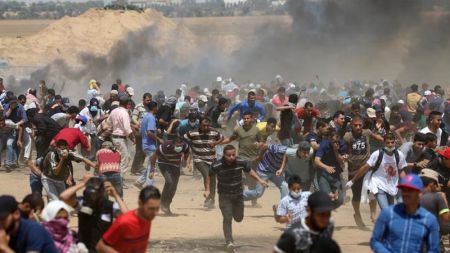
When Palestinians launched the Great March of Return on March 30, Israel sensed an opportunity for confrontation. It started sniping down one unarmed protester after the other, while blasting propaganda about how these Palestinians constituted a “threat” to its security and how it had the “right to defend itself”.
To date, Israeli soldiers have killed more than 120 peaceful Palestinian protesters. But the Israelis did not stop there.
As international public opinion swung dangerously against their favour, the Israeli occupation forces began to respond to the peaceful demonstrations by targeting armed resistance groups in Gaza, bombing their training grounds, arms storage, tunnels and logistics capabilities, as well as assassinating several of their members.
The Israeli army had no justification for these attacks; it simply wanted to enforce a new reality on the ground: That peaceful resistance would be met with brute force and any escalation would be followed by a broader military assault.
After some deliberation, a military response was launched from Gaza. Many within the armed resistance groups were convinced that Israel should not be allowed to impose this new reality on the ground and should be shown that there will be a response to its military assaults.
What this episode shows, however, is that it is increasingly difficult for Israel to maintain the status quo. Its strategy of “Gaza will not live and will not die” no longer seems to be working. It fears that small improvements and patches will no longer appease the Palestinians.
And it is in this context that Israel seems to face three options in Gaza: reoccupation, another war, or lifting of the siege.
Reoccupation
There have been some voices of the extreme right in the Israeli government, military and intellectual elite who have been calling for a reoccupation of Gaza. They believe that establishing militaring control over the strip again could remove the threat that it poses.
They call for taking over the entire strip with troops on the ground and carrying out a comprehensive eradication operation against Gaza’s armed groups. After that is fulfilled, Gaza would supposedly be handed over to a third party, such as the Palestinian Authority or an international body, to address and administer the humanitarian needs of the population.
Those who advocate for this solution know full well that they are looking at a bloody disaster. Israel will undoubtedly meet severe resistance in Gaza which would lead to dozens, if not hundreds of Israeli soldiers killed. There is nothing more painful for Israel than to have its soldiers return from the battlefield in black body bags.
If it reoccupies the strip, the Israeli state will then have to provide the minimum level of food, water and electricity to the economically exhausted population. That would put a heavy strain on the government budget.
The death toll that such a military operation would exact on Gaza’s civilian population would mean a harrowing defeat on the international stage for the Israeli narrative. International outrage at Israeli crimes is growing day by day and it will eventually reach a breaking point.
It is important to mention here that this option is not very popular within Tel Aviv’s decision-making circles, whether in the government, army or intelligence, because they realise just how steep the price they would pay is.
A crushing war
This option of another major military assault on Gaza is popular with influential political and military figures in Israel as it is perceived to be less costly than reoccupying the strip. It seems to fulfill the urgent need to come up with a new deterrent against Hamas after its recent missile attacks on Israeli settlements near Gaza.
Israel has grown accustomed to launching an attack on Gaza every few years, as part of its “mowing the grass” policy. Whenever the Hamas’ capabilities – whether human or logistical – grow, a need arises to cut them back through air attacks or field assassinations that restore Israel’s deterrent for a few more years.
After the several operations Israel launched between 2006 and 2014, it may well be about to launch another one. In spite of their conviction that this option is needed soon, high-ranking generals are leery of it because they know the Palestinian armed groups have rebuilt their capabilities and prepared their ranks over the past four years.
A war with in Gaza would not be a picnic, but they see it as a necessary evil or a “no choice war”.
Complete disengagement
This option would see Israel lifting its siege on the Gaza Strip economically and administratively. It would also include the construction of a sea port or an airport under Israel’s tight security control and international guarantees.
This option takes the burden of supporting Gaza’s two million inhabitants off Israel’s shoulders, but its strategic implications make the Israeli leadership shy away from it. It would make the creation of a Palestinian entity with state-like features feasible, without it having to present the customary “instruments of obedience” to Israel, as the West Bank does.
In addition, there wouldn’t be enough guarantees that Hamas would not take advantage of these new port facilities to bring in weapons that may well upset the military status quo.
As the situation on the ground in Gaza changes and Israeli threats against Palestinians increase, all of these three options are possible. Israel will make its detailed calculations on each one of them, but in the end, developments on the ground will determine which way events unfold.
Courtesy Aljazeera