BY: Mirza Waheed
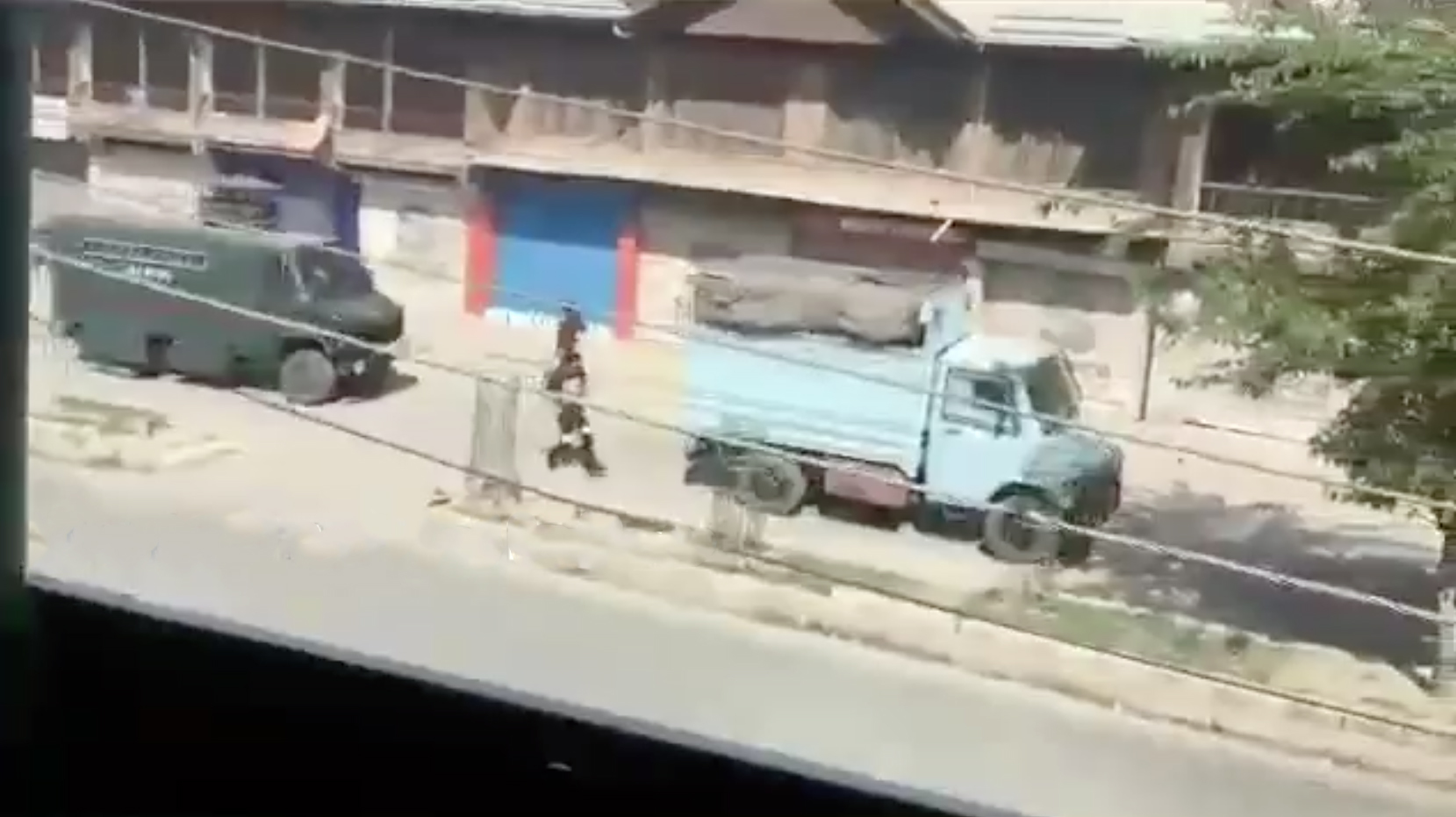
A young man by the name of Adil Ahmed Yadoo was mauled to death by a police vehicle on May 5 in Kashmir. Adil had been pelting stones at Indian paramilitaries and police as protests broke out once again in Kashmir following yet another gun battle between Indian armed forces and Kashmiri militants.
You watch the video even as a voice inside says, “Don’t.” Your nine-year-old might pop into the room just as you go full screen. You won’t be able to explain anything mid-gasp. You watch even as you know it will be disturbing, looking wide-eyed as a young man from home is flattened by a monster vehicle. You watch, pause, and rewind a tiny bit, to ascertain the exact moment Adil is mown down.
In an alternate, imagined viewing, you hope the truck stops at the precise moment the boy is about to come under the wheels. But you know it won’t because it didn’t. You also hope that watching the video for yourself will tell you that what you have read and heard about the incident so far was wrong. That it was not that horrifying, or probably not even true. Perhaps it was an accident; perhaps the police driver lost control, went a bit berserk, and ended up killing the boy. All that, however, belongs firmly to the imaginary. The mowing down of the 18-year-old protestor is entirely true. You’ve just watched the video. The vehicle doesn’t pause, doesn’t swerve to give the boy a sliver of a chance. It doesn’t brake, it just roars ahead. A Kashmiri voice is heard saying, “moud ha.” He’s died.
Adil’s killing might have been passed off as an accident, and the government did make a lazy attempt to spin it so, but for the video which was filmed, as it appears, from a window across the street in downtown Srinagar where Adil was among other protesting boys pelting stones.
The boy was taken to the Shri Maharaja Hari Singh Hospital, the main hospital in Srinagar, where most of Kashmir’s injured, maimed, and blinded are taken, where a multitude of Kashmir’s wounded and dead have been taken since 1989, when the Indian state decided that the only way to deal with the uprising was to kill the boys. At the hospital he’s declared dead, his internal injuries gifted by a fortified personnel carrier far too many to allow him any hope of life.
An entire range of methods
This is not a common mode of killing Kashmiris. There exists an entire range of methods. Running fat vehicles over young bodies is just the latest.
We’ve, of course, seen killings by the bullet, as thousands interred into graveyards, gardens, and mountainsides will testify. Death by tear-gas canisters breaking open skulls, too, as 17-year-old student Tufail Matto raises his hand from the afterworld. Tufail was killed as he returned from tuitions in 2010 during another of Kashmir’s many bloody summers. You can also kill a Kashmiri by pumping 300 lead pellets into his body from close range, as the dead cash-point guard Riyaz Ahmed Shah will confirm. Or, if you choose, you can bludgeon them to death, countless blows of rifles and iron rods ensuring a life is extinguished as effectively as a dagger to the throat. Young academic Shabir Ahmed of Khrew, who was beaten to death by “drunken soldiers”, will tell you this via his surviving wife and little son. The Army that did that to him later said his killing was “regrettable”. Nothing more.
If you’d, perchance, like further proof or illustration of the many ways of killing, you will need to go back in time to find Sameer Rah who was clubbed to death after he had shouted a few slogans. He had a piece of fruit in his mouth when his body was found dumped in poison ivy bushes in August 2010 when protests raged across Kashmir and the Indian state, once again, decided to shoot its way out of a political crisis. Sameer would’ve turned 16 this year.
You can also pick the poorest of the poor in Kashmir, take them to a forest with the promise of rewarding work, murder them in cold blood, mutilate their faces, brand them terrorists, and shout encounter, yeah!
There are many more listings in the macabre catalogue.
You can kill a Kashmiri, protestor or not, young or old, girl or boy, by blinding them for life, as hundreds of haunting eyes in dark rooms across the Valley might signal to you, all dreams snuffed out with a pull at the trigger of the birdshot gun deployed to suppress protests in Kashmir.
You can also kill a Kashmiri’s soul by tying him to the front of a truck with ropes – after having beaten him – tie a placard on his chest, and parade him for hours as a human shield. You can then humiliate him further, a year later, as a ruling party member extols the virtues of torture by selling clothing with a representation of the scene emblazoned on the front. It turns out torture t-shirts sell rather well in new India. Farooq Ahmed Dar, whose torture video went viral last year, continues to murmur a one-word reminder: justice. His torturer was given a medal. This year, as many more Kashmiris, militants and civilians, are killed, it’s the video of Adil crushed by an armoured vehicle that has gone viral.
Kashmir and Kashmiris are now almost entirely cornered in a siege where militarism of the most vicious kind is an everyday, routinised affair. The slain are mourned, protested, and memorised momentarily, until another Kashmiri is killed by another means. One shudders to think what new ways of Kashmiri-killing might Delhi devise to silence dissent and aspirations for freedom and justice.
There may, however, still exist a simpler way of dealing with the troublesome, dissenting, and annoyingly imperishable Kashmiri: talking. You might be surprised to find out they are quite capable of and rather good at conversation. What’s more, it doesn’t involve killing.
Mirza Waheed is a novelist and the author of The Collaborator and The Book of Gold Leaves.
Courtesy Scroll.in