By: J Berkshire Miller
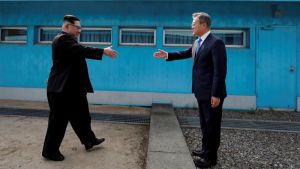
Last month, reclusive North Korean leader Kim Jong-un continued his diplomatic charm offensive when he stepped over the demilitarised zone border – which has divided the two Koreas since the 1953 armistice – and held summit discussions with South Korean President Moon Jae-in. The meeting, which was the third occasion for an inter-Korea summit, has received mixed reviews from analysts and foreign stakeholders in the region.
During the summit, Kim and Moon released the Panmunjom Declaration where both sides made pledges to enhance high-level dialogue, reduce tensions on the peninsula and a host of other confidence-building measures. It was historic in many regards, and we should applaud the Moon administration, in part, for its ambitious approach to reduce tensions on the Korean Peninsula.
However, on the critical issue of North Korea’s nuclear and ballistic missile programmes, there was no concrete path forward on denuclearisation – which is a key condition for the US, South Korea, Japan and others in the region. During the meeting, Seoul and Pyongyang “confirmed the common goal of realising, through complete denuclearisation, a nuclear-free Korean Peninsula”, but there was no tangible path forward to verify this process. This was in stark contrast to previous commitments, all of which were subsequently broken by Pyongyang, made by North Korea over its nuclear programme. For example, during the Six-Party Talks in 2005, North Korea agreed to verifiably denuclearise its programme through the allowance of inspectors from the International Atomic Energy Agency (IAEA) and an eventual return to the Nuclear Non-Proliferation Treaty (NPT).
Of course, much has changed since 2005, especially the dramatic enhancement of Pyongyang’s weapons of mass destruction (WMD) and missile capabilities. However, the comparison remains an instructive point and the critical issue of verification must be addressed sufficiently, if there is to be any deal coming out of a looming summit between Kim and US President Donald Trump in the coming weeks. Indeed, the outcome of that meeting will serve as a key catalyst for the future trajectory of inter-Korea ties.
How are things likely to pan out for inter-Korea relations in the coming months?
On the positive side, the Moon administration can point to tangible, and rapid, improvements in the inter-Korea relationship over the past year. Some examples of this, in addition to the recent summitry, include the resumption of military hotlines, more frequent political dialogue, people-to-people exchange, and pledges to avert conflict around the historically tense Northern Limit Line in the West Sea. Indeed, the Moon administration is pulling out all the stops on its neo-Sunshine policy aimed at bringing North Korea in from the cold. Of course, much of this is also wrapped up into Moon’s sense of pan-Korean identity, in which he shares a fraternal tendency to reunite the Koreas, despite their stark divergence over the past seven decades. Bolstering his engagement platform are sky-high approval ratings, closing in on 80 percent.
However, despite these significant developments over the past few months, it is important to remain cautious about the limits of any inter-Korean rapprochement. In sum: we have been here before. There have been two prior summits between the leaders of South and North Korea, both in 2000 (between Kim Dae Jung and Kim Jong-Il) and 2007 (between Roh Moo-hyun and Kim Jong-Il). During the second summit, Moon was chief of staff to President Roh and helped orchestrate the meeting with North Korea. The Kim-Kim “Sunshine Policy”, based on cultivating economic and cultural ties as a tool towards a peaceful reunification, also remains a key element of thought for many Korean politicians – including Moon – despite the failure of the outreach to Pyongyang.
The key difference now is new leadership. Kim Jong-un is now officially on his public diplomacy tour – with successful summits in China and South Korea, in advance his important upcoming meeting with Trump. Kim has also outlined the importance of economic growth for North Korea, as outlined in his Byungjin policy line, which prioritises a parallel track of nuclear weapons development alongside economic development. Meanwhile, Moon has re-energised “pro-engagement” policies after years of conservative rule in South Korea that favoured a tougher approach to North Korea.
The future of the Korean Peninsula, however, remains opaquer than the ebullience displayed at last month’s Panmunjom summit. Will these great aspirations turn into reality, or is it merely an intermission from the long-standing security tensions on the Korean Peninsula? The answer to this largely rests on the intentions of the Kim regime towards denuclearisation. Perhaps, Kim has had a revelatory moment and miraculously come to terms with the idea of trading in his nuclear programme for sanctions reduction and security guarantees from the US and South Korea. However, it remains more likely that he continues to be allergic to the idea of giving up his WMD programme and views the possession of nuclear weapons as the ultimate insurance card against a US-South Korean attack. In the regime’s mind, it would be suicidal to relinquish that trump card after working so diligently towards those capabilities.
Courtesy Aljazeera