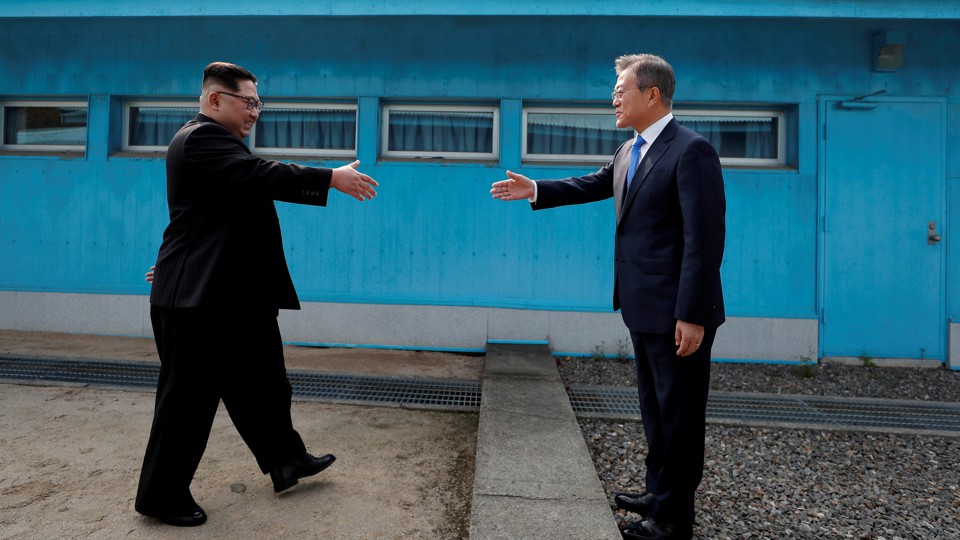
SUMMITRY is in vogue these days. North Korea’s Supreme Leader Kim Jong-un’s meeting with President Moon Jae-in on April 27 has been the most promising in the series. The two-day meeting at Wuhan between President Xi Jinping and Prime Minister Narendra Modi was not a summit that marked a decisive turn in the relations between the two countries. The talks yielded little to boast about. Using summits as a platform to enhance prestige at home debases a valued diplomatic process.
France’s President Emmanuel Macron went to meet President Donald Trump for two reasons. One was to show that France matters in world affairs. The other was to persuade Trump to relent on his threat to pull out of the Iran nuclear deal by the next recertification deadline, May 12. Zeal prompted him to make an unwise suggestion of amendment to the accord, which Iran rightly rejected. So did Trump. In contrast, German Chancellor Angela Merkel went to meet Trump for a purely transactional summit.
We need to accurately assess the worth of a summit in modern times. The high noon of elegant diplomacy in the 19th century saw few summits. Resident ambassadors were chosen by the head of government. Winston Churchill first used the word ‘summit’ in a speech in February 1950, and then in the House of Commons in May 1953, soon after Stalin’s death. He proposed that “a conference on the highest level should take place between the leading powers without long delay” adding that “if there is not at the summits of the nations the will to win the greatest prize … doom laden responsibility will fall upon those who now possess the power to decide”.
Experts frowned at it. Kennan opined, “The multitude of ulterior problems that press upon a prime minister or a head of state is so great that no single subject, especially one not regarded as of primary importance, is apt to receive detailed and exhaustive attention. Nor can the senior statesmen stay with a problem for any great length of time. Their time is precious, other responsibilities take them away.” He described them as “harried, pressed, groaning under the spotlight of publicity, under the limitations of physical and nervous strength, under the multitudinous pressures of high position, flitting from problem to problem like bees from one flower to another, touch each only briefly and sporadically, hoping always that some sort of pollination will spring from their magic touch”.
Kissinger was more balanced. “The advantage of a summit meeting is that the participants possess the authority to settle disputes. The disadvantage is that they cannot be disavowed. A summit meeting can make binding decisions more rapidly. By the same token, the disagreements are liable to be more intractable and the decisions more irrevocable.” However, “the possibility of using summit conferences to mark a new departure in the relations of states should not be underestimated”.
Transactional summits do not arouse high expectations, especially if held frequently. The illusory summit is harmful. Israel’s Menachem Begin was not sincere, and the concerns of Egypt’s Anwar Sadat centred on Sinai. The 1978 Camp David Accords left Palestine in the cold. The 1945 Yalta Conference was another; the ‘Declaration on Liberated Europe’ wiped out the 1944 Churchill-Stalin percentages accord on Eastern Europe. It could have averted the Cold War; Yalta could not.
The Gorbachev-Reagan summit at Reykjavik in 1986 came close to an accord to eliminate nuclear weapons, but failed. The Musharraf-Vajpayee 2001 Agra Summit yielded a draft agreement — which Lal Kishan Advani torpedoed.
It is tragic that the one summit that could have truly shaped the history of South Asia was not held. By the end of 2006, Pervez Musharraf and Manmohan Singh had all but finalised their four-point accord on Kashmir. The prime minister delayed his trip to Pakistan. After the March 2007 protests in Pakistan, all hopes were gone. A summit can mark a departure from the past, but it requires leaders of authority who have the vision and ability to follow up on the accord reached. Summitry is not a game for small men to play.
One summit truly changed the course of history. France’s Charles de Gaulle invited West Germany’s Konrad Adenauer not to Paris, but to his home in the remote village of Colombey-les-Deux-Églises far to the east. In September 1958, it conveyed a strong message: we begin anew.
Centuries of animosity were buried by an agreed fundamental — their role in Europe. The entente survives still as the foundation of the European Union. It required de Gaulle to grant independence to Algeria, defying public opinion at home and even risking his own life. It was he who raised France’s stature in the councils of the world. De Gaulle was no romantic, but a realist with vision. They don’t make men like him anymore.
Courtesy Dawn