BY: Apoorvanand
Muslims of India have been feeling more vulnerable and insecure in the first four months of 2018 than ever before. Recent cases of failed justice for crimes committed against them have disheartened the Muslim community.
Even to outside observers, it is increasingly clear that Muslims are being ostracised and singled out and that state institutions are failing them in India.
Struggling for justice in Kathua
In January, an eight-year-old girl was abducted, sexually assaulted and murdered in the Kathua district of Jammu and Kashmir. The girl was from the Bakarwal Muslim nomadic community. The eight men accused of participating in her abduction, assault and murder, on the other hand, are Hindus. The primary accused is a retired revenue official, while one of the others is a police officer.
When the girl’s body was discovered near a temple in the forest, almost a week after her disappearance, Bakarwals demanded a special inquiry. The court-monitored investigation revealed that her abduction, rape and murder were purposeful and preplanned. It indicated that the attack on the girl aimed to scare the Bakarwal community away from Kathua.
Last month, when the special team investigating the murder, headed by a Pandit Hindu and a Muslim, went to file its charge sheet, it faced stiff resistance from some members of the Jammu and Kashmir Bar Association.
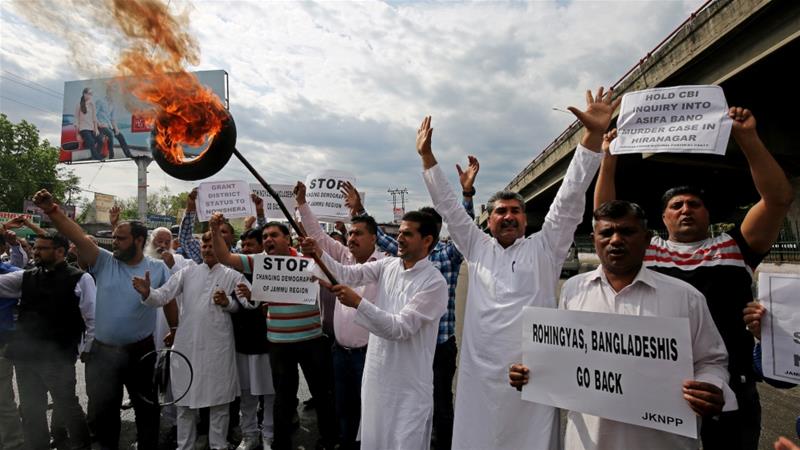
They rallied against the investigative team and accused them of serving an “anti-Hindu agenda”. They claimed that they, too, wanted justice for the brutalised girl, but said the investigative team was biased against Hindus. They said they wanted the probe to be conducted by the Central Bureau of India (CBI) instead.
The lawyers also had other, clearly anti-Muslim, demands. They demanded a change in the land use policy in the state which allows the nomads to retain the plots they had in their possession. In protests, supported by other Hindu groups and political parties active in the area, they also asked for Rohingya refugees to be removed from the area. Both these demands had nothing to do with the “fairness” of the investigation into the girl’s murder. And together, they made the protesters’ anti-Muslim agenda crystal clear.
Today, many people from the Hindu community, against all evidence, seems to be convinced that this crime could not have been committed by Hindus. Instead, they allege that the child must have been killed by the Rohingya or the Bakarwals themselves. They claim the entire case is a Muslim-Kashmiri conspiracy aiming to undermine the Hindus.
What started as a demand for a probe by a higher impartial agency has now taken a definitive anti-Muslim turn, with the local Hindu population outright denying the possibility of Hindus being involved in the crime. But these anti-Muslim sentiments are not only being promoted by Kathua lawyers or members of the public. India’s top institutions, and even the ruling party, seem to be following a similar agenda.
After lawyers tried to stop the investigative team from filing the charge sheet against the men accused of the murder, the photos and videos of the agitation were shared widely in the media. Following a strong public reaction to the incident, the Supreme Court instructed the Bar Council of India (BCI) to send a fact-finding team to Kathua.
In their report to the top court, the BCI said the Kathua lawyers didn’t prevent the special investigative team from filing the charge sheet and blamed the media for “misreporting”. In fact, the team went beyond its mandate and even said the “demand” for a CBI probe into the crime “seems to be justified”.
Many members of the ruling Bharatiya Janata Party (BJP) have also openly put their support behind the accused and criticised the investigation. Two BJP ministers in the state of Jammu and Kashmir addressed a rally in support of the accused, which caused a public outcry across India and both ministers were forced to resign from their roles.
But after that all the BJP ministers resigned from the ministry. When new members from the party joined the government, it was pointed out that at least one of them was present in the rally opposing the probe. The new deputy chief minister insensitively said that the Kathua rape and murder was a minor incident and was being unnecessarily hyped.
Seeking justice from Gujarat to Delhi
But beyond the Kathua case, there have been many others that give the impression that India’s Muslims can no longer trust state institutions, including the judiciary.
In March, many Indian states were hit by violence during the Hindu festival of Ramanavami. Attacks on Muslim localities in different parts of Bihar and West Bengal states have been reported. In many places, Muslim houses and business establishments have been attacked, burned and looted. Similar attacks have been going on for the last four years, but the level and intensity of violence has increased manyfold in 2018. The administration and the law-and-order authorities, in most cases, failed to take action and allowed this to happen.
In April, an Indian court overturned the conviction of senior BJP party member Maya Kodnani who was sentenced to 28 years in jail for her part in the murder of 97 people in 2002 in the state of Gujarat. Her co-accused Bau Bajrangi also got relief in his sentence. It was clear that the prosecution was not interested in making a good case against the accused. Kodnani’s acquittal has dismayed and angered the Muslim victims of the Gujarat riots, who had fought a long battle to secure justice.
Also in April, the accused in the 2007 Mecca Masjid blast case in which nine people were killed, were let off. All the accused belonged to organisations practising Hindutva ideology.
This was a major case in which the investigative agencies had proved the role such organisations had played in the killing of Muslims. Lawyer Rohini Salian, who was the main prosecutor in this case, had openly accused the National Investigation Agency (NIA) of pressurising her to “go soft” on the accused. In a recent interview, she repeated her charge.
Before this, the Uttar Pradesh government initiated the process of withdrawing 131 cases – all naming Hindus as the accused – including 13 murder and 11 attempted murder cases – relating to the 2013 mass violence against Muslims in the cities Muzaffarnagar and Shamli.
In late April, six Hindu men were arrested in Gurugram, in the state of Delhi, after photos and videos of them disrupting a Muslim Friday mass prayer went viral on social media. But they were swiftly let out on bail.
Even more worryingly, around 500 people claiming allegiance to various Hindutva outfits close to the ruling BJP came out in the streets of Gurugram on April 30 in support of the six men. The protesters demanded the scrapping of the charges against the accused, as well as a ban on prayer meetings in open spaces and government land without approval from authorities.
India’s Muslims have a feeling that a physical and psychological war is being waged against them. The state apparatus, as is evident from the examples given above, is turning a blind eye – if not giving direct support – to the injustices being committed against them. With the general elections around the corner, many fear that anti-Muslim violence in India is only going to increase and intensify in the coming months. This, unfortunately, is being seen by the BJP as a legitimate method of mobilising Hindu votes in the electoral battle.
Courtesy Aljazeera