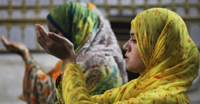

As the ‘urs’ or death anniversary of Moinuddin Chishti, among the greatest Sufi masters the world has ever seen, comes around again, I was reminded of how Sufi khanqahs (hospices) and dargahs are not only sacred spaces but also welcoming spaces, without any restrictions of religion, caste or class. This is why people started flocking to the saints during their lifetime and continued to visit their shrines after they left this world. These places became community centres for the dispossessed, desperate and diseased of heart, mind and body.
On a recent trip to Karnataka, I spent a lot of time in the dargahs of Bijapur and Gulbarga. During the 13 th century, many Sufi saints came and settled in present-day Karnataka, in and around the three major cities of Bidar, Gulbarga and Bijapur. With so many Sufis settling in these three major areas it is natural that their influence is also great.
I visited the shrines of Sheikh Aleemuddin Ala, Sheikh Abdur Razzaq Qadiri, Khan Mohammad and Hazrat Shah Murtaza Qadri in Bijapur and of Hazrat Gesu Darz in Gulbarga. My visit coincided with ‘amavasya’. All these dargahs were extremely crowded with devotees, both Muslim and non-Muslim, who had travelled from many parts of Karnataka, Maharashtra and Andhra Pradesh for the occasion. They told me they came here every month on ‘amavasya’.
‘Amavasya’ is the name given in Hindi to the night when there is no moon, while ‘Purnima’ is the night of the full moon. Both are very important in Hindu culture – ‘Purnima’ is considered auspicious, while ‘amavasya’ is considered inauspicious. As per tradition, on the night of amavasya, evil spirits roam around unchecked and at night tantra and black magic can be performed. So people come to dargahs for refuge against these evil spirits and to get rid of any effects of the evil eye. Many come to pray for their needs and for solace from worldly cares.
At the dargah of Sheikh Ameenuddin Aala, I met Ambuja who had come with her daughter Saujanya and relative Nagamma. My friend Abdul Aziz Rajput, acted as translator. Ambuja’s maternal aunt used to come to the dargahs on Thursdays and on ‘amavasya’ to pray as her daughter was having marital problems. After a few visits, her husband took her back home and her problems were sorted out and she was now living in domestic bliss. She, in turn, asked Ambuja to start visiting the dargah for speedy disposal of her problems. Saujanya had been feeling restless and the mother fearing the effects of the evil eye started visiting and very soon Saujanya felt better too. Now they were regular visitors and would visit on other days too for other problems.
This kind of seeking of intercessions in dargahs instead of seeking medical help is common in dargahs across India. The reasons are not very far to seek. The dispossessed and disenchanted finds solace in the welcoming and friendly environment of a dargah. Since everyone is asking the saint to intercede on their behalf with God for something or the other no one feels disadvantaged or poor. This is one place where everyone comes with outstretched hands and feel they are greeted with open arms of the saint and their religion, caste or class doesn’t matter.
In the dargah of Hazrat Shah Murtaza Qadri, I met Amina Bi who had come from Sholapur. She had been visiting the dargah for the past 50 years and would spend a night here on the 28th of every Islamic month. She said that these visits ensured that there was peace, prosperity and health in their houses if she visited the dargah. The months in which they didn’t visit they would suffer losses and fall sick.
I talked to many and the same pattern was repeated in almost every dargah I visited, where a spirit of bonhomie, devotion and faith binds people to the saints and their fellow seekers.
I was reminded of the books written by Mehru Jaffer on the great Sufi saint, also known as Khwaja Garib Nawaz — The Book of Muinuddin Chisti and The Book of Nizamuddin Auliya. Khwaja Muinuddin Chisti, she says, “was welcomed by the people of Ajmer and made a home here where he kept the doors of his home and his kitchen open to anyone who cared to stop by to spend time with him and share knowledge about the purpose of existence. Ordinary citizens of the city flocked around Moinuddin Chishti because of the oceanic generosity displayed by him. He befriended those human beings who were shunned by the elite living in palaces and patronizing temples. It is Muinuddin who inspired other Chisti order mystics to always keep an open kitchen and to share both worldly and spiritual matters with those who have nothing in life and who are the majority in most societies.”
Perhaps it is for this reason that the followers of the saints’ flock to their shrines to celebrate their festivals with them, share their sorrows, ask for boons and offer chadors and flowers when it is fulfilled. Holi, Diwali, Basant, Eid are all celebrated in the dargahs with great enthusiasm and inclusiveness.
In an atmosphere when attempts are made to polarise on lines of caste and religion, mostly for the sake of favourable election results, this is like a soothing balm to the heart.
Just as kings have come and gone but these spiritual kings still rule our heart, elected representatives may come and go but those elected by the heart stay there permanently. For these spiritual leaders don’t divide but join. They are not scissors which cut but as Baba Farid said, needles that darn. – Indian Express