BY: Jawed Naqvi
EVERYONE has the right to change their opinions and to choose or dump their political beliefs or allegiances. At an intellectual level, changing or discarding an opinion is considered a sign of a healthy mind.
A cardinal rule in academia is to keep questioning the axiom unrelentingly. Professor Sarvepalli Gopal’s masterly lectures (in gentle Oxbridge) on the kisan movement in Uttar Pradesh opened entire new perspectives for his history students. However, when a student one day noted an anomaly in what he was saying and what he had written in his book, the historian’s rejoinder contained a world of wisdom: “Is there anything wrong in changing an opinion?”
Journalists are a part of a society’s intellectual sinews. As with any other profession, there are good journalists and bad journalists. Some journalists, be it out of personal ambition or missionary zeal, cross over into the political arena.
Well-regarded journalists in India have gone to the Congress, others have gone to the BJP. A few have become active members of the Aam Aadmi Party and so forth. Some journalists end up becoming public relations officers for business houses they otherwise served less honestly as handout hacks. There was a time when a fairly large number of journalists actively belonged to the left, some of them card-carrying members of this or that communist party.
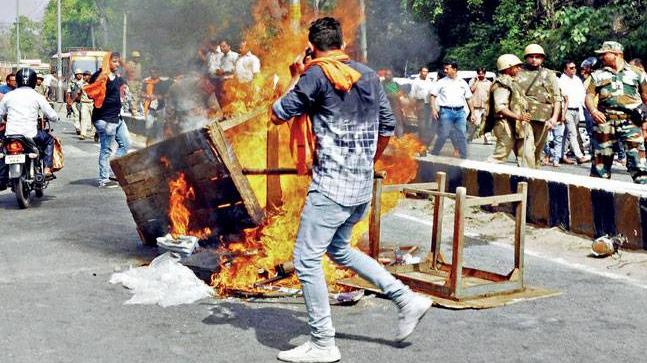
After the recent bout of communal violence in Kasganj in Uttar Pradesh a few of my colleagues rushed to the spot to investigate the story. I picked up Riot After Riot, an insightful book by a journalist-turned-politician about religious violence and other forms of conflicts dogging India. M.J. Akbar’s book carries a word of praise from Khushwant Singh, another giant of a journalist.
The Congress party inducted both as MPs; Singh went to Rajya Sabha under Indira Gandhi and Akbar to the Lok Sabha to be part of Rajiv Gandhi’s eventful tenure. Khushwant Singh supported Mrs Gandhi’s emergency and later sponsored the candidature of BJP leader Lal Kishan Advani to Lok Sabha, a decision he later regretted. Akbar went over to the Rajya Sabha as Prime Minister Modi’s handpicked man assigned to an important cabinet post at the foreign ministry.
We don’t really know what Akbar feels about the transition from this to that party. I am not even aware if he has ever explained the reasons for the transition. But let us see what he wrote earlier and whether his political move to join the Bharatiya Janata Party, the political front of the Rashtriya Swayamsewak Sangh he once criticised, came with a change of opinion about his faith in India’s secular tryst.
“Law and order have two enemies: the Full Truth and the Complete Lie. When people realise the truth, they start revolutions. When they are fed lies they begin meaningless riots.” I am quoting from Riot After Riot.
“Lies are the staple of every communal disturbance. They are spread by people who have a stake in this stupid violence, who have something to gain out of impoverished Hindus and Muslims fighting each other. Businessmen, traders, politicians, goondas, ‘leaders of cultural organisations’ (like the Hindu Rashtriya Swayamsewak Sangh — RSS) feed the people with lies, watch these lies become convictions in people’s hearts, watch the passions build up, and then these leaders actually set up the events which will provoke a conflagration. They simply stick a pin into the nerves of people, and it is only a matter of time before the people explode.
“Then, when the first round of violence is over, when the initial steam has been let off, the lies keep on circulating. The people must not realise that they have been fooled. Or they will tear down their false heroes. There is fuel ready in the murky events that make up communal violence, and upon this more lies are heaped and spread.
“After all, if the Hindus and Muslims live in peace, how will the RSS find another convert? How will the trader sell arms? How will a shopkeeper have the pleasure seeing a rival’s shop burn down? How will the goondas loot? How will the communalist kill fellow human beings? Keep the life floating friends!”
In a chapter titled ‘Split-level war in Jamshedpur’, Akbar blended some serious spot reporting with useful insights into what can be discerned as a pattern of communal violence generally, and in Jamshedpur specifically.
“The steel city of Jamshedpur has witnessed communal strife ever since the first steel mill was built. It is now a nouveau riche city with different communities competing for as much of trade and commerce as they can.
“Wealth breeds crime as well as prosperity; the city has its share of the underworld. Tension has many causes, many faces. Religious festivals and processions lead to rioting which politicians are quick to exploit to their advantage. Early, in April 1979, Bala Saheb Deoras, head of the Rashtriya Swayamsewak Sangh, a Hindu fundamentalist organisation, visited Jamshedpur and exhorted Hindus to assert their rights in a Hindu country. Ten days later the city went up in flames, reducing entire localities to ashes and leaving scores of innocent men, women and children dead.”
Akbar’s journalistic exposés were celebrated as quiver to protect the poor and the abused from their exploiters.
Even the Maoists had a soft corner for his work, as perhaps he had for them. “The threads by which the tribal has been trapped has taken a long time to weave. To create a good slave you must first kill his pride, his self-respect, his notion of himself as an ordinary, equal human being. The slave’s body is needed — the man’s for labour, the woman’s for labour and abuse; but to control the body, the inner spark, which ignites anger must be crushed. There are many weapons in the spider’s arsenal, both psychological and physical, but the chief one is dramatically simple: hunger.”
Courtesy Dawn